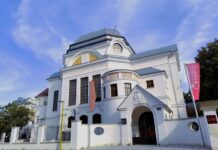


















With squares smothered in lush vegetation and steep streets lined with colourful houses, Candelaria, the capital's historic quarter, has a Spanish feel, but with a tropical temperament.
El Dorado! It couldn't be more in keeping with the history, the dream, the fantasy once generated by a mythical lake where the Indians went to strike gold. El Dorado Airport... With a name like that, it's a bit like the Bogota hub announcing that gold was at the end of the runways. And in a way, it is. There, right in the centre of Colombia's capital, in this Museo del Oro, the only one of its kind in the world, with its 34,000 pieces of silverware from the societies that inhabited the region before the arrival of the Spanish caravels.
Nothing to do with the civilisations of the Incas or the Aztecs, but all the same... Hundreds of trinkets, tiaras, fibulas, rings and hairpins; some of the jewels are absolutely modern, like Keith Haring or Picasso, way ahead of their time. The show culminates in a room, almost like a safe, where you enter in small groups. With all the doors closed, the room, at first plunged into darkness, is gradually illuminated by spotlights that pause on one display case or another. Gold, gold and more gold; mountains of worked gold, but also emeralds by the bucketful, including the largest rough stone in the world. It's easy to understand the violent colonial intentions of the conquistadors.

Bogotá's gold museum, a treasure trove of unprecedented wealth
showcases the precious know-how of civilisations
pre-Colombian, before the discovery of this Eldorado
so dreamt of by the Spanish conquistadors.
Before their arrival in the 16th century, a dozen or so Chibcha and Caribbean peoples lived there, more or less organised and practising intensive agriculture. Some were masters of goldsmithing, which of course did not escape the envy of European adventurers. So it was one day in the year of our Lord 1502, or perhaps 1499 depending on the source, that white sails appeared on the horizon. They were those of Alonso de Ojeda, a former companion of Christopher Columbus who, with his spears, crucifixes and banners - the story goes - brought misfortune to the Amerindian people.
The natives were amazed, and the welcome was hardly distrustful; sometimes it was downright warm and full of gifts. This did not last long, as the region was soon placed under Spanish control, and the cities of Santa Marta, Cartagena and Bogotá were founded in 1525, 1533 and 1538 respectively. In a way, the Mass was said in just thirty years. It was a colonial mass that was completed in the early 1820s, under the impetus of "El libertador", Simon Bolivar.

All the gold in Bogota
Travelling in modern-day Colombia means moving from one era to another, thanks to a rich heritage; from a baroque church to a neoclassical house, from a colonial square left in its original state to unconquered defensive walls. Even if you're not particularly culturally inclined, whether you're a corporate tourist or just a tourist, there's no escaping it. Everything is written there, everything is told by the stones and stuccoes: the Amerindians, the conquistadors, the colonials, the slaves, the pirates, the revolutionaries and the liberators... As a result, you can explore the country as if you were looking at the illuminations in a book of hours. You can also listen to it, sometimes lulled to sleep by the hymns of the Roman church, sometimes wildly set to African rhythms.
Bogotá, Candelaria district, the historic heart of the capital, on a Sunday morning. The churches are packed to the rafters, the faithful meditating as they listen to a priest's sermon in Latin promising them a much better life after this world of misery. Basically, nothing very different from what the conquistadors once told the Indians. And it seems to have worked so well that today more than 90 % of the population is more or less practising Catholic. But do the faithful still see the decor that is part of their daily lives, all those baroque cherubs and rococo gilding, ebony pilasters and polychrome statues? For sacred art is omnipresent in Colombia, reminiscent of the beacons once laid down because they were deemed necessary for the cohesion of a new country.
But it is far from being the only testimony to Colombia's colonial heritage, an art form dedicated to the Christian God. You only have to wander around Bogotá's tiny historic quarter to appreciate its wealth. Almost everything is there: the Plaza de Bolivar, the Capilla del Sagrario in the Catedral de Bogotá, the Museo de Arte Colonial, the Teatro de Cristobal Colon, the Museo Iglesia de Santa Clara, and also, in a beautiful old house with a patio, the Botero Foundation, which, in addition to a large number of the master's paintings, displays works by Degas, Monet, Klimt, Ernst and Picasso that were once his personal collection...


Chronicle of a renaissance foretold
Candelaria is a pretty place. It's pretty, but not easy. After all, it's situated at an altitude of just over 2,600 metres, with a curving landscape full of exhausting false flats. So it's breathless to wander through the straight streets lined with low houses, some dazzlingly white, some painted red or green, all punctuated by wooden balconies. Many of these streets are pedestrianised, as over the last ten years or so the authorities have taken matters into their own hands, rehabilitating this treasure that had long been abandoned, virtually a lawless area.
From then on, the bobos arrived, followed by architects, designers, web and media people and the restaurants, designer boutiques and galleries that go with them. All the same, while it's safe to stroll around during the day - it's very quiet, quite provincial, almost rural - you'd do well to be wary at night and only take a taxi. The area has a lot going for it... And there's nothing going on in Candelaria at night. Or very little. It's as dead as a dead house, you could almost hear a night fly.
When it comes to nightlife, the Zona Rosa, in the north of the city, is the place to be, shining brightly until dawn. This modern district, with no real charm, is home to all the nightclubs, bars and restaurants, and all the big hotels. In any case, there's no point in psyching yourself up and imagining you're a hostage on every street corner. The scourge has certainly not yet been totally eradicated, but enormous progress has been made in the fight against violence in Colombia. And if we don't indulge in unreasonable behaviour, we won't be risking any more in this country than we do in certain red-light districts of Paris or Marseille. Now, if, at the stroke of midnight, you go wandering around a shanty town with your jewellery and cameras in full view, then...

Villa de Leyva, beyond the savannah
Corporate groups with very little time to spare before a business event in Bogotá, or business people in bleisure - in short, anyone who wants to get away from the hustle and bustle of the city for a while and get a feel for the Colombian countryside - can do as the Bogotanos do at the weekend: head for Villa de Leyva, a four-hour drive away.
After the gigantic traffic jams that are the norm in the capital, you cross the green "Bogotá savannah", hectares of meadows on a plateau bordered by the Andes where cows and horses graze peacefully. This is followed by a massif of flat mountains, sometimes planted with olive trees, which is quite extravagant at this altitude. And suddenly, the shock! An oversized Plaza Mayor lined with immaculate low-rise houses. At 14,000 m2, it's one of the largest squares in the Americas. In fact, it's the very essence of 16th-century Andalusia, with its Roman tiled roofs, its green-painted wooden balconies, its church flanked by a tower that's a little too massive, its arcades, its benches next to the doors and its Mudejar fountain, inspired by Arabic architecture... The whole city is like that, intact and tumbling over its disjointed cobblestones, living its life completely out of time. So what you'll find here is first and foremost an atmosphere, whether you lean back for a moment in the shadow of the silent wall of a working convent or linger in a tree-lined patio brightened by souvenir shops and restaurants. A half-day, a night and another half-day are more than enough to take you back in time. Unless you decide to take up a sporting activity, of which there is no shortage in the area. Choose from horse riding, canyoning, 4×4, quad biking...


Cartagena, mixed-race beauty
But the really lucky ones, those who will be the envy of many on their return, will plan a few days on the Caribbean coast and the phantasmagorical Cartagena. Then it's back to El Dorado airport and the arrival, after just a short hour's flight, in the first city built in Latin America by the Spanish. It was here that the galleons bound for the ports of Andalusia filled their holds with gold and emeralds. It was also here that the unfortunate slaves captured in Africa were unloaded, more dead than alive, the very Catholic kings having banned the enslavement of the natives in a selective moral outburst. Something of this remains today, as a large part of the population of Cartagene de India - Cartagena de Indias, so named so as not to confuse it with Spanish Cartagena - is black or of mixed race. At night, the squares of the old city are the scene of spontaneous African dance performances.

As soon as they disembarked, the slaves were sold in the Plaza de Los Coches, just behind the Puerta del Reloj, the city's monumental gateway that still stands today. Almost everything still exists in Cartagena. Protected by the ramparts that once gave it a reputation for invincibility, the colonial city stretches for two kilometres along the seafront. Admittedly, it's not very big, but it does take a bit of time to explore it, with church after palace, monastery after shady square... And all this under bougainvillea spilling from balconies in a tropical heat bordering on hellish. But in this case, it would be a marvellous hell where you would dream of damning yourself, happily installed in a patio overgrown with vegetation, well hidden behind whitewashed walls. Historic walls and patios are what some of the top-of-the-range restaurants and hotels offer, such as the Sofitel, which has taken over the space of a former convent, or Casa Pestagua, a boutique hotel that has won numerous international awards and is housed in the home of the late, wealthy Count of Pestagua.

The freshness of a island cArab
Yet Cartagena is far from being a museum town, or at least that's how it's often portrayed. People live here, talk to each other from one balcony to the next, go down to the ground-floor supermarket and, in the evenings, go out to listen to merengue or, more likely, salsa. Preferably on the terrace of Donde Fidel, the institution in this field. Unless you go beyond the old city walls and venture into the Getsemani district, taken over by young students eager for painted walls, rock discos and Caribbean restaurants. But in the unlikely event that you have forgotten the Caribbean atmosphere of colonial Spain, you will find it in its original freshness two hours away by speedboat. In the San Bernardo archipelago, on an almost deserted island-hotel, Punta Faro. A blue sea, a cove, a beach of pinkish sand, coconut palms, a microscopic fishing village, luxurious straw huts, bicycles, cats and a few harmless iguanas along the way... Life!


Special report - Colombia: the wonders of a colonial America
- Colombia: the wonders of a colonial America
Meet Claudia Terrade, CEO of Quimbaya Latin America
Colombia: address book