

















With the winter season approaching, Air France is pursuing a strategy based on the development of its long-haul network, the upgrading of its product offering and the reinforcement of its positions in major international markets. Following the launch of Las Vegas in the spring of 2026 and the reinforcement of New York, the airline continues to focus on the United States as well as long-haul leisure destinations.
This year, Air France has added a CDG-Las Vegas route, while New York continues to expand, with a second daily service added to Newark. Air France effectively operates 11 daily flights between Paris and New York, JFK and Newark. In 2027, this airbridge will benefit from a new lounge in the New Terminal One at JFK with a capacity for 400 people. The final improvement regarding the United States is that the Orlando route is becoming daily.
On the long-haul leisure segment, the airline indicates that flights to Punta Cana will continue next year until 1st May, instead of late March. Still on this segment, Air France will also operate two weekly flights to Male, Maldives, from 18th December to 8th March, while Phuket will be served by three weekly direct flights. Finally, on 1st February 2027, an Airbus A350 will serve CDG-Saint-Martin, equipped with the new premium cabins.
On the European network, the company announced it was continuing its Paris CDG-London Gatwick service.
In the French West Indies, Air France will launch a Pointe-à-Pitre–Panama City service from 11 December, with seamless connections from Fort-de-France and Cayenne.
The upgrading of the service is continuing in parallel with the rollout of the new La Première suite. Following New York, Los Angeles, Singapore and Tokyo-Haneda, the cabin has been extended to several other destinations, notably Atlanta, Boston, Houston, San Francisco and Abidjan. Air France expects its entire La Première network to be equipped with the new cabin by the end of 2026.
Interview with Nadia Azalé, Managing Director France
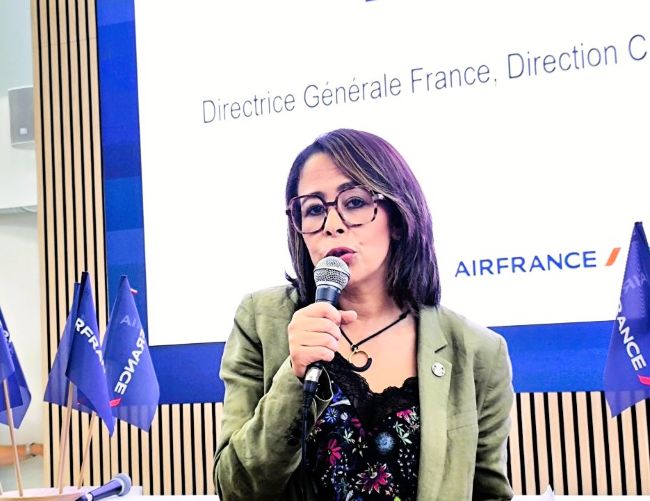
Nadia Azalé, Managing Director France for Air France, discussed the evolution of the French market, business demand, and the performance of premium cabins with Voyages d'Affaires.
The French market remains relatively solid. How is business travel evolving more precisely?
Nadia Azalé - Business travel behaviour is quite different from leisure travel behaviour. We are seeing very strong performance across several business travel segments. In a complex geopolitical context, Premium cabins are holding up well. The redeployment of our offering towards certain Asian destinations has also largely contributed to this performance, which is generating a unit revenue that remains well valued.
There are nevertheless significant differences between companies. Some large corporations continue to do very well, while smaller ones are adopting a more wait-and-see approach given the international climate.
What are the destinations where corporate demand remains the strongest?
Nadia Azalé—We mainly find the very large destinations. New York and Shanghai are performing particularly well, as is Tokyo. In Europe, business remains stable, with prices holding up well.
Country by country, Tanzania is seeing good growth and is becoming an interesting destination on the French leisure market. Portugal is also performing very well, as is Northern Europe.
We are seeing notable growth in Scandinavia, particularly in Denmark and Sweden. In addition to the major northern cities, Air France serves several secondary northern cities with operations that can be highly seasonal, such as Lapland.
Do the United States remain a strong market despite the current context?
Nadia Azalé: Yes. Even though the US market is generally more complicated, we have managed to maintain our passenger volumes. We are now present in 19 destinations in the United States, including both major cities and secondary destinations like Phoenix. Las Vegas, for example, became our 19th US destination with the launch of the direct service from Paris-Charles de Gaulle in April 2026.
Do business travellers continue to favour premium cabins?
Nadia Azalé: When we look at the results, premium cabins are doing very well. Even First Class is showing good performance. This is driven in particular by very strong traffic flows between Europe and Asia, as well as between Europe and the US West Coast.
For Air France, this is encouraging because it proves that our upmarket strategy is paying off. We are investing over a billion euros a year in renewing the fleet and cabins, and we are seeing the return on investment in customer satisfaction and loyalty.
Premium Economy is thus experiencing the same momentum as the Business and La Première cabins?
Nadia Azalé: The Premium cabin is growing strongly, both in terms of passenger numbers and revenue. It is following a trend comparable to that of Business class and is meeting a real demand.
That doesn't mean it has cannibalised Business class. It’s an intermediate product that meets a different need, offering more comfort than the Economy seat and a specific experience.
The initial customer feedback is very positive. Satisfaction has increased by 24 points compared to the first-generation fixed-shell seat.
Le CDG Express is intended to make access to Paris-Charles de Gaulle easier. Is Air France considering a specific product combining this train and the flight?
Nadia Azalé: At this stage, we have no specific plan to announce regarding the CDG Express. Nevertheless, the arrival of the CDG Express will be important for the attractiveness of Charles de Gaulle. It will make it possible to connect the airport and Paris in around 20 minutes from March 2027, and therefore to erase the travel time difference that exists for CDG when compared to Orly. This restores value to the Roissy-Charles de Gaulle hub.
Air France already works with SNCF. Is intermodality set to develop further?
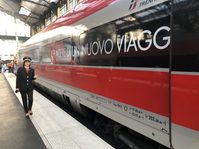
Nadia Azalé: We work with the SNCF and today we have a product that makes it possible to combine train and plane travel to several dozen destinations. The network is gradually expanding and we are already at around 27 destinations.
This is a real challenge for us, particularly because it makes it possible to offer an alternative to short-haul flights and it also aligns with our decarbonisation goal.
However, the question of luggage remains a sensitive point in these intermodal journeys.
Nadia Azalé: It is indeed a subject we are working on. The objective is to make the journey as simple as possible. Today, certain interruptions remain and the customer may have to collect their luggage before continuing their journey. We are looking to improve this logistics.
On the other hand, what we already guarantee is the possibility of transferring the customer to the next train or flight in the event of a missed connection. This protection is important to encourage customers to combine train and air travel.
A few words on the new New York JFK lounge?
Nadia Azalé- From next year, we will be transferring all our flights to the new Terminal One at New York JFK. We are going to open a lounge there covering over 2,700 m². It will be the largest Air France international lounge, with over 400 seats. It will be spread over two levels and will offer, among other things, dining areas, a bar with a selection of French wines and champagnes, as well as areas dedicated to wellness, relaxation and work.
We have also recently opened new lounges, notably at London Heathrow and Frankfurt.
What improvements are planned for Economy?
Nadia Azalé: Certain investments and services concern all cabins, notably Wi-Fi, in-flight content and entertainment options.
We also continue to regularly evolve the cabin service. We observe trends and customer expectations, and we are gradually adapting our offer. The objective is to have a sufficiently broad range to meet the needs of different customer segments, while continuing to improve the onboard experience.