



















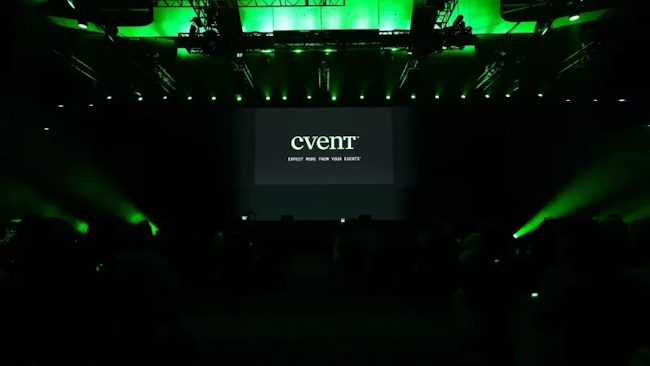
New logo featuring a capital 'T' for technology instead of a 'C', a new brand promise – "Expect More from Your Events" – and a new deep green colour: Cvent showcased its pivot towards AI at its annual Cvent CONNECT conference, held in Nashville before nearly 5,000 attendees and thousands more online. This great leap forward, fuelled by a billion-dollar investment plan and the mobilisation of nearly 2,000 engineers, is nonetheless based on an observation that runs counter to the technological wave: the importance of in-person meetings.
Its importance is said to have grown even further as artificial intelligence makes content production more commonplace and industrialised. Whilst 98 % of the events and marketing professionals surveyed by Cvent place events at the heart of their strategy, 85 % of them also believe that “ The rise of AI-generated content has made it harder to build audience trust. ".
" In a world where AI can generate almost anything, people are craving authenticity., estimates Reggie Aggarwal, founder and CEO of Cvent. Events are the only channel that AI cannot replicate. Through a new unifying concept, Presence Premium, Cvent theorises this idea that, in the age of AI, human presence and in-person encounters are paramount.
The more the world becomes automated, the more valuable a room full of real people becomes. However, events still need to be better organised… using AI. Over the next decade, the organisations that will stand out will be those that can reimagine what AI unlocks and find the right technology partners to seize that opportunity. "predicts Reggie Aggarwal. Hence the announcement by the American publisher specialising in event technology of over 70 product innovations, including 34 new AI capabilities covering the entire event lifecycle. All are presented as already available, in beta version, or expected by the end of 2026.
CventIQ at the heart of the reactor
The backbone of this offensive, CventIQ, launched last year, is an AI engine designed specifically for events and fuelled by over 25 years of proprietary data. Its key advantage is its "headless" design, which allows users to trigger tasks – sending a sales brief, setting up an event, producing content – from their usual third-party tools like Claude, Salesforce Agentforce, or ChatGPT, without needing to use the Cvent interface.
Another tangible change for organisers also lies in the new Cvent Assistant. Expected in Q3 2026, this virtual companion will allow them to describe their projects in natural language, add existing documents like the budget or the brief of a past event to obtain an event outline in a matter of minutes. An almost immediate first draft that avoids long production hours.
Still with this idea of natural language search, MICE buyers will be able to describe their needs in a few words through Cvent Assistant, regarding the destination, the services sought and the audience size, to receive a targeted selection of venues from the Cvent Supplier Network. From this autumn, participant management will be added, which applies a modification request across the entire platform with one click, as well as a conversational analysis module focused on analyses and benchmarking. For generating personalised reports and comparing event performance with that of similar events in real-time.
Hotels: watch out for the score
This AI shift is also changing the game for hotels and event venues, whose visibility will increasingly depend on the quality of their listing on the Supplier Network. Within this framework, an AI Content Assistant will assign a dynamic score to each profile, with concrete recommendations to improve its ranking in organiser searches. Among the other tools offered to suppliers.
Hotel and event venue teams will notably have access to Planner Navigator and Response Assistant, to structure follow-ups, build proposals more quickly and ultimately reduce the time between a request and a proposal, but also to 3D Event Designer to optimise room layouts. Not to mention the complete overhaul of the Passkey experience, Cvent's solution dedicated to managing room blocks, a historical source of friction that will see improvements by the end of the year.
Participants' experience can also be enhanced by new AI tools, with an assistant answering their questions and suggesting sessions, as well as a personalised agenda generator. All of this can be refined by participant profiles and information accumulated from one event to the next, or even automated networking based on their profiles, activity and objectives via Network Builder, with the AI drafting the initial introductory message. Some solutions are already available, with some in beta version.


