Crossing the US border is likely to become an increasingly difficult ordeal for travellers, especially business travellers. The signs of closure are multiplying in the United States - sent out regularly by the Trump administration - at a time when the organisation of the next football World Cup could have invited easier access. But by considering tightening the conditions for granting the ESTA (Electronic System for Travel Authorization), the visa-free entry system, Uncle Sam is worrying travellers and all those involved in the travel industry. Among the measures that are causing a furore is a proposal to make it compulsory to provide information on social network identifiers and their history over a period of five years, and even ten years in the case of e-mails. Until now, this request has been - and remains - optional. The use of biometrics is also planned, along with the requirement for a self-portrait ("selfie").
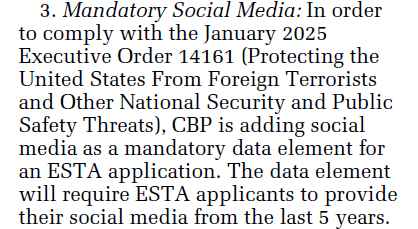
In the "Mandatory Social Networks" section, the Federal Register states: "In order to comply with Executive Order 14161 of January 2025 (Protecting the United States From Foreign Terrorists and Other National Security and Public Safety Threats), CBP is adding social networking as a mandatory data element in an ESTA application. This element will require ESTA applicants to provide their social networking information for the past five years," it said, adding that comments are open until 9 February.
The same official document states that "CBP intends to update the ESTA application site to require applicants to provide a facial photograph, or 'selfie', in addition to the photo on the passport biography page. In addition, CBP plans to update the mobile application to require that submissions made by third parties also include a "selfie" or photograph of the applicant's face. These photos would be used to better ensure that the applicant is the legitimate holder of the document used to obtain ESTA authorisation."
A third of travellers discouraged?
The consultation on this subject has therefore come to an end. It remains to be seen whether - and when - these proposals from U.S. Customs and Border Protection will actually be implemented. And many voices are being raised to prevent such a development. The World Travel & Tourism Council (WTTC) has published a study to temper the desire for closure, playing on a sensitive issue: the financial impact. According to the WTTC, the planned changes to social networking at the US border could reduce visitor spending by $15.7 billion and impact 157,000 American jobs. In addition, a third of international travellers say they would be less likely to visit the US if the changes were introduced.
Gloria Guevara, CEO of the WTTC, says: " US border security is vital, but the planned policy changes will undermine the job creation that the US administration values so highly. Our research shows that over 150,000 jobs could be lost if this policy is implemented, the same number usually created every quarter in the US. Even modest changes in visitor behaviour, discouraged by the planned changes, will have real economic consequences for US travel and tourism, particularly in a highly competitive global market. ".

The business travel ecosystem is also sounding the alarm. The GBTA (Global Business Travel Association) has spoken out through its CEO, Suzanne Neufang. " Security and efficiency in business travel are not mutually exclusive. While GBTA strongly supports efforts to protect U.S. borders and enhance traveler security, the proposed changes present significant risks and could reduce the benefits that business travel brings to organizations that send their employees to the U.S. as well as to the U.S. destinations that host them ". The management of the GBTA points in particular to the impact on MICE: " A balanced approach will strengthen national security while ensuring that the United States remains an accessible, attractive and competitive destination for international meetings and conferences. ".
The networks go wild
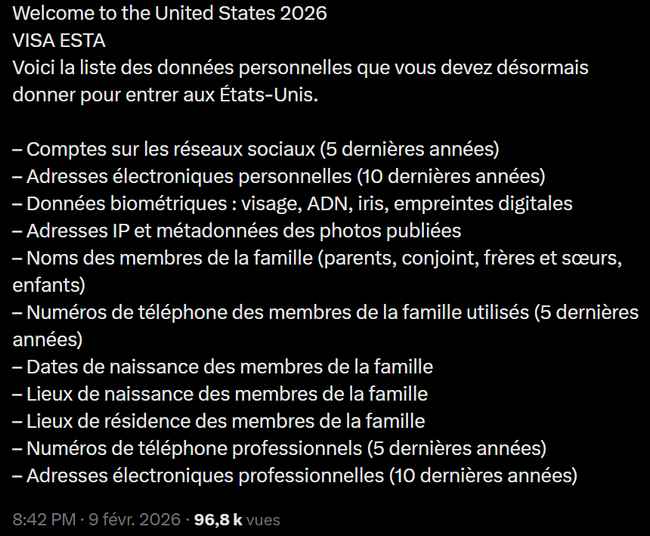
While the timetable only marked the end of consultation on these plans, social networks in France quickly went into overdrive, wrongly (at least for the time being) confirming their entry into force. Several usually moderate and reliable voices relayed the introduction of these measures. At the same time, they expressed their opposition to such intrusions into the private and professional lives of future visitors to the United States. The signals sent out by the Trump administration make the introduction of these measures credible - the American authorities did not wait until 2026 to authorise themselves to introduce such measures. basic" or more advanced inspections of electronic devices at the border, without a warrant. But if US officials were already keeping an eye on social networks, they will at least have had the opportunity to gauge the potential impact of these plans on travellers. And many of them are anticipating a boycott of the destination if things become clearer, including in the business travel ecosystem. "Follow me, I'll run away from you"...