








A culture of seriousness without taking oneself too seriously
How do you explain Nantes' economic dynamism?
Francky Trichet - We could talk about an alignment of planets between different elements. Firstly, there is the quality of life which is the envy of many, with its proximity to the sea and nature in the city. That's what companies, employees and, more generally, talented people who come to Nantes always say. We also have the skills When companies come to set up here, they wonder whether the environment will support their growth. We are fortunate to be able to rely on a wide range of players in the trainingThese include universities and their laboratories, and schools in a variety of fields. Finally, there is thestate of mindthis Nantes culture of serious without taking itself seriously. We are very demanding when it comes to the projects we develop. Nantes' family of innovation is very close-knit, and we nurture this with lots of events and initiatives. The companies that come here like this culture of goodwill, of the short scale sometimes, with older people helping the younger ones... There are also inspiring places as the Creative district When you cycle to work every morning and you see this creative bubble, the elephant, or soon the heron tree, this creative thread that we weave in culture with the Trip to Nantes but also in the world of start-ups and digital technology, all of which contribute to the desire to be in Nantes.
Is this a new phenomenon?
F. T. - There has always been this tradition of innovation. Our slogan, "Land of the daring", in fact taps into the "Julevernian" imagination... And then with the end of the shipyards, we had to ask ourselves what we were doing behind this closure, and there was this desire to assert it fully. This led to the creation of the creative district and, more generally, a determination to focus on the cultural and creative industries, digital technology and innovation, in order to become a truly innovative and daring area. So the acceleration took place in the 90s, and then everything followed: it permeated every stratum of life in Nantes. This Nantes-style leap forward has become a trademark that everyone has adopted and now claims as their own.
This creativity, this 'step aside', is reminiscent of Montreal...
Francky Trichet - This is absolutely true! So much so that we're setting up a partnership with Montréal. Nantes will be in the spotlight at the next Montreal Digital Spring in May, and we'll be inviting Montreal to the Nantes Digital Week event in September 2019. So we're already exchanging partnerships. The Quartier des spectacles and the Quartier de la création are linked, the Cantines are linked... We're really stepping up the pace with Montreal because we share a common sensibility, just like our Mayors, two women from the same generation. This influences our values and convictions.
How do you design a business district in the start-up spirit?
F. T. - Above all, we do it with people. Politicians used to be builders, but now they are catalysts of energy. We can no longer design a district without involving start-ups to find out how they imagine working together. We're creating places to forge links. We also try to anticipate wasteland, to keep spaces where we haven't anticipated everything, where history hasn't yet been written. There's nothing more frustrating than wanting to plan for 5 years ahead, only to realise that you're 600 m² short of what you need to carry out a new, distinctive project. We also need places for sharing, these "third places" that can be Fab Labs, Users Labs, spaces for co-creation, living spaces on the ground floor, where people can meet simply, where there will be a pooling of resources so that they can get to grips with a subject. We did this with the Cantine Numérique, which started out as a small association. The premises burned down, but there was a resilience. Everyone said: "Don't touch my Canteen!", and we realised that we had to re-establish this emblematic place through which many companies have passed. And that's still the case: when companies arrive in Nantes, they often spend three or four months at the Canteen. It's important to feel that good vibe when you move to a new city, to sense that things are buzzing and that there are lots of events going on. So we need to keep event spaces that are part of the public good. All these points of concentration, of creation, of vibration, of creative friction, it's important to study them when thinking about the organisation of a district.

How do you manage the balance between large groups and start-ups in a business district?
Francky Trichet - We need to create living neighbourhoods, with places of creative friction that are part of the common good and are often managed by associations. The big groups can send their executives there to "oxygenate their minds". Moreover, the theory that "large groups will bring start-ups to their premises" is not necessarily the right one. If you do that, you run the risk of drying up the breeding ground. Often, it's better to do the opposite: I advise large companies to send their executives and management teams to these locations. It's much more profitable. What's more, there's been a shift. The big groups have realised that start-ups don't necessarily want to go to their premises. We mustn't let the big groups suck start-ups into their premises. We need to leave these places where young projects can mature and emerge, with friction and exchange, rather like the corridors of a student residence. It's good to have start-ups concentrated in the same place: they're swarming, they're exchanging ideas... If we can also have an in-house accelerator, that's even better. We have Imagination Machine, which is part of this approach, bringing a different culture and a new way of thinking. It all works a bit like a training centreAnother area in which Nantes has distinguished itself. It's a bit like the Canary effect: we like to support our young talent!
The Quartier de la Création and Euronantes embody two very different concepts of the business district...
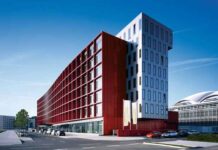
F. T. - It's not the same story... On the Creative districtWe've been able to give a new lease of life to an industrial heritage site, with a little 'Station F' feel. For EuronantesThere was virtually nothing there, so everything had to be built. So it's more modern, more urban, in the sense of a traditional business district. But Euronantes is close to the station, which is a big advantage for businesses, and to the creative district. Of course, Euronantes is less vibrant than the Creative Quarter, and it's not the kind of place where you'd set up the equivalent of La Cantine. But there are companies that play this role in their own way, like iAdvize, a great start-up from Nantes.
Do the people of Nantes feel at home in this changing city?
Francky Trichet - The people of Nantes love to see their city transformed by innovation, creativity and nature in the city. Of course, some neighbourhoods are gentrifying. This is the case in all cities undergoing transformation, but we are very vigilant, mixing uses by integrating 25% of social housing into the buildings. In any case, if there's no mix, there's no fertile ecosystem. Diversity is essential. A city dies if there's too much intellectual consanguinity, too much gentrification. If a city is to remain creative, it needs a mixed environment and controlled wastelands.
Special report - Nantes: a trip to the business centre
Nantes: a trip to the business centre
- Interview with Francky Trichet, Deputy Mayor of Nantes responsible for Innovation and Digital Technologies
Nantes: address book


