












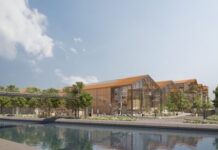







A mega-city in the middle of a desert plain: in 2015, Egypt embarked on a gigantic project to build its New Capital, forty-five kilometres east of Cairo. Eight years on, construction is stretching over 270 square kilometres, halfway between the historic capital and the port city of Suez. This New capitalThe project, estimated at 60 billion dollars, involves the development of 21 residential districts, as well as 25 districts dedicated to economic or government activity.
Starting this year, a large part of the government will begin its slow migration from Cairo. Already, the unthinkable is taking shape, in the middle of the desert: a huge park, artificial lakes, nearly 2,000 educational institutions, a technological innovation park, nearly 700 hospitals and clinics, more than 1,000 mosques and churches, a 90,000-seat stadium, a number of hotels with a total of 40,000 rooms. In addition, there is an ultra-modern infrastructure: solar farms, a electric train line to Cairoand a new international airport.
Decongesting Cairo
The project is based on the need to relieve congestion in today's capital, with its incessant urban traffic and ageing buildings that are costly to renovate. With more than 21 million inhabitantsCairo is home to a fifth of Egypt's population, which is itself growing by more than a million people every year. But this is not a recent development. Since the 70s, Egypt has embarked on a new towns programme which aimed to entertain the capital's population by attracting them to more modern cities.

In 2018, as the country's population reached 100 million, the government announced a fourth generation of new cities, based on environmentally-friendly technologies and intelligent public services. These will be complemented by green spaces and cutting-edge educational infrastructure, helping to attract a young, educated population.
This is how the second fourth-generation city came into being, New Alameinlocated on the coast of the Mediterranean, is currently being developed at a cost of 14 billion dollars, with the aim of making it a world-class tourist destination. urban centre with 3 million inhabitantswell positioned in the tourism and education sectors. All in all, by September 2021, no fewer than 37 new towns were being planned or developed, while 24 existing towns were entering the renovation phase.
For the New capital However, the ambitions turned out to be much greater: the project, dear to the heart of Egyptian President Abdel Fattah al-Sisi, is loaded with symbolism. In the 2000s, Egypt turned to the urban planners of Dubai to design the project. This partnership was soon disrupted by disputes over financial control and did not last very long. The Egyptian army took control of the project, and by 2016 it was the China which is emerging as Egypt's favourite partner.
The New Capital takes shape
In the space of two years, the China State Construction Engineering Corporation (CSCEC) has signed two successive agreements. The first was for the construction of ministerial buildings and agencies and the President's office, not to mention the parliament complex and a convention and exhibition centre. The second contract sees the entire central business district falls into CSCEC's lap: a complex comprising a total of twenty office buildings, five flat blocks, two luxury hotels and, above all, the famous Iconic Tower385.8 metres high. The highest in Africa.

In many ways, the New Capital aims to overtake Cairo. This is how airport project will have the capacity to handle 300 passengers per hour. It will cover 5,000 square metres, with 45 service buildings, a 50-metre-high control tower and a 3,650-metre runway suitable for large carriers. Another example: a new archaeological museum covering 8,500 square metres with a central exhibition hall and multiple galleries. Or the arts and culture district, which will feature an opera house with a capacity of over 2,000 people, a vast library and a range of ancillary cultural buildings and restaurants.
In terms of housing, the New Capital aims to accommodate several million people, while creating at least two million jobs. Last summer, the Egyptian authorities announced that 90% of the first ten residential districts had been completed. But who will come to live in this metropolis? The question is now on everyone's lips in Egypt. At over 80,000 dollars for the first prices, flats in the New Capital appear to be out of reach for many Egyptians, and the property market that has developed around the residences has mainly favoured the acquisitions of wealthy investors.
For the time being, the few public sector employees venturing onto the huge site have complained of an interminable daily journey of more than two hours. This is a challenge for the government, which has confirmed the transfer of 30,000 employees, scheduled to take place in March. According to the Egyptian press, 9,000 flats have so far been allocated to them.
Foreign partners in demand
To make it easier to reach, the New Capital will soon be linked to Cairo by a 35-kilometre monorail. The 70 Alstom Innovia trains are designed to carry 45,000 passengers an hour, providing a one-hour link. The consortium formed by Alstom and Orascom Construction, which won the $2.7 billion contract in 2019, will operate and maintain the monorail for 30 years.
This is not the only area where international expertise has been sought: Siemens has won a contract to set up a platform to supervise the electricity network. Capitalising on its experience as a host country for the COP 27which was held in Sharm-el-Sheikh last year, Egypt also wants to turn the New Capital into a "world capital". smart cityA green city where contactless payments are the order of the day. Atos is working with the Egyptian authorities to manage intelligent infrastructures for communications and data centres.

Security will be ensured by a network of 6,000 cameras and a sophisticated surveillance system developed by the American company Honeywell. Schneider Electric is also active in the field of clean energy, and has already equipped the roofs of public buildings with solar panels. The aim is to extend this renewable energy project to the whole of the new metropolis, through a gigantic call for tenders covering one million square metres.
In the meantime, there is no shortage of criticism of the project, including in the ranks of Egyptian MPs. Worried about the negative trend in the country's economy, some are calling for a halt to the mega projects involving a high level of dollar debt. This is not stopping the New Capital from pushing ahead with new projects in the country: COP 27 saw the signing of a major 15-year contract with Deutsche Bahn for the construction of a 2000-kilometre, three-line high-speed rail network. The Northern line, which will serve the New Capital, should be operational in 2025.


