
















"Can you feel the crisis? I mean as a foreigner. Without any proselytising, I can say that if you travel around the country, you won't notice a thing; which is obviously not the case for us Greeks. But for tourists, everything is as it was in the best of days: the restaurants are full, the streets of Athens are crowded in the evening, the hotels always provide the best service, the shops are perfectly stocked and there is no violence. The demonstrations you saw on television were in front of the Parliament, and you were shown a lot. Without ever mentioning that two streets away, Athenians were chatting on café terraces, as usual. As usual. CThat's how John Casulli, President of Imt Travel Services, one of the largest incoming agencies in Athens, sums up the case.

And on the face of it, he's right. Because nowhere in Athens, except perhaps on the Place Syntagma - in front of the Parliament building - where the megaphone is sometimes blown loudly, is there the slightest hint of tension. People still go out a lot in the evenings, drink a toast and get on with life, re-discover the world almost as much as they did on the agora in the time of Pericles, and begging is far less common than on the pavements of Paris. Crime? No more than in any other major city in the world, and perhaps even a little less. It all depends on the time of day and the neighbourhood... Which, in any case, is of little concern to incentive groups who, by definition, go out in groups and hardly ever venture into dark out-of-the-way streets.
Luminous acropolis
 Let's kick off our trip with a tour of the Greek capital's heritage by climbing the unmissable Acropolis hill to the Parthenon, a universal splendour commissioned by Pericles and built by Phidias between 447 and 438 BC. We're all familiar with the profile of this luminous building, but once you're there, you'll be in awe of the talent of the architects and artists of the time, and indeed of human genius. Because, who knows why, we all feel a bit like we come from there when we step on the sacred rock of the Acropolis. The essence of democracy, perhaps? A little later, the elegance of the contemporary style will not escape the notice of visiting groups either, for example during a private tour followed by a very upmarket cocktail given within the glass walls of the Acropolis museum designed by the Franco-Swiss and Greek architects Bernard Tschumi and Michel Photiadis respectively. A delight of statues, friezes and objects, all remarkably well staged. The highlight is the caryatids, the famous female columns from the Erechtheion, one of the temples on the Acropolis, which were brought here because they were attacked by pollution.
 While we wait for the evening cocktail party, we'll go around the rock to the Plaka district, just below it, otherwise known as Old Athens. A part of the city that was falling into disrepair until Mélina Mercouri, then Minister of Culture, took the task in hand and set about rehabilitating it. Today, this village within the city is gradually regaining its splendour. You'll find alleyways so narrow they won't allow even a single car to pass, flights of stairs climbing up the hill, trellises providing shade and half-wild plants falling from the high walls, which are usually painted with ochre.
And then, apart from the streets specialising in hideous souvenirs reserved for tourists, there are fabulous taverns, popular restaurants and very chic canteens, as well as kafeneions - bistros in Greek - where students meet. "For groups, we organise interactive tours, as the area lends itself particularly well to this, says Anna Wilforster, Sales Director of Pam Tours DMC. We call it an interactive tour, because the participants have to meet the locals to get by... So they set off on their adventures in very small groups and, along the way, have to identify mystery photos, take cookery and dance classes, taste ouzo in the oldest distillery in Athens or coffee - we have a thousand and one ways of enjoying it in Greece - at Café Mélina, right in the middle of Plaka".
A little further down the road, another district, Monastiraki, is also very picturesque. Some of them, like Baïraktaris, attract the attention of the whole of Athens and the international art world, as evidenced by the plethora of celebrity photos on the walls. At the same time, countless stalls selling counterfeit goods are followed by a flea market, market halls as lively, especially early in the morning, as those in Paris once were, and alleyways so exotic that you'd think you were in Istanbul, Cairo or even Asia - anywhere but Athens. The whole area is bordered by the ruins of the ancient agora, to boot.
An effervescent gas factory
 What has been said and written about Athens? That it was ugly, that it was polluted, congested, dangerous, poorly designed, stuck between neoclassical and 1960s style, built in a hurry... In short, we've said all the bad things we could about this city whose charms, it's true, don't immediately jump out at you. But you have to know how to conquer the old lady. To appreciate it in all its details. Especially as, since the 2004 Olympic Games, it has given itself a real beauty at the same time as it has thrown itself wholeheartedly into modernity, not to say post-modernity. You only have to visit the Gazi district - which is gradually overtaking Psiri in its trendiness - to be sure. And spend an evening there to be sure.
It was here, on the outskirts of the city, that a former gasworks - hence the name Gazi - was transformed into a cultural centre. Opened in 1999, it has since spread to the surrounding area. As a result, the smallest rusting factory, the smallest derelict factory and the most dilapidated of warehouses have been transformed into fashion boutiques, contemporary art galleries, discotheques and trendy cafés. And if it's trendy, it's trendy in Athens. So don't go there in the morning - all the streets are absolutely empty - preferring the late afternoon, or even the night, when all the world's creativity is in full swing. And all this against a backdrop of iodised air that reminds us that we are, after all, on the shores of the Mediterranean.
Because it is never far from the Mediterranean, the land of Greece. Never more than 80 km away, wherever you are. So let's leave the great urban centres, even if they are by the sea, and head for the Peloponnese, which has become an island since the Corinth Canal was opened in 1893. It's a very steep country, made up of wild mountains, gorges and plateaux, a jagged coastline, deep gulfs and sometimes a few plains greened all year round by millions of orange trees and at least as many olive trees... And Anna Wildforster warns us straight away: "The trouble with the Peloponnese is the roads! Even though the whole region is no bigger than three French départements... But apart from the motorway and a few main roads, it's up and down quite a lot, and there are a lot of twists and turns... That said, we don't hesitate to offer a day trip to Nafplio and Epidaurus in the Argolid during an incentive trip to Athens; after all, Nafplio is only 2? hours from Athens. Sometimes, we settle in for two days. In that case, you can really explore"..
Nafplio, the little Venice of the Peloponnese
 So it's Nafplio. A small provincial town that was the first capital of the Greek state, in 1828, when Athens was no more than a market town with barely a few thousand inhabitants. A delight of Italianate alleyways, pierced by the Venetians; balconies, fountains, houses of very noble proportions, almost strict, and an enclosed square with a pavement so shiny you'd think it had been polished with encaustic. Above it, overlooking the town, the citadel built by the Venetian occupiers at the turn of the eighteenth century.e Across the water, on an islet a few minutes by caïque from the port, stands an old Venetian fort that is a favourite with photographers and postcard sellers.
After all, Nafplio is an eminently touristy city, with plenty of hotel rooms, bars, cafés and restaurants to choose from. So incentive groups are perfectly catered for. As we said, it's also a perfect base for exploring the south-western Peloponnese. Start with Epidaurus, a sublime theatre that has remained intact since the time when tragedies were performed there "as they came out", and considered to be the masterpiece of its kind in the entire ancient world. Designed according to the golden ratio, it could seat 12,000 spectators and boasts exceptional acoustics. Since the 1950s, Epidaurus has been back in the limelight, and every year it hosts an internationally renowned festival (www.festivals.gr) featuring some exceptional singers, including the divine Callas.

Continuing along the road through the scents of a Mediterranean forest, you come to a steep coastline that has so far been untouched by urban development, with the exception of a few very wealthy isolated villas here and there. At the bottom of the peninsula, you could almost touch the island of Poros and, a little further south, the island of Hydra, the chicest of the chic, forbidden to cars and scooters, but on the other hand very permitted to mules and handcarts, and much sought-after by privileged Athenians. The sea is blue beyond belief, with coves, beaches and fish restaurants to die for. From here, you can return directly to Athens by boat, with or without private hire, or by hydrofoil in an hour and a half. This gives you the opportunity to add a mini-cruise to your trip.
 "Personally, continues John Casulli, I think that on a fairly short trip, say three or four days, you have to choose between Athens and the Peloponnese. It's a bit difficult to choose between the two. What's more, the Peloponnese is a very cultural destination, so it's more suited to reward trips than incentives as such. But everything will be better once we have a direct Paris-Kalamata route this summer, in the heart of the Peloponnese, operated by Aegean. For the moment, Kalamata is only linked to France via Athens by a flight of around 35 minutes.. For the time being, Anna Wildforster, who also has high expectations of this direct link, has solved the problem by proposing the privatisation of a small cruise ship departing from Athens. "We always take on a guide who's not stuffy and, between the entertainment and games, the cocktails, lunches and dinners where the emphasis is on Greek cuisine, we make stopovers in Hydra, Poros and Monemvassia"..
Monemvassia. A huge, Gibraltar-like rock just a stone's throw from the coast. On top is a fortress town, a perfectly preserved marvel that bears within its walls the memory of just about every occupation Greece has undergone over the centuries, including Frankish, Venetian and Turkish. The Ottomans officially occupied the country from 1458 to 1830. Four long centuries that the Greeks have still not really digested, but whether they like it or not, they have also left their mark on Greek culture, both in the arts and in everyday life.
Cat heaven and crazy cachet
 You enter the medieval town of Monemvassia through a chicane gate designed to prevent water hammering. The cobblestones underfoot are the same as those found throughout the town. To one side, a staircase - staircases are everywhere - leading to the covered way. In front, the main street, so narrow that it's sometimes hard to pass each other, which leads directly to the church square. The fairly high dry-stone houses are all, or almost all, remarkably well restored and maintained. Even the tourist shops have retained their character, with their medieval-style shutters. And everywhere, fig trees, bougainvilleas, cacti and wild grasses where countless cats lounge, all plump from their daily lunches and dinners in the restaurant. If the world's cats have a kingdom, it's Greece. They are perfectly at ease everywhere, respected, waiting on the port for the return of the fishermen who never forget them, or sitting under a restaurant table, hoping for a little something. Fish, if possible. The rest of the time, they are napping, taking unlikely breaks in often unexpected places: in the shade of one of the citadel's many vaulted passageways, among the objects in a tourist shop window, in a plastic bowl, on an embroidered cushion forgotten on a bench... As you will have gathered, Monemvassia is not a dead place; it is certainly one of the most charming sites in the Peloponnese.
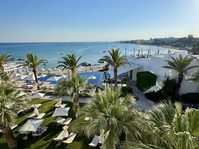
 Further south-west is Kalamata, which, like Nafplio, is another of the region's hubs. But that's where the comparison ends, because, let's face it, apart from its location, its international airport and the fact that it's linked to Athens in three hours by motorway, Kalamata isn't of the slightest tourist or cultural interest. People arrive here only to leave straight away, leaving individual tourists to escape to the Magne, a region which, however fascinating, is not suited to business tourism due to a lack of infrastructure. As a general rule, tourists head north-west along the coast to the finest resorts in the Peloponnese, with all the rooms, restaurants, meeting rooms, function rooms, amphitheatres and water sports facilities they need. Among these establishments, the Romanos, remarkably designed, could even feature in the top ten of Mediterranean seaside hotels.
With words so high, life so sweet
 The Peloponnese. There's blue as far as the eye can see, golden sand, a hinterland that's remained as authentic as ever, farms and meadows, charming villages where life goes on quietly, village squares, churches, chapels and kafeneions where, with kilos of white wine - wine is measured in kilos in Greece, not litres - people talk so loudly and passionately about sport and politics that you'd swear it was the start of a general brawl. There are also tables on the terraces where you can linger as long as you like over a simple cup of coffee; there's also great, no-fuss, popular cuisine - stuffed tomatoes, souvlaki, Greek salads, tzatziki, grilled aubergines, moussaka, giant beans... - that you always come back to; there's a whiff of rebetikoa kind of blues invented in Piraeus in the 1920s that has come back into fashion and has been widely reinterpreted. in aeternam under the plane trees: the real Greece!
 And then there's Olympia, a little bit of the ancient world - what else could you do when you're in the Peloponnese? It's a site that's universally acclaimed, starting with children who think very highly of today's champions, continuing with adults who think of the same things but add a little history, and ending with culture lovers who are also interested in the moving red brick walls of the workshop, or at least what remains of it, where Phidias sculpted his gigantic statue of Zeus, one of the seven wonders of the world, as well as the sculptures in the adjoining museum, in particular Praxiteles' Hermes.
The vestiges of Olympism
 The archaeological site, a World Heritage Site, is immense. And even if the destruction ordered by a Byzantine emperor of Roman origin, Theodosius 1erAlthough the town was converted to Christianity and a few murderous earthquakes have reduced all the buildings to ruins, the walk is truly enchanting. And in the shade, to boot. In fact, the museography is so well done, with a photo of a model in front of each building - gymnasium, palestra, stadium, temples... - that it's easy to imagine the grandeur of the place.
On the other hand, it is much more difficult to bring to life the crowds that frequented it every four years for... a thousand years. At that time, each region was able to present its own champion of Greek origin for wrestling, chariot racing, pentathlon (wrestling, discus, javelin, long jump and foot race) and unarmed boxing. The events lasted five days and were forbidden, including as spectators, to women and slaves who, if they failed to comply, were immediately thrown off a nearby cliff. At the same time, the games served many other purposes. To show off, to settle political disputes diplomatically, to conclude trade agreements, to discover poets, historians or artists... It's fair to say that in this respect, the modern games have invented nothing.

Then it's back to Athens, which takes 2 hours 30 minutes on the motorway. It's an absolutely superb stretch of road, virtually untouched by flashy signs and passing through totally unspoilt countryside. "Incentive organisers are hesitant, and they're wrong, concludes John Casulli. But it's true, I repeat, that with the opening of Kalamata airport next year, the Peloponnese should really open up to business tourism. In fact, we're already noticing it, because while the last two years have been difficult, 2014 is shaping up very, very well. Organisers, sponsors and participants alike have understood. The Greek crisis is of little concern to them. I'd even go so far as to say that it's all to their benefit, with hoteliers redoubling their efforts and attentiveness to their customers. By the way, did you feel the crisis? No, not really!