






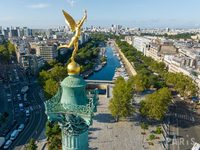















The fact is, the second millennium has propelled Madrid into a new hotel era. In just one decade, the number of beds has risen by 40 % and there are now over 300 hotels in the city, of which a good twenty are five-star hotels. But this trend, which is bringing the Spanish capital closer to all the world's major cities, does not prevent a certain 'Madrid exception'. International chains are clearly less present in Madrid than elsewhere. Is this a weakness? Not necessarily. In fact, Madrid is very proud of its distinctive character, and favours local brands. Some confidential, others a little less so, but all very upmarket.
One example among many, in the Salamanca district: in 2009, after two and a half years of renovation, the establishment that was once the Park Hyatt was restored to its original name of Villa Magna, while remaining completely independent. Its owners have no other hotel in their portfolio other than the Ritz in Lisbon. The supreme accolade is that this 150-bedroom hotel, which now offers a third of very elegant suites, is one of just four Madrid establishments to be included in the Leading Hotels of the World. Chic, it is embellished with offbeat elements such as the metal sculpture in the lobby and a beautiful psychedelic stained-glass window, a vestige of the original structure dating from the 70's. As for the rest, the discretion and refinement displayed in the marble bathrooms, the mirror-effect television screens and the softness of the sheets are matched only by the absolutely impeccable service. Of course, there is no swimming pool at Villa Magna, but there are terraces and patios, all of which can be made private, and where you can work in the cool of the summer evenings.
Spanish Grandes
Real Madrid chic

Alongside Melia Hotels and NH, players of European or even global stature, other chains have concentrated on their own market, such as Hospes, which brings together around ten luxury hotels, the only foreign version of which, the Lancaster, is on rue de Berri in Paris. Housed in a building dating back to 1883, the Hospes Madrid is a 41-room boutique hotel where details from the past have been preserved and beautifully combined with more contemporary touches. Heavy wooden doors, ashlar patios and elaborate iron pillars meet glass and velvet, shades of parma and silver.
A soft scent of violets wafts through the corridors, delicately enhancing the colour of the sofas and cushions. It's a comfortable place to relax - you can't miss a trip to the beautiful spa - or to work.

Indeed, of all the meeting rooms, the most striking is the one housed in the former library, whose windows open onto Independence Square and Retiro Park. So it's impossible to forget that you're in Madrid.
Tradition and modernity
"Dream Team" of architects

You might think that such a work of art - for that is what it is - would attract leisure visitors. But you'd be wrong: "90 % of our customers visit us on business".says Valeria Knop. Because the fifth floor is almost entirely given over to conference rooms; because the IFEMA convention centre is only one metro stop away and the airport two stops; and because, contrary to popular belief, business clients don't just like to sit under fine gold panelling. It's a shame, for business-express travellers, that the location is a little out of the way. But how could such total creative freedom have been allowed right in the heart of the historic centre? After all, this is a 315-room hotel...

As you can see, Madrid's five-star establishments rival each other in creativity, personality and quality. But alongside them, there are still establishments in the Spanish capital that are a little simpler; in other words, more affordable. This summer, for example, opposite Retiro Park, in a former 19th-century palace, opened the Petit Palace Savoy Alfonso XII, a four-star 87-room hotel belonging to the High Tech chain, which is present only on the peninsula and owns around thirty hotels. This is a different tone, almost a different lifestyle... In Madrid, in this metropolis that always plays a bit of provocation, there are establishments that are 'only' stamped with three stars, and yet they are grandiose. A few years ago, the Room Mate chain was launched on the basis of a friendly concept: the name of a friend who means well and invites you to discover his or her city. While there are now four Room Mate Hotels in Madrid, with Mario, Laura, Alicia and Oscar, New York now has its Grace, Mexico City its Valentine, Barcelona its Emma... Luxury bed and breakfasts that, like the real Madrilenians, know how to remarkably combine comfort and style. tranquilo to theestudioso.
Click on the following link to find all the geolocated addresses in this practical guide:
http://g.co/maps/9kcd7


Special report - Madrid: winning back business
The zeitgeist: Movida verte and Arty
"In Spain, France enjoys a positive image": Alain Harfouche, Occitane Espana S.L.
Barajas Airport: the Madrid hub's broad horizons
Urban redevelopment: 25,000 trees for a new neighbourhood
- Hospitality: Boldness and more boldness
Toledo getaway: time for mystical ecstasy...
The spirit of the place: Dario Barrio
Madrid: address book
