















An increase in supply, more affordable fares and, ultimately, a growth in passenger traffic: such is the initial assessment of the opening up of the rail market to competition, according to a study conducted by the consultancy Frontier Economics on behalf of the French Rail Association (AFRA), which is thus actively pursuing its lobbying efforts. According to the study, this opening up is all the more necessary given that 15% of the market is currently unsatisfied by SNCF, which would represent 25 million passengers a year.
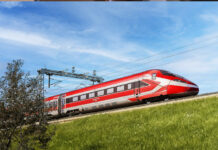
With the surge in popularity of rail travel – driven not only by environmental concerns but also by rising fuel prices – this unmet demand could rise to 24% by 2030 if no action is taken, meaning 46 million passengers would be left behind. Already, Trenitalia’s entry onto the Paris–Lyon route has led to a 20% increase in passenger numbers, accompanied by a fare reduction of around 10%. This is still a long way from the price reduction seen in Spain, where the opening up of the Madrid–Barcelona line led to a 47% drop in fares alongside a 77% increase in demand.
One billion euros of economic benefit for the network in 2035
The arrival of new entrants is made possible in the first instance by the underutilisation of the high-speed network and the new signalling and rail safety systems that allow more trains to run. The study challenges the idea that these new companies are detrimental to the network because they increase its maintenance costs while benefiting from a reduction in track access charges for three years. Frontier Economics estimates that they contributed €86m in 2025 to the funding of the network, « beyond the lines they serve alone ». A sum that is expected to climb to €146m in 2026 and €640m by 2031, taking into account the arrival of Velvet and Kevin Speed.
" This contribution could pass the one billion euro mark in 2035 if France reaches the same degree of openness to competition as our neighbours, which is close to 40% »says Catherine Galano, executive director of Frontier Economics. The issue of tolls thus remains one of the crucial points, according to Afra, for opening up the market. «They are three to four times higher than those of our neighbours. This is a barrier that limits the development of supply », says Solène Garcin-Berson, Managing Director of Afra. Their amount, which is 50% higher than that of Italian or Spanish lines – with levels expected to rise further in 2027 – forces new operators to achieve the highest possible load factor. Afra is therefore campaigning for their reduction in order to lower ticket prices and encourage the addition of frequencies. This would potentially result in an additional 50 million travellers by 2035.
Open competitor distribution on SNCF Connect
To boost load factors, Afra is campaigning more than ever for all rail operators to be distributed via SNCF Connect, SNCF's sales platform. Following the Senate vote on the framework law on transport, Afra hopes the text will soon be adopted by the Assembly, which would allow this distribution to be opened up by 2028. The context is pushing in this direction following the opinion of Fnaut (the national federation of transport users« associations) and, above all, the action of the European Commission, which wants rail ticketing to guarantee neutral and transparent display of offers in the coming years. " It is essential for travellers and new operators that this comes to fruition as soon as possible », assures Solène Garcin-Berson. And to add that they « do not take passengers on the SNCF but actually generate more ".
The fact remains that the entry ticket to establish a foothold in France is astronomical for new market players. According to Afra, it is in the region of 1 billion euros over 5 years, taking into account the acquisition of trainsets, the maintenance depot, staff training, marketing for the brand launch, scaling up operations, and so on. That is more or less the amount raised by Velvet for its launch in 2028, of which €850m is for the acquisition of 12 Avelia Horizon trainsets from Alstom.