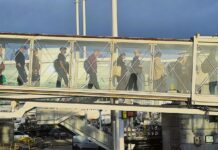















For passengers arriving by public transport, the novelty begins as soon as they exit the CDGVAL - inaugurated in April 2007 - and enter a completely redesigned "shopping" area. On the left, the new Hall 5 and its thirty or so check-in desks. On the right, the atmosphere is brighter, the walls are more colourful and there is now a food court all decked out in red.
Right from the outset, the aesthetic ambition of the "new" terminal, summed up by its director, Christophe Laurent: "To give colour, light and space. To break the impression of greyness that could be reinforced by the omnipresence of concrete, a noble but sometimes dark material." It's an ambition served by the brushstrokes, but above all by the large bay windows that have invaded the building in place of the blind walls. Fluidity: this is the other key word of this vast grooming operation, which continues on the upper floor where the vast majority of the registration desks are still located. For these, the radial layout has been replaced by a frontal layout, to remedy the confusion that has long reigned on this floor at peak times. "Generally speaking, the whole refurbishment has been carried out with a view to restoring space for check-in and avoiding the clash of queues", adds Christophe Laurent, who also intends, in the near future, to facilitate the movement of frequent travellers in the transfer area, once they have passed the escalator crossing the famous "central shaft" of Roissy 1. From December onwards, the Parafes project, conducted in collaboration with the air and border police, should speed up the identity verification procedure thanks to biometric fingerprint recognition for European passengers. At the same time, the airport is working with airlines to organise priority queues for the best-identified passengers.
Once through the police checkpoint, you enter the "reserved area". In this part of the terminal, where passengers linger before going to their boarding satellite, the upscale nature of the retail park and - via the lift - the opening of the very funky La Terrasse restaurant have crystallised the winds of change. To complete the review of details, you need only take the long conveyor belts leading to the satellites, four out of seven of which have already been renovated. On the menu: improved commercial offerings, new workspaces and a concentration of those dreaded "screening checkpoints" that have become the dread of frequent travellers since 2001 and the inflation of security regulations. In the satellites as in the rest of the terminal, service improvements also include clearer signage and the installation of Internet access terminals (for a fee) and electrical columns for recharging batteries.
Next stage: the exterior
The "terminal 1 experience" has been improved for departing passengers, but also for arriving passengers. The baggage delivery area has also been lit up, with screens displaying the scheduled delivery time for each flight. This calms impatience at a time when it can be critical, especially for long-haul passengers. The Star Alliance member airlines are also delighted, as they continue to consolidate their operations in terminal 1, where they alone already account for almost 60 % of business. "Move under one roof' is our product. And in the last six years, six airlines from the alliance have already joined us in terminal 1. And there's more to come: Continental will be moving here in November and TAM next spring", enthuses John Krempa, project manager at Roissy for Star Alliance. With their designer furniture, flat screens and free Wi-Fi, the new Star Alliance lounges - inaugurated at the end of 2008 - symbolise not only the renovation of the terminal, but also the union contract linking it to the alliance. "The memorandum we signed in 2005 formalised a mutual commitment to increase traffic and capacity. If Star Alliance had said to us 'we want to change the terminal as soon as possible', it is quite clear that we would not have invested in the same way", explains the terminal manager.
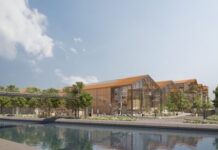
What about tomorrow? The issue is not completely closed. It involves renovating the three satellites that still operate under the "old regime". It also involves redeveloping the "linear" area - the outside of the terminal - where the idea is to "break away from the current concept, which is very busy and very dark" in order to "urbanise and give space back to pedestrians" by reserving an open, 16-metre-wide thoroughfare for them. Work is due to start in early 2010, with the eventual aim of seeing shops and terraces flourish on this new "external boulevard" of the terminal. And, perhaps, celebrate its 40th anniversary in the open air.
File - Passage to terminal
- Transfer to terminal
Aesthetics
New signage
Icare exhibition