












The superstitious will see it as an effect of «Friday the 13th». On this November 13, the US Civil Aviation Authority, the FAA (Federal Aviation Administration), caused an exceptional disruption. It ordered a nationwide suspension of departures at the country’s airports following a failure of the communication and surveillance systems for air traffic. Thousands of flights were delayed and then cancelled, with expected repercussions lasting for several days.
The measure was triggered at 15:36 Eastern time (21:36 in France), at which time several control centers began experiencing communication and radar data transmission problems. U.S. airspace was finally reopened at 20:15 local time (02:15 Saturday in France), that is after about five hours of interruption.
In a statement, the FAA confirmed that it had imposed a nationwide stop to departures at all U.S. airports due to communication problems affecting several regional air traffic control centers.
According to the US Secretary of Transportation, Sean Duffy, the problem lies in aging air traffic management equipment that is unable to handle too much data volume. The overload caused inconsistencies in the information transmitted to controllers, affecting communications and radar systems.
For his part, the Secretary of the Interior, Markwayne Mullin, stated that no evidence indicated a cyberattack. Sean Duffy, for his part, ruled out the responsibility for the new digital equipment: according to him, the recently modernized facilities continued to operate normally. It was the historical infrastructure, which relied, among other things, on analog telecommunications, that was compromised.
The incident thus reignites the debate about The aging of the American air traffic control system, This argument was immediately turned into a controversy by the Trump administration. The federal government is indeed blaming the Congress for the slow pace of approving a budget increase for the modernization of air infrastructure, after an initial funding package of 12.5 billion dollars had already been approved.
After campaigning for $30 billion for aviation, Sean Duffy is now demanding $50 billion in Congress to accelerate the modernization of the traffic management system. He even wants this increase to be adopted urgently before the end of the year, as Congress remains in Republican majority.
Disruptions for several days but no problems in Paris
Regardless of the ongoing controversy in political circles, it is the travelers who will pay the consequences of this shutdown, the longest one the United States has experienced since September 11, 2001.
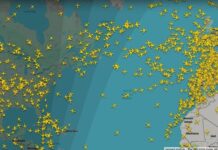
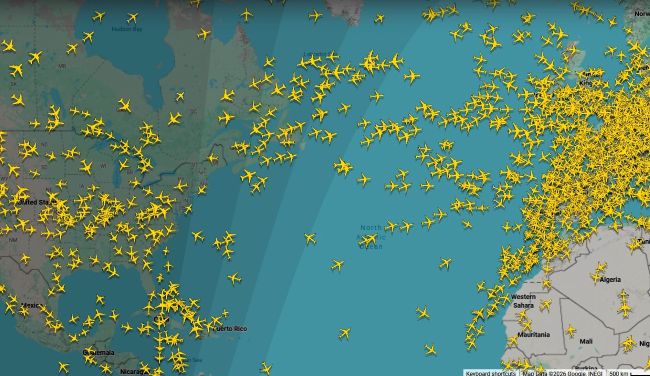
The reopening of the airspace after five hours did not immediately restore operations. At the time of the shutdown, more than 3,500 aircraft were in flight. Security procedures allowed their gradual landing, but at least 827 flights were rerouted to other airports, according to data from Cirium reported by Associated Press. More than one million passengers could have been affected, while some 30,000 departures and arrivals had to be cancelled following the FAA announcement.
Now, all airlines must reactivate their aircraft and crews to restore their schedules and transport thousands of passengers. A delicate equation that will require recalculating the entire fleet of each airline from their base locations. Aircraft are located in different airports than those originally planned, while pilots and flight crew members must find their rotations. Sean Duffy warns that the return to normal will take time and that some airlines will have to postpone flights for the following day.
In its operational bulletin of November 14, the FAA confirms that several restrictions remain in effect, notably in Seattle, San Diego, Newark and Minneapolis, at the request of certain airlines. Weather constraints and controller availability also complicate the resumption.
This morning at departure from Roissy, Air France flights were normally departing while the schedules of American airlines showed delays of 30 minutes to 1h40 on average. The most complicated situations will be for passengers connecting on domestic routes. It is therefore recommended that travelers contact their airline.
The chaos could indeed last at least a week. But everything should return to normal for Thanksgiving week, one of the busiest periods for air transport, according to Sean Duffy. However, he does not rule out further incidents until the aging equipment is replaced.