















How is Lyria's business traffic doing?
Fabien Soulet - After a period of recovery in the second half of 2021, Lyria experienced a blip in December-January due to the fifth wave of the Covid epidemic caused by the Omicron variant. The recovery is now strong, which has convinced us to go on the offensive by reprogramming 100 %s from our offer from Monday 28 March. This means 17 daily round trips between France and Switzerland. As in 2019, this represents an increase of 30 % in the number of seats available, i.e. 4,500 extra seats and the equivalent of around thirty flights if we make the comparison with air travel. Lyria has recovered 80 % of its business traffic at the beginning of March, and will be higher in April. By way of comparison, it had already reached 85% last November before the Omicron wave.
What are the reasons for this upturn in supply at a time when the business market has not yet returned to its pre-pandemic levels?
F. S. - We are convinced that the business market is there and that the train has a role to play in this recovery. The health crisis has had a paradoxical effect. While Lyria's traffic has been affected, thehe pandemic has also strengthened the competitive advantages of the train with our business travellers. The train reflex has become essential, both for customers who were already using us and those who tried us out during the crisis. According to figures published by the Marco Polo Association, a think tank dedicated to business travel, while Lyria has been below the market during periods of restraint, our company has performed superbly during periods of recovery. Lyria can therefore hope to quickly return to its business traffic levels, or even exceed it as early as 2022 or 2023. All the more so as this policy will increase the number of passengers on our trains.
Lyria can therefore hope to quickly return to its business traffic levels, and even exceed them as early as 2022 or 2023.
Does the issue of sustainable mobility work in your favour?
F. S. - It is clear that this current dynamism is also based on the instructions of large companies whose travel policy, in line with their CSR commitments, consists of give priority to rail to the detriment of aircraft on journeys of less than 4 hours. This approach is particularly visible in Switzerland. I would like to stress that the study carried out by the Swiss consultancy Infras, published in 2021, showed that the emissions from trains and the rail environment in general were, depending on the route considered, up to 20 times lower than those from planes. This is important, because companies are now asking for precise figures on this subject, and our teams are able to provide them. a personalised carbon footprint for each service. As a reminder, Lyria competes head-on with airlines on all its routes, from Paris to Geneva, Basel and Zurich. With a market share of 50 % in 2019, our aim is to gain significant additional market share over the next 12 months.

Are any new features expected in terms of on-board services?
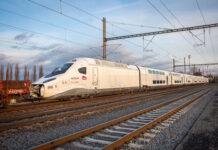
F. S. - A qualitative leap has already been made with the use of 15 double-decker TGV trains and the return of the Business 1st from the start of the 2021 academic year on our various routes, from Sunday lunchtime to Friday evening. This means we can offer our customers a consistent service throughout the day, whatever the train. For €195 one-way on the Paris-Geneva route, for example, business travellers benefit from access to a dedicated area in the Grand Voyageur lounge at Paris-Lyon station, a comfortable journey in a 1st class coach, a meal or snack on board depending on the time of day, and free Wi-Fi throughout the journey. The useful time spent working on board is the other factor that makes rail competitive with air travel. It accounts for 83 % of Lyria's door-to-door journey time, compared with 30 % for a journey by air.
Has Lyria put any commercial offers in place to support this takeover?
F. S. - A high level of commercial activity was maintained throughout the Covid period between our BtoB teams and companies. The two proposals launched in 2019 for businesses are still in place: the first aimed at key accounts, the second adapted to SMEs with corporate fares for 1st and 2nd class, whatever the size of the company and its volume of travel over the year.
Franco-Swiss journeys of less than 4 hoursParis-Basel : 6 daily return services in 3 hours 04 minutes |