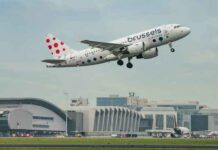
French skies will be disrupted on Monday 20 November due to a strike notice issued by several air traffic controllers' unions. As a result, the French Civil Aviation Authority (DGAC) has asked airlines to reduce their flight schedule by 25% at Paris-Orly and Toulouse-Blagnac airports and 20% at Bordeaux-Mérignac and Marseille-Provence airports.
A strike in the shape of a swan song? This industrial action is in fact linked to the adoption by the National Assembly of an law to better anticipate the scale of strikes and thus avoid preventive flight cancellations. A bill to this effect was tabled on 1 January 2008.er The draft law was drawn up by Senator Vincent Capo-Canellas, of the Union Centriste group, on the symbolic date of May 2023. It passed its first reading in the Senate in mid-June and was adopted by the lower house on 15 November. Hence the ire of certain unions such as the CGT and Force Ouvrière, which are in the minority among air traffic controllers, but are the source of major disruption.
" Between the repeated strikes with very few strikers and the irresponsible management of the day of 11 February 2023, the exposure of the profession was unprecedented. In the words of the Syndicat national des contrôleurs du trafic aérien (National Union of Air Traffic Controllers): "In 2023. A majority union which considers that " the current system, which has been used by other trade union organisations, is out of breath" . " An asymmetrical system "factor of public service disruption" Transport Minister Clément Beaune told the House.
Until now, the air traffic controllers' unions were obliged to give five days' notice of strike action, without strikers having to declare their participation individually. This is in contrast to other air transport professions - flight attendants, ground staff - who are obliged to declare themselves on strike under the Diard Act of March 2012. As a result, without being able to assess the exact number of strikers, the DGAC was obliged to cancelling flights on a massive, pre-emptive basisThis is out of line with the actual number of strikers.
These air traffic control disruptions are affecting not only domestic flights, but also airlines flying over France. Eurocontrol notes that " 30 % daily flights in Europe were potentially affected by industrial action in France this year" .
Once the law comes into force, the DGCA will be able to adapt these cancellations to the real scale of the strike while providing airlines and passengers with more precise information on the number of flights affected. Will France lose its title of European champion for delays due to air traffic control strikes? With the Olympic Games just around the corner, airlines and travellers alike are certainly accepting the omen.