

















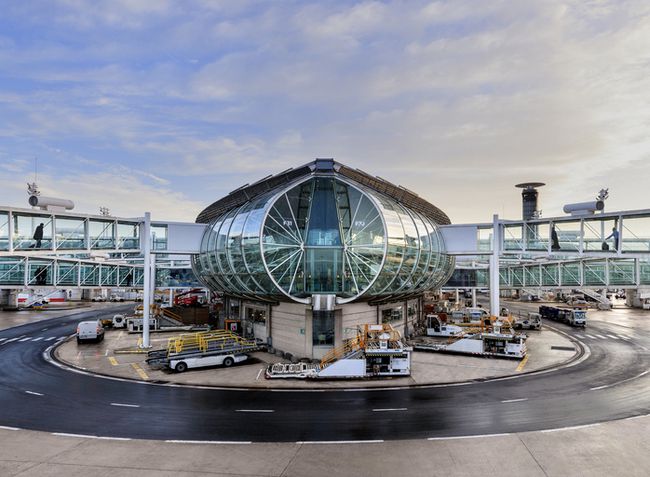
Doing better with what we have: this is the objective of the ADP group, which has just presented its draft economic regulation contract (CRE) for 2027-2034 covering the expected developments at Paris CDG and Paris-Orly airports. " We are confirming our strategic decision not to build major infrastructure projects, but rather to increase the density of existing infrastructure. "This is what Philippe Pascal, who took over as head of the group from Augustin de Romanet in February, describes. In order to increase Paris CDG's capacity to 90 million passengers by 2024, compared with 76 million today, there will be no terminal 4, as was once envisaged, but rather an addition of new buildings that will make travellers' journeys more fluid and, as a result, optimise airline operations from 2027 onwards. Against a backdrop of increased competition between the world's major hubs.
Why 2027, rather than next year? Because the project presented is still subject to validation by the Autorité de Régulation des Transports (ART), an independent body whose endorsement is necessary to trigger the government's signature, expected at the end of next year. However, the project is not being developed by ADP alone, and has already been based on a wide-ranging consultation this summer with the local authorities and residents living near the two airports. At the same time, " the airlines were completely involved in its definition, right down to certain details "Air France, ADP's biggest customer, has undoubtedly made its wishes known.
There remains one point that the airlines may not appreciate all that much: the announced increase in charges to finance this project at a total cost of 8.4 billion euros - revenues from shops and other non-regulated activities are not included in this economic regulation contract - an investment in line with what other major European airports are able to invest, according to the group's management.
For the period 2027-2034, ADP is proposing an annual fare increase of +2.6 points, excluding inflation. An average over the period, but with higher increases in the first two years". to make up for the ongoing destruction of value "explains the Group CEO. And all this with modulations, in particular a reduction in the difference in charges between mainland/Schengen flights and international flights in favour of the latter, or a bonus-malus system benefiting the most eco-responsible airlines. The airport group also emphasises its competitive edge over its rivals, with Amsterdam Schiphol and London Heathrow more than 35% - and Frankfurt more than 15% - higher than Paris airports.

But let's assume that the project as presented passes through the remaining stages without a hitch, between validation by users, negotiations with the DGAC and the ART's opinion: how will this economic regulation contract translate into reality for passengers? The first phase, between 2027 and 2030, concerns them first and foremost, with a smoother journey. This will be achieved by reducing waiting times at borders, by increasing the density of screening equipment and by deploying the latest generation of screening machines, so that passengers do not have to remove their liquid baggage, scissors or computers. While these investments fall outside the regulated framework of ADP's activity and are based on security and not airport taxes, " this equipment has already been introduced at Paris CDG terminal 2E and Orly 3, and will continue to be deployed in 2026 and 2027, the pace depending on the fact that only one supplier is currently approved by the EU "says Justine Coutard, Chief Operating Officer of the ADP Group.
To go even further, a new departures and arrivals border will be proposed in 2030 at Paris-CDG's Terminal 1, with a doubling of the surface area dedicated to border controls and a tripling of the number of Parafe terminals. At the same time, terminal 2E will see the construction of a new 18,500 m² building, designed to accommodate a new arrivals border, almost double the size of the current one, while allowing the creation of a new lounge offering, expected in 2031.
The second phase of the project, running from 2030 to 2032, will focus on densifying and optimising the existing infrastructure. This will result in increased capacity for check-in counters, screening and baggage delivery. There is also a plan to renovate the boarding lounges to make them denser. At Paris-Orly, for example, a new 10,000 m² building will be constructed between halls 1A and 1B to house a new security control area with the latest-generation screening machines. The removal of the current areas will allow the space freed up to be used to expand the boarding lounges in halls 1A and 1B.
At the same time, ADP intends to increase the rate of "contact" boarding, improving both the customer experience and the performance of airlines. To this end, a new 28,000 m² international satellite will be added to terminal 2E in 2030 to accommodate six wide-body aircraft on contact. At the same time, Paris CDG will also have a new offshore area to accommodate 10 wide-body aircraft positions once passengers have disembarked and while waiting for the next take-off. Also in 2030, terminal 3, which will also be densified, will save passengers the need to take a bus by making 6 aircraft positions accessible on foot and will benefit from the additional capacity of 7 medium-body aircraft positions.
Following this will come the third phase of the project, in 2032/2034, involving the creation of new infrastructure and the development of intermodality. Expected in 2034, a new international satellite will be added to terminal 2E, replacing the current terminal 2G, which will be demolished, to provide additional capacity for 9 wide-body aircraft. To reach this new satellite and facilitate connections, the internal Lisa metro will be extended to the satellite from a common station between terminals 2E and 2F.
While the arrival of the CDG VAL, providing a direct link with Paris, is expected next year, in anticipation of line 17 of the Grand Paris by 2030, intermodality will also be part of the plans with the construction of a new building between the CDG2 station and terminal 2E to provide a direct connection with rail transport from 2033.

With regard to Paris-Orly, whose capacity will increase to 37 million passengers from the current 34 million, the airport to the south of the capital will await the delivery in 2024 of a new boarding satellite connected to Orly 2 and Orly 3 with, to reach it, a "skybridge", a pedestrian footbridge that will pass over the aircraft taxiways connecting the satellite to the two terminals. The whole system will be capable of handling 8 aircraft at a time. As for intermodality, this will be enhanced by the construction of two reception hubs to rationalise the remote parking facilities, alongside a public transport system to better connect all the sites.
But ADP is already looking beyond the economic regulation contract. " In 2027, our future strategic plan will articulate our long-term vision of value creation across all our activities, so that the ADP Group can play its full role as an economic, social and regional driving force, and as a key player in the development of France. "said Philippe Pascal. By then, in 2027, all the terminals will have been renamed to simplify the journey for passengers, with no more letters, just numbers. Terminals 1, 2, 3, 4, 5, 6 and 7 have already been renamed.