
















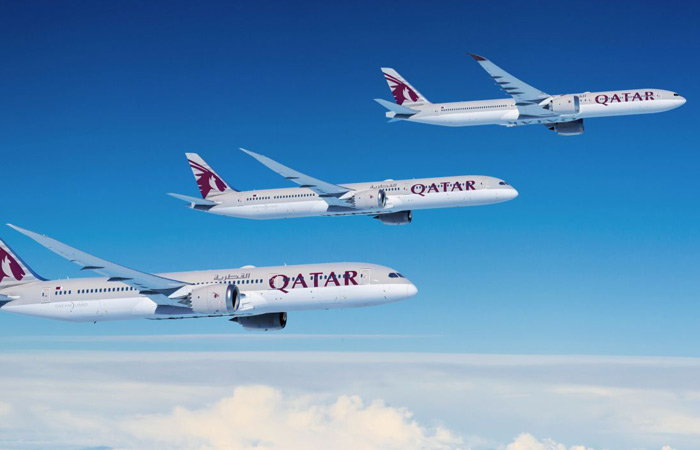
Contestation is growing over one of the most decried open skies agreements since the European Union: the one signed in 2021 with Qatar, which allows the airlines of both political entities to serve any airline linking Doha to the European Union and vice versa.
Except that the signing and application of this agreement appear to be marred by irregularities, as denounced by several organisations - in this case the European Cockpit Association (ECA), the European Network Airlines' Association (ENAA) and the European Transport Workers' Federation (ETF). The three are calling on the European Commission to immediately suspend the Comprehensive Air Transport Agreement between the European Union and Qatar. They express concern about the lack of transparency in the negotiations, governance and fair competition when the agreement is signed in 2021.
This stance comes after media reports revealed that the European Commission has dismissed a senior official who oversaw discussions with Qatar. The decision follows an investigation by the European Anti-Fraud Office (OLAF) and an internal disciplinary procedure. The allegations concern compliance issues relating to conflicts of interest, transparency obligations, the acceptance of gifts and the disclosure of documents.
In a joint statement published on 5 February, the European social partners in civil aviation believe that these recent developments have undermined confidence in the process that led to the agreement.
On closer inspection, it is true that the signing of this open skies agreement seems to have benefited Qatar alone. Just look at the current state of air links between the European Union and the Emirate: on the one hand, Qatar Airways, which serves 27 EU destinations (including Paris CDG and Nice in France); on the other, two EU airlines land in Doha: Finnair and Iberia. It has to be said that, despite having one of the highest per capita GDPs in the world, Qatar's population of just 3.1 million does not generate much enthusiasm in terms of potential...
According to the 3 organisations, international agreements should help to establish a level playing field while preserving the economic and social sustainability of the European aviation sector.
The Association of International Airports, Europe Chapter (ACI Europe) is nevertheless strongly opposed to a suspension of the agreement. In a press release, ACI warns of the consequences of a suspension for European air connectivity, consumer choice and the EU's international credibility.
According to the airports, the EU-Qatar agreement has in fact helped to diversify air routes and strengthen opportunities for local communities, travellers and businesses. They also point out that there is no tangible evidence (sic) that Qatar Airways has acquired a dominant or unfair position in the European market.
The available data also show that Qatar Airways' seat capacity in Europe during the current IATA winter season (October 2025 - March 2026) is still 10 % below its pre-pandemic level in 2019. European airlines, on the other hand, have virtually no capacity at all.
In this legal and media battle, Qatar has plenty of leverage to freeze any decision by the European authorities on this agreement...