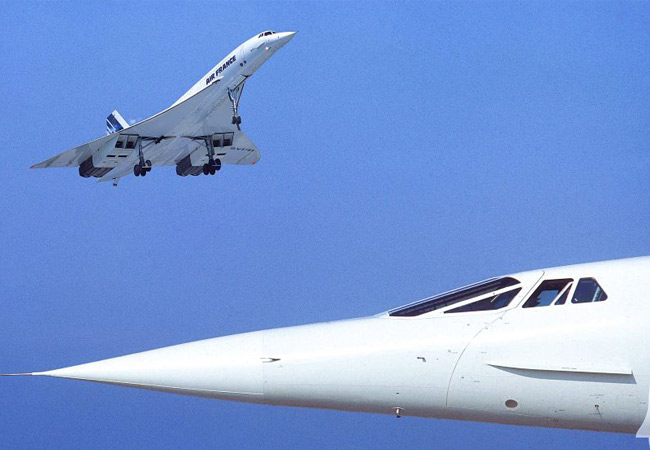
Nearly a quarter of a century after the last commercial flight of the ConcordeThe United States has reached a major milestone towards the return of supersonic air travel. The American Federal Aviation Administration (FAA) has indeed announced new regulations intended to eventually authorise civilian supersonic flights over the continental United States. The ban in place in the 70s had effectively limited Concorde flights to just the cities of New York and Washington, the two cities being located near the Atlantic Ocean.
Between 1976 and 2003, Air France primarily connected Paris-Charles de Gaulle to New York-JFK., with a flight time of approximately 3 hours and 30 minutes. The airline also served Washington on occasion. For its part, British Airways operated routes connecting London Heathrow with New York JFK and Washington during the same period.
There was indeed a Concorde route between Dallas and Washington (with connections to London or Paris) operated by the US airline Braniff. However, the latter flew at subsonic speed over the United States. The venture was short-lived, lasting only one year.
However, the more favourable view of the United States today is due to the development of a new generation of aircraft capable of connecting major cities in half the time, while limiting, or even eliminating, the famous "sonic boom" which had led to the ban on flights over American territory.
Furthermore, the potential companies developing new aircraft are American. For example, Boom Supersonic, which is developing the Overture, an aircraft with 64 to 80 seats capable of flying at Mach 1.7. The company claims to have already received more than 130 letters of intent from airlines such as American Airlines, United Airlines, and Japan Airlines.
Other projects are also being studied by NASA with the experimental X-59 aircraft, designed to demonstrate the feasibility of quiet supersonic flight.
US Secretary of Transport Sean P. Duffy presented this initiative as a decisive step for American aeronautical innovation. And of course, thanks to the visionary spirit of US President Donald Trump. « Restoring supersonic flights over land isn't just about speed. It's about stimulating American innovation and ushering in a new era of air travel. "he said.
A new noise regulation
The FAA's proposal establishes a first certification standard based on the noise level of future supersonic aircraft. A second regulation, expected before the end of the year, will set the noise limits during take-off and landing phases.
The American authority estimates that advances in aerodynamics, composite materials, propulsion, and noise reduction will make it possible to operate supersonic aircraft without producing the supersonic boom that had caused numerous public complaints.
The FAA plans to finalise the entire regulatory framework by mid-2027, offering manufacturers sufficient visibility to commence the certification of their future aircraft.