


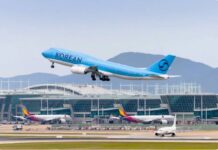















The reorganization of flight numbers following the The operational integration of Asiana Airlines by Korean Air And the arrival of Trinity Airways on the Paris CDG-Seoul Incheon route transforms the France-Korea axis.
For the European markets, these changes represent both the final disappearance of Asiana, which was absorbed by Korean Air, and the strengthening of the presence of a new airline on major European destinations.
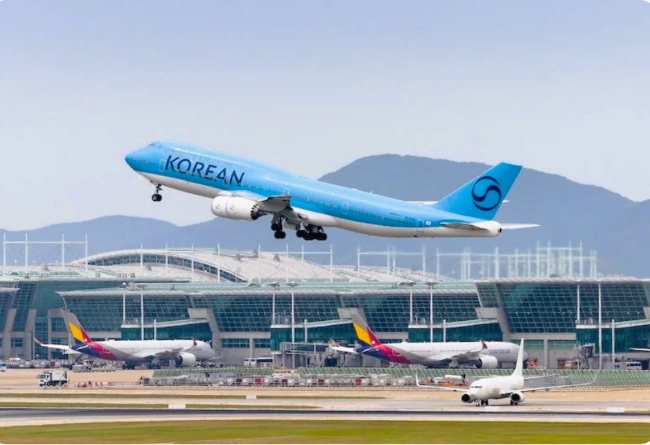
Korean Air and Asiana Airlines are indeed preparing for their operational merger, a major milestone of which is scheduled for December 17, 2026. The transition directly affects about thirty international routes on all continents.
In Europe, Asiana’s international flights will gradually abandon their OZ commercial code in favor of the KE code of Korean Air. Among Asiana’s European routes to Seoul-Incheon, flights to Paris-Charles-de-Gaulle, currently designated OZ501 and OZ502, will thus become KE903 and KE904.
The other changes also affect the connections to Barcelona, Budapest, Frankfurt, Istanbul, London-Heathrow, Milan-Malpensa, Prague and Rome-Fiumicino.
The new codes and flight numbers do not necessarily mean a change in schedules, aircraft, or frequencies. They primarily represent a commercial and operational harmonization of the two networks. However, passengers already holding Asiana tickets for travel starting December 17 should monitor their airline’s notifications: reservations and flight numbers are being gradually transferred into Korean Air’s systems. The migration will continue until December 3.
In parallel, Trinity Airways, formerly T’way Air, plans to launch its flights between Seoul-Incheon and Paris-Charles de Gaulle on June 2, 2027, with Airbus A330-900neo aircraft. This opening follows the development of its European network, after Barcelona, scheduled for March 29, 2027, and Rome-Fiumicino, on April 15.
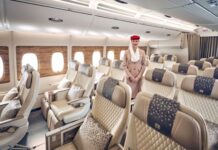
The former T’way Air plans to operate its A330-900neo aircraft in a configuration of 336 seats, including 12 in business class and 324 in economy class. Paris-CDG will thus be served four times a week, with an increase to five weekly frequencies starting on June 12.
The company thus continues its positioning on the major European gateways, with an offer aimed at diversifying travel options between South Korea and Europe. And to become a new Korean alternative to the all-powerful Korean Air.
