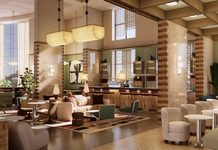
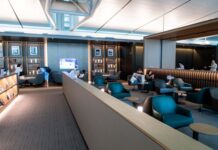


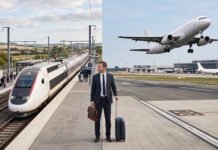









As the train gradually nibbles away at air travel's market share, particularly for journeys of up to three hours, rail companies are developing services before, during and after the journey. The aim is twofold: to make them more competitive with the airlines, and to win the loyalty of business travellers. The services on offer now include access to areas where they can work or relax. Directly inspired by the airline industry and designed to appeal to first-class passengers and frequent business travellers, lounges are beginning to appear in stations.
"The lounges are a major part of our service offer to business customers. In these areas, business passengers can work, rest or organise their 'after-trip' by booking a taxi or parking space, for example, explains Agnès Ogier, Marketing Director of SNCF Voyages. They make life easier for our most frequent travellers, and we have a duty to make them more pleasant, more comfortable and easier. In the future, these lounges should become even more important. To make them a real stopover on the journey, SNCF is planning to enhance these areas with specific services, such as a concierge service.
A renovation programme is already underway to meet the needs of increasingly mobile customers. For the moment, the French rail company offers 11 lounges with an average surface area of around 200 m=. These lounges are used by nearly a million passengers every year, and feature free WiFi access, a range of daily newspapers and magazines, a hot drinks dispenser and comfortable armchairs. They also allow passengers to collect and exchange their tickets.
More than just VIP lounges

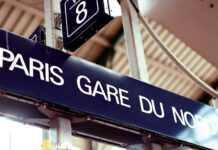
But the SNCF is going further than just offering VIP lounges to meet the needs of its demanding customers. Last November, the company, through its Gares & Connexions branch, signed an agreement with Regus, the world leader in flexible workspaces. The agreement covers the establishment of business centres in Le Mans, Bordeaux, Nancy, Amiens, Paris Nord and Lille Flandres stations. The first centre, with a surface area of 300m=, will open at Le Mans station at the end of 2012. This will be followed in 2013 by Bordeaux, Nancy and Amiens, and in 2014 by Paris-Nord and Lille Flandres, which, at 1,500m=, will be the largest of all.

"Developing spaces dedicated to professionals and businesses in French stations is a necessity in today's society"., explains Sophie Boissard, Managing Director of Gare & Connexions. The SNCF subsidiary thus aims to cater for the needs of the millions of workers and employees who primarily use the train for their journeys. Indeed, 60 % of domestic journeys are between home and work, whilst 15 %d are for business purposes. This represents a significant number of passengers who would be delighted to find facilities and services at stations that save them time and reduce unnecessary journeys.
New working frameworks
Real transport hubs

Across the border in Switzerland, Lyria carried more than four million passengers in 2011, including almost two million international passengers and 32 % travelling for business reasons. To attract more business customers, the Swiss rail company plans to increase its first-class capacity. At the same time, in Zürich, high-contribution passengers and "frequent flyers" have free access to a lounge that seats around fifty and welcomes between 400 and 700 passengers every day. "We are convinced that stations are centres of welcome and exchange in their own right. The opening of these lounges reflects our desire to support our customers both before and after their train journey".says Émilie Perrot, Lyria's Sales and Marketing Director.
 By offering such services, the German company aims to make it easier for business travellers to get around, by providing a place to hold a meeting and work in complete peace of mind, with the added bonus of a catering service. All without having to travel far from the station and spend time looking for the right place. The Frankfurt show also offers the possibility of reserving rooms for ten people, equipped with a range of equipment, including overhead projectors. To create more user-friendly venues, Deutsche Bahn is now planning to renovate all its stations. The materials used will be wood, glass and steel, and the colours used will be dominated by red, the company's signature colour. In addition, still with a view to supporting its business customers, all DB trains offer a seat service and have first-class compartments for five people that can be made private for business meetings.
High-speed meetings
 Alongside the lounges installed in stations, some train companies are now equipping their trains with private workspaces. Alongside Deutsche Bahn, Thalys is one of the forerunners in this field, opening a private lounge at the head of each first-class train in 2010 on the Paris-Brussels line. This space takes the form of a mini meeting room: four luxurious armchairs surrounding a real meeting table, designer coat racks, power sockets and a WiFi network!