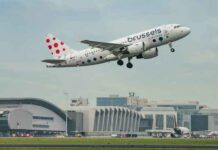
How are services from Brussels Airport to Zaventem now organised? While train traffic to the airport from the city has still not resumed - only taxis and private cars are allowed, as well as chartered coaches - the airlines are getting organised to cope with the gradual resumption of traffic from Belgium's main air hub.
Brussels airport reopened on Sunday with a handful of flights. But according to information from Brussels Airlines and Brussels National Airport, traffic will gradually build up, although it will probably take six months to return to the same level of capacity as before the attack. In 2015, Brussels welcomed 23.5 million passengers, with January and February alone seeing between 1.2 and 1.5 million passengers using the hub.
For the time being, the temporary facilities will only be able to handle 800 passengers per hour, a fifth of the airport's normal capacity. Many flights will therefore continue to land on secondary hubs for a few months.
Brussels Airlines resumed these flights on Monday, but on a limited basis. According to the airline's provisional timetable, 27 flights are operated this Monday within Europe, including services to Nice and Thalys services to Paris. On its intercontinental network, the airline is operating three flights from Brussels to New York, Banjul/New York and Paris.Dakar and Douala/Yaoundé. Around twenty other routes are operated, mainly via Liège and some via Antwerp. Other long-haul flights to Africa also depart from Frankfurt or Zurich with pre-routing. From Tuesday, Brussels Airlines will be offering 72 flights to Europe - including Lyon, Marseille, Nice, Paris and Toulouse - as well as five intercontinental routes (New York, Coventry/Dakar, Cotonou/Abidjan, Luanda/Kinshasa, Entebbe/Kigali and Freetown/Monrovia).
It has also been announced that Lufthansa has resumed one of its direct flights to Brussels, as has Air Canada. The Star Alliance airlines are likely to be among the first to resume direct flights to Zaventem.
For the other scheduled airlines, alternatives are offered at the nearby airports surrounding the Belgian capital, as few intercontinental airlines have actually reallocated their flights to other hubs. "With the exception of the tragic day of 22 March, there has been no real increase in capacity or flights reallocated to Roissy", confirms an ADP spokesperson. The airport authority made the same observation in Amsterdam, noting no significant additional movements.
On the other hand, Liège airport handles many intercontinental and European flights. Liège - a major freight hub - in fact has all the infrastructure to handle high-volume air operations: the airport has two runways, one of which is 3,600 metres long - capable of handling large aircraft - and a secondary runway of 2,400 metres, sufficient for medium-haul aircraft. The terminal, which opened in 2005, can handle 1.5 million passengers a year, or 500 an hour.
As a result, Brussels Airlines has transferred around fifteen of its flights to Liège. But that's not all: Lufthansa and British Airways have reorganised their flights out of Liège, as has Thai Airways International, which offers four flights a week from the Walloon hub. Until the end of the week, the following airlines will be operating their frequencies to Brussels via :

Other carriers such as Emirates, Finnair, Qatar Airways, SAS Scandinavian Airlines and United re-routing their passengers to other cities, generally covering the cost of the transfer to Brussels. The main alternative airports are Amsterdam, Paris CDG, Düsseldorf and Frankfurt.
The low-cost carriers have also reallocated their flights to alternative airports: starting with Lille, which is hosting flights from Easyjet and Vueling. "This represents 40 to 42 movements a day, more or less equally divided between the two airlines. We have set up a direct shuttle bus service from the airport to Brussels Midi station, the cost of which we are covering in solidarity with our Belgian colleagues", explains Edouard Aulanier, Head of Communications at Lille.
At Brussels South-Charleroi, Belgium's second busiest airport with seven million passengers, two additional Ryanair aircraft - normally based at Brussels Zaventem - have been transferred to the low-cost hub. Ryanair already operated a base at this airport. Air Arabia and other low-cost and charter airlines have also transferred their flights. This represents around fifty additional movements per day.
This provisional arrangement is likely to last until at least May, while Brussels airport continues to redevelop its structures to cope with a higher volume of traffic.
Brussels, an essential hub for Belgium
Brussels is one of Europe's leading airports in terms of passenger traffic, ranking 20th in 2015 with 23.5 million passengers - up 7% on 2014. The Brussels hub - the hub of the national carrier Brussels Airlines - carries 75% of Belgium's passenger traffic.
In economic terms, Brussels Airport is the second largest economic growth centre in Belgium, accounting for 18% of the country's GDP, the equivalent of €3.2 billion injected into the local economy every year. The airport is also a major cargo hub, handling 490,000 tonnes of freight a year. The airport provides direct and indirect employment for 60,000 people.
According to the original April 2016 timetable (source: flightmapsanalytics), Brussels Airport was connected to 155 cities worldwide by 56 scheduled airlines. The total seat capacity offered over one month (based on April 2016) was 1,353,321, with Brussels Airlines with 487,803 seats accounting for 36% of the total seat capacity. It is followed by Ryanair, Jetairfly, Lufthansa and Easyjet.