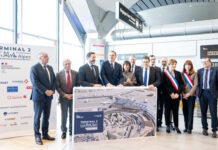
"We could never have imagined that we would have had to build an extension to Terminal 2, our hub, in just a decade. When we opened Terminal 2 in 2003, we carried eight million passengers. With our Star Alliance partners, we carried 27 million last year", said Lufthansa CEO Carsten Spohr with pride at the inauguration of the new satellite.
Lufthansa's decision to make Munich the airline's second hub, alongside Frankfurt, has transformed the airport's destiny. "Without the hub, we would simply have remained a major provincial airport. Today, Munich airport is a real economic engine for Germany and Bavaria. It generates 4.4 billion in revenue and 30,000 jobs", says Markus Söder, Bavaria's Minister of Finance and Chairman of the airport's Supervisory Board.
Until now, Terminal 2 had a capacity of 25 million passengers, accommodating 18 airlines in the Star alliance, including Lufthansa. "This is in fact the second largest international hub for our alliance", says Mark Schwab, Star's CEO. The addition of the satellite brings the airport's total surface area to almost 400,000 m2 - including 126,000 m2 for the satellite alone. In fact, the satellite has a capacity equivalent to that of an airport like Cologne or Stuttgart, with its 11 million passengers, making it possible to handle 36 million passengers a year in terminal 2. An additional pier is planned for the future, which will enable the airport to handle almost 5 million more passengers. This should enable Terminal 2 to cope with its traffic over a decade. "We expect to handle between 8 and 9 million passengers in the satellite in a full year", says Philip Ahrens, Satellite Project Manager. The satellite can handle 27 aircraft at a time - including two Airbus A380s - virtually eliminating the need for tedious bus transfers. The satellite is linked by an automatic shuttle bus, which takes just one minute to cover the 400 metres to the main terminal. "We've added five minutes to the minimum transfer time. But with a connection time of 35 minutes, we continue to offer one of the best performances in Europe", says Corinna Born, International Media Manager for the airport.
Munich has a reputation for being one of Europe's best airports for service, with the hub being one of the few in the world to have achieved a 5-star rating from Skytrax. To live up to its reputation, the satellite offers a full range of services. Wi-Fi is available throughout the terminal, while some fifteen shops are open. A dozen restaurants are grouped together in a central square inspired by Munich's Viktualienmarkt. They offer Bavarian specialities - including the famous Airbräu beer, the only one in the world to be brewed directly in the airport. Lufthansa and Star Alliance have five lounges available, including a First Class area with a terrace overlooking the movement of the aircraft.
Munich, a practical and aesthetically pleasing hub, is also a major nerve centre for Lufthansa and Star Alliance. With its 18 airlines present in Munich, the alliance serves a network of 147 destinations in 53 countries linked by 355 daily flights. "We have expansion plans", says Thomas Winkermann, CEO of the Munich Lufthansa hub. "We will be opening two new intercontinental destinations this summer, Denver and Teheran. Munich will also be receiving 11 new Airbus A350s to replace the Airbus A340s and open up new routes", he adds. Munich is linked to 113 destinations in Europe (April 2016) with connections to 26 intercontinental destinations, including around ten in North America and another ten in Asia. Munich is even one of the main hubs to and from... Italy. "We're only a two-and-a-half-hour drive from northern Italy, and a lot of Italian passengers come to Munich to catch their flights," says Corinna Born. Munich has even set up a special area for Italian customers, while the Lufthansa group - with its Italian regional subsidiary Air Dolomiti - links the Bavarian capital to 14 Italian cities, including some destinations with poor international connections such as Ancona, Catania, Lamezia Terme and Trieste. According to airport statistics, in 2015 the hub handled 1.56 million passengers to and from Italy, while the number of departing passengers with Italian nationality reached almost 850,000 in 2015.