















There is a lot of talk about the growing importance of Chinese groups in the hotel industry. What role does your main shareholder Jin Jiang play in the development of Louvre Hotels?
Françoise Houdebine : Jin Jiang has taken us into another dimension. This takeover provides us with growth levers for Campanile and Golden Tulip, the two brands on which we are going to base our international development. This is true in China, of course, and in South-East Asia more generally, but also in all the markets where Chinese business customers are likely to travel; in Africa, the Middle East, Brazil... In the end,
we're an international company, but with French know-how and savoir-vivre.
Will this French spirit accompany your developments?
F. H. We're delighted to be opening our first Campanile in Shanghai, in the historic Bund district, in September. We are presenting ourselves as a truly French brand, with the product retaining its European DNA while being slightly adapted to the Chinese market. Our ambition is to have nearly 500 hotels in this market over the next five years. Campanile meets the expectations of Chinese business travellers. And business travellers as well, because today's CSP customers are more pragmatic in their way of consuming.
Trendy, not has-been, budget hotels?
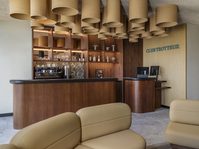
F. H. A budget hotel today offers 80 % of the services offered in a five-star hotel for 20 % of the price. Before, it was mainly a good bed, but a small bar and an unattractive restaurant. Once checked in, the traveller's main concern was to go out and spend the evening. We wanted to give them reasons to stay with us by making it more convivial. We have knocked down the partitions in the lobbies to make way for large work tables, giant screens and high-speed WiFi. Business travellers will be able to rediscover the atmosphere of evenings out with friends, one eye glued to their laptop, the other to a sporting event, while chatting with other travellers who are here for the same reasons.
Is Golden Tulip, your flagship international brand, developing in the same way?
F. H. : This brand, which was taken over seven years ago by our former shareholder Starwood Capital, hadn't really moved forward since then. We had to reinvent its model before going any further. The positioning was rethought around a more playful customer experience. Without being yet another brand targeting millennials, we took an interest in their consumption patterns. Working hours are less strict, the 9am-5pm code is outdated. So we've redesigned our lobbies as third places, places that are neither the office nor the home, but places where people can live and share.
How is this organised in practice?
F. H. The lobbies, now gigantic, will offer a host of different experiences based around micro-concepts. They will host small ephemeral boutiques run by local craftsmen or designers, because business travellers don't always have the time to go shopping. This "micro" aspect will also be present in the restaurants, with tapas to share or a food truck at the entrance to the hotel. In Paris, for example, guests can enjoy a coffee and croissant in the morning, a glass of wine and local specialities at lunchtime, and a soup in the evening in winter. At the same time, we want to offer star-rated restaurants, but with prices not exceeding €40. Finally, on the high-tech side, an application will be launched, linked to a vast digital wall that will act as a concierge. The opening of the Golden Tulip Shanghai in 2017 will bring all these developments to fruition.
| KEY DATES |
| 2013 Vice President, Sales & Marketing, Louvre Hotels Group |
| 2005 Vice President Sales, Marketing & Communications at Concorde Hotels, the luxury arm of the Groupe du Louvre |
| 1996 Hilton Paris Business Development Director |
| 1991 :Sales Director, Disneyland Paris |