















Report Serge Barret / Photos Alain Parinet
The Canaries are an apocalypse; a petrified chaos of seven main islands in the middle of the Atlantic off the coast of southern Morocco. Practically at the tropic, then. They're all volcanic in origin, but each of them has its own unique features. a different character. Some are fairly flat and very arid, like Fuerteventura, others are black with lava, like Lanzarote, and still others are fairly steep, like Gran Canaria.
And it is precisely Gran Canaria that, for the moment, passes beneath the wings of the plane as it lands. Isolated white villages in the mountains, small towns, yellow ochre, dark brown, burnt Sienna; purple too, here and there, gaps of green that wind their way through steep canyons and eventually run aground in the blue-white waves of the Atlantic.
Gran Canaria airport is not far away, no more than half an hour from the centre of the town. Las Palmas de Gran CanariaThis is the island's capital and the first stop on a three- or four-day "green" trip, as is now often the case in business tourism. It's not much, but it's enough time to get to the heart of this almost round island with a radius of just 50 kilometres.


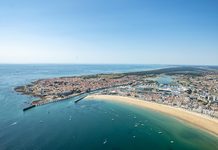
Las Palmas de Gran Canaria has almost 400,000 inhabitants and a surprising atmosphere A very modern, almost bustling city... But also a city that stretches out, Rio-style, along its Las Canteras beach. With, as you'd expect in such cases, especially in large Spanish cities, a wealth of bars and restaurants and, at one end, a remarkable conference centre designed by the famous Catalan architect Oscar Tusquets.
There's that, there's the port and there are also classical, neo-classical and even modernist buildings along the avenues and pedestrianised streets. But especially VeguetaIn other words, the historic centre, full of charm and clustered around its cathedral, which was first built in the early 16th century. The streets, squares, chapels, noble houses with elaborate wooden balconies, high whitewashed walls and municipal market are as clean as a whistle. Vegueta is also the district of museums, with, as its figurehead, Casa de ColonIn other words, the governor's house where Christopher Columbus stayed on his way to the unknown in 1492.
And what a house it is! Three successive gothic-renaissance patios paved with round pebbles, stone colonnades, a magisterial central well, potted plants and bright red and firecracker blue parrots roaming free, just like the ones Columbus brought back as gifts from the Americas to Isabella of Castile.
Above all, one of the rooms contains life-size reproduction of the interior and deck of La Niña, one of the navigator's three caravels repaired here due to damage during a final stopover before the long crossing. Light wood, wood and more wood. Deck, ropes, captain's cabin and bed, hieratic armchair for special occasions, chart table and shutters with mantelet... A child's dream, even if, on the face of it, several weeks confined to this with crew, provisions and live animals could not have been a sinecure.
The rest of the house is just as interesting, with rooms for an account of the Admiral's various voyagesOn the first floor, there is a rich collection of paintings and a presentation of the history of the Canary Islands in general and Las Palmas de Gran Canaria in particular, backed up by models. The museum can also be hired out for upmarket events, including cocktail parties and gala evenings.
Precisely, in this history of the island, we will open the veil of a a civilisation that is still relatively unknown and which flourished long before the arrival of the Spanish. There are gaps in the history of the area, and the culture of the people who lived there is even more mysterious. But if you want to know more, it's best to walk five minutes from the Casa de Colon to the Canario Museum, founded in 1879. Fabulous, fascinating and preserved in the style of the past, in other words with display cases that would not have been out of place in a 19th-century museum.e century. This adds a touch of old-fashioned charm to the place. On the other hand, this time in the midst of modernity, everything is ordered, museographed, classified and explained. These range from everyday objects - ceramics, polished stones, millstones and mortars - to displays of housing - round dry-stone huts - to skin clothing and old basketry. But the highlight is the gallery on the first floor, which features a gigantic collection of human skulls and mummies...


Who are these Guanches?What are the origins, origins, origins and origins of the Aboriginal peoples, a generic term used to describe all the groups occupying the archipelago before the arrival of Europeans? Where did they come from and why did they settle on these remote islands? How did they live and why did they disappear? We know some things, but we don't know everything, far from it. Starting with their origins, for which no definite proof has been found. However, linguistic elements, DNA analyses and pottery decoration bases tend to prove that they were probably nationals of north-west Africa, a Berber people who arrived around 2,000 years ago with animals and seeds for sowing.
How did this happen? We have no idea. We suspect it's by boat, but that's all. Why this migration? We have no idea either. All we know is that they spread out over the different islands of the archipelago and, incredible as it may seemThey never communicated with each other again, having lost the ability to navigate in the process. This did not prevent them from having a highly structured social organisation on all the islands, with a chief, nobility, plebs and religious rituals. They lived in their troglodyte houses, cultivating crops, rearing livestock and waging war between tribes until the arrival, at the turn of the XIV century, of the first European settlers.e The Spanish and Portuguese, who, according to their custom, exterminated them - not so easily after all - or reduced them to slavery. Few escaped.


Lost civilisation
Discovering the gigantic landscapes of Gran Canaria based on the tangible traces left by this lost civilisation can also be a great way to discover the island's cultural heritage. an excellent common thread of your stay. As long as, from time to time, you can break away from this somewhat simplistic framework by visiting a banana plantation here, tasting a magnificent Canarian rum there or testing an excellent coffee elsewhere, deep in a valley, the only one grown in the European Union. Let's go !
The tour begins at the Canarii site - the name given to the sub-group of Guanches who lived on Gran Canaria - of Cenobio de Valeron. First there are steps cut into the rock, then a sun-drenched path running for around fifteen minutes along the side of the mountain, a breathtaking view on mauve-coloured peaks and deep valleys, and along the way, two dragon trees, the totem trees of the whole of Macaronesia, i.e. the group of islands made up of the Canaries, the Azores, Madeira and Cape Verde. Suddenly, tucked away in a steep fold in the mountain, a gigantic cavity opens up, like a gaping maw open to the winds. Its walls are pierced like a Swiss cheese by countless alveoli, 200 in all, which were in fact granaries carved into the rock. And not, as legend has it, a convent of intrepid and very sporty nuns.
Why were they placed there? Because, once sealed with a stone, or even a door, these snacks were completely invisible from the foot of the mountain. Because daily life in pre-Hispanic times was no more the stuff of enchantment than anywhere else on the continent. Groups from the same island fought dryly, pillaged, coveted and beat each other with wooden weapons and carved stones. Or even sticks, the palo, which was wielded with such dexterity that it gave rise to a combat sport that is still practised today.
We know that the Guanches' diet consisted mainly of cereals, wheat or barley flour, and that this laid the foundations for the gofio, a very nourishing dish still used in the Canaries. So they knew pottery, which they made without a wheel, as some Berber craftsmen still do. Pots, pans, goblets, but also figurines with tiny heads, big arms and big thighs, one of which, that of the goddess Tara, has become famous the world over.
The village of Atalaya is now one of the most important pottery production centres on Gran Canaria, and it is here that Isabel Quintana Rodriguez welcomes visitors, gives demonstrations, shows them around her small museum, does business in her shop and, above all, organises traditional pottery workshops for groups of up to 40 people. The session continues with a visit to a troglodyte house transformed into an eco-museum, as this is how many of the island's inhabitants lived, some of them until the 1960s.
The surrounding fields rustle with the foliage of thousands of banana trees, a favourite plantation in this part of the north of the island, and winding roads lead to the charming villages of Santa Brigida and above all Teror, so misnamed because its whitewashed walls exude the charm of the island. a truly gentle way of life. The old people are in their place, on the benches in front of the church. The facades of the noble houses of the XVIIe and XVIIIe centuries are lined with the long wooden balconies typical of Canary architecture, bunches of acacia trees shade the pedestrian streets and souvenir shops slumber. But that's out of season, because in summer, sorry! Buses stand shoulder to shoulder in the car parks, and everything disappears under hordes of tourists who seriously spoil the atmosphere.


The calm before the apocalypse
White villages, tiny villages serenely clustered around their church, are found just about everywhere on the island. Fataga, for example. Enjoying peaceful days in an oasis dominated by black lava mountains. It's all there: the little church, of course, the steep streets, the low dry-stone houses, the sun-bleached tiled roofs, the white walls of the gardens bursting with bougainvillea and two or three bodegas at the centre of it all. That's all and that's a lot, but it's especially necessary before tackling the climb to one of Gran Canaria's legendary sites.
Canyons, veins of green, torn mounts, layers of black lava, desperate roads skirting vertiginous ravines, a plain of russet rock, an apocalyptic, almost hostile world. Fortunately, the blue of the sky is there, reassuring, convincing us once and for all that we are still very much on earth. Then, in a pine forest, comes a recessed car park, the starting point for a 45-minute ascent, on foot and hilly under a killer sun. All the way up, at an altitude of 1,810 m, you can see two gigantic monoliths planted here for what seems like eternity. One last effort, and the reward is there: a natural red ochre esplanade where two lonely sentinels take pride of place in the middle of a great nothing, one of which, Roque Nublo, is no less than 80 m high. It's simply sublime. There's an obvious mystery about the place, a touch of magic no doubt due to the souls left behind by the Guanches who worshipped here.
The view is obviously breathtaking.


Little Saint-Tropez
Then it's back down to the sea and the seaside resorts that have made the reputation of the island of eternal sunshineBut it also has a cut-and-dried image, due to the overuse of concrete mixers in the 70s and 80s. This still exists, of course, particularly in Puerto Rico, where architects should be condemned for their plastic cruelty. But let's move on. Let's head for the delightful port of Mogan and linger a while on its colourful quays. Pleasure boats, but fishing boats too, a glamour that feels more Mediterranean than Atlantic, white houses with balconies whose edges have been highlighted with touches of colour, and countless restaurants and cafés. At its most accessible, it's a little Saint-Tropez.
Not far away, around thirty kilometres, are Gran Canaria's two most famous seaside resorts, Maspalomas and Playa Del Ingles. They border a famous sea of sand; in fact, a nature reserve made up of dunes up to ten metres high, eight kilometres long and one kilometre deep. A true southern Morocco...
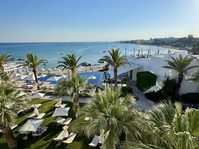
For their part, the two seaside resorts offer everything usually found in international resorts, with an obvious connotation of rainbow tourism in Playa del Ingles and a clearly more chic tourism in Maspalomas. The sea is blue and not too rough, the sun is out all year round, the quality of the hotels borders on excellence and the urbanisation is undeniably more controlled than elsewhere. In short, if you add the cultural aspect, you have all the ingredients for contemporary tourism. All just four hours from Paris by direct flight.
Special report - Gran Canaria: sunshine on a lost civilisation
- Gran Canaria: sunshine on a lost civilisation
Gran Canaria: practical guide
Interview with Ines Jimenez Martin, Director of the Gran Canaria Convention Bureau