

















Information updated on 15 July
- Like the conflict opposing United States to the China at the beginning of JuneAir links between France and the Middle Kingdom are going through a period of turbulence... Overall, the logic is the same: a problem of reciprocity that would not be respected by the Chinese authorities: " Air traffic between France and China is currently experiencing disruption due to the imbalance in services between French and Chinese airlines." says the French embassy, which advises travellers to " check regularly with the airline you have booked a seat with to make sure that your flight is being maintained, including on the day of departure. Some airlines market seats on unauthorised flights and only cancel these unauthorised flights at the last minute, even though they have known for several days that the flight cannot take place." .
- After MelbourneAs a result, other international hubs for business travel are again introducing restrictions and even confinement measures. Los Angeles is one of the areas affected by the new restrictions imposed by the Californian authorities. The hub of BangaloreIndia, has been under lockdown since 14 July, and neighbourhood lockdowns are coming into force in Tangiers, Bogotà and Manila.
- Since 8 June, the United Kingdom imposed a quarantine of fourteen days to all travellers, including those from the European Union, despite opposition from the "Quash Quarantine" movement, which brings together some 500 companies including British Airways, easyJet and Ryanair. This quarantine is no longer imposed on France since 10 July. The measure has also been lifted for other countries such as Italy, Germany and Spain.
- Since 1st Julythe European Union is once again accessible to a list of 14 countriesThe list, unveiled on Tuesday, includes Algeria, Australia, Canada, Georgia, Japan, Montenegro, Morocco, New Zealand, Rwanda, Serbia, South Korea, Thailand, Tunisia and Uruguay. Travellers from China will also be accepted as long as the principle of reciprocity is applied to European travellers. This list, which does not include top business destinations such as the United Statesthe RussiaIsrael or Brazil, needs to be updated every fortnight.
- The airport ofOrly reopened its doors on 26 June. After 13 weeks closedis Transavia which reopened the ball, with a first flight to Porto.
- From 7 Julybusiness travellers will once again be able to visit DubaiThis was made official by the local authorities on 21 June. Entry requirements include a negative Covid-19 test and appropriate health insurance.
- Rail companies are benefiting from the reopening of Europe's borders: Thalys is operating at 20% of capacity, but will be ramping up to 50% on 12 July. Lyria already provides 50% of its supply, and should reach 70% at the beginning of July. Eurostar is an exception, as the "fourteen weeks imposed by Great Britain is severely limiting demand. Eurostar therefore operates only one daily return service from London to Paris and Brussels.
READ ALSO: " Trains back on their feet in Europe"
- In his speech on 14 June, Emmanuel Macron presented the broad lines of the third phase of deconfinement. This saw the whole of mainland France reclassified as a "green zone", and has been accompanied by measures to open up the market since 15 June, particularly for European mobility. However, on the day after the 35th anniversary of the Schengen Agreement, the reopening is very relative depending on the country of departure and arrival. The United Kingdom, for example, is maintaining its "four-week period", as is Spain, where the opening will wait until 21 June. France - like Belgium - has opted for a Europe-wide opening, but applies the principle of reciprocity. Other governments are imposing tests on nationals of the most exposed countries, or limiting their access to neighbouring countries, as in Norway and Denmark. According to Emmanuel Macron, borders outside Europe should open up from 1 July, but here again access will vary widely from one country to another. To make things clearer for travellers, theEuropean Union has set up a dedicated websiteA map of the route, specifying travel options based on departure and arrival points.
READ ALSO: " Return to mobility with the second phase of deconfinement"
- Air France announced the 18 May the gradual resumption of flights between now and the end of June, focusing on the domestic network, Europe and the French overseas territories. The airline is counting on a flight schedule representing 15% of its usual capacity for this period, based on 75 devices. At the domesticsince Paris CDGAir France will connect Ajaccio, Bastia, Biarritz, Bordeaux, Brest, Calvi, Clermont-Ferrand, Figari, Marseille, Montpellier, Nice, Pau, Perpignan, Toulon and Toulouse. The airport of Lyon-Saint Exupéry will be linked to Biarritz, BordeauxBrest, Caen, Lille, NantesNice, Pau, Rennes, Strasbourg and Toulouse.
- Passengers on international flights arriving on theParis-CDG airport are now controlled by thermal cameras installed by the ADP Group in the baggage delivery area.
- L'Italy reopened its borders on 3 June.
- Since 18 May, Lyria operates a second daily return service between Paris and Geneva (departure from Paris at 2.18pm), plus a return trip from Paris to Basel.
- Emirates resumed operations at Paris the 22 Mayat the rate of three flights a week.
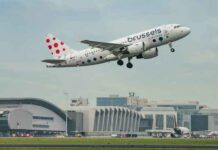
- Brussels Airlines has set a date of 15 June.
- These announcements are part of a a more general trend of increased activity in European skies. This momentum is still modest, but should amount to some 700,000 seats in the coming weeks.
- Le 13 MayThe European Commission has urged Member States to reopen borders within the EU, calling for a "gradual and coordinated" approach.
- L'Spain made official the entry into force of a " quatorzaine "since 15 May. This applies to anyone arriving from abroad (including from France), with a few exceptions. In particular, cross-border workers are spared this measure.
- In the wake of this, the France has decided to apply the same measurement to travellers arriving from Spain, " on a principle of reciprocity" .
- The other way round, IATA has come out against these quarantine measureswhich may well put the brakes on resumption of flight activity.
- At the same time, an agreement has been reached between the Francethe Switzerland, l'Germany and theAustriaFederal Councillor Keller-Sutter confirmed this at a press conference: " We are aiming for complete opening of the border on 15 June between Germany, Austria, France and Switzerland" she added.
- Le decontamination started in France on 11 May is accompanied by a host of health measures for the transport sector. Visit wearing a mask is compulsory, whether it involves taking a train (SNCF, Eurostar, ThalysLyria) or a flight Air France.
- La airline Since 11 May, it has also been operating a system of temperature control of passengers. If the infrared thermometer reads over 38 degrees, Air France reserves the right to deny boarding to the passenger concerned.