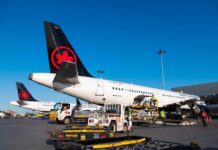













As part of the Connecting Europe Days "Five sustainable European flights converged at Lyon airport, where the EU event was taking place. These flights used innovative technologies, fuels and air navigation procedures to minimise their carbon emissions, demonstrating the EU's commitment to sustainable development. potential for transforming the environmental impact of the aeronautics industry. Flights - fromAmsterdamBarcelona, Bucharest, Frankfurt and Lisbon - were carried out within a framework of measures designed to reduce this impact. They showed what measures have been put in place to make air transport more sustainable.
Routes optimised for the environment
By taking advantage of the airspace normally reserved for the military and having more efficient approaches to airports, new routes have been created. These measures improved trajectories and descents in the airspace approaching Lyon. In this way, the five flights achieved a more optimal trajectory to minimise fuel consumption and therefore reduce emissions. These results were made possible by cooperation between Eurocontrol, the air navigation services of eleven countries and their respective national military authorities, in partnership with the Albatross project.
The airlines, including Air France, easyJet, KLM, Lufthansa, Transavia and Vueling, each applied an increase of 30 % in the use of biofuel on this total of ten flights from Lyon.. Such a result makes it possible to reduce CO2 emissions by 27 % per flight compared with using conventional fuel.
According to environmental experts, increased use of SAF is the most effective way of decarbonising aviation over the coming decadesThis will continue to be the case until newer technologies, such as hydrogen, become available. However, the major problem remains too little production and therefore very high prices for the acquisition of SAF. Incentives are needed to encourage production and close the price gap between SAF and conventional paraffin.
Carbon-neutral airport operations and infrastructure
This is what the VINCI Airports group, which manages Lyon airport, does. The airport is an exemplary part of the Group's environmental strategyHaving already achieved carbon neutrality with offsetting in 2017 under the Airport Carbon Accreditation scheme. Lyon is now on track to become the first commercial airport in France to achieve net zero CO2 emissions by 2026. Lyon has also been selected as pilot airport VINCI Airports to use hydrogen and welcome hydrogen-powered aircraft from 2023. The project is being carried out in partnership with Airbus and Air Liquide.
All these initiatives aim to achieving the EU's climate target of zero net carbon emissions by 2050. The European aeronautics industry is committed to this roadmap, but if today's exceptional measures are to be possible on a larger scale, it is calling for greater political support.
In the near future (around 2030), new technologies are set to arrive on the market. They must be fully supported by funding programmes at EU and Member State level to stimulate the development and deployment of new technologies and their procedures.
National governments must fully implement the Single European Sky. This means, for example, deploying measures such as cross-border free-flow airspace (allowing aircraft to freely plan a more direct route between defined entry and exit points). Or theflexible use of airspace (making it possible to switch from military to civilian use at short notice).
A single emissions trading and offsetting system will prevent carbon leakage and double counting of emissions.. It justifies the usefulness of an ambitious global measure, CORSIA (Carbon Offsetting and Reduction Scheme for International Aviation), set up by the ICAO.
CORSIA is market-based, across all sectors. It represents a comprehensive approach that moves away from a patchwork of national or regional regulatory initiatives. It offers a harmonised means of reducing emissions from international aviation, minimising market distortions, while respecting the specific circumstances and respective capabilities of ICAO Member States. At 1 January, 102 countries had announced their participation in this new measure.. Other countries are due to join CORSIA on 1 January 2023.
Air France-KLM as a model for more virtuous air transport

Air France-KLMwhich was taking part in Connecting Europe Days, also presented its Destination Sustainability" report. This programme highlights the airline group's ambitions in terms of corporate social responsibility (CSR). It is essentially based on the environment and the challenges posed by the climate emergency, as well as human beings.
In a context that remains unsettled, Air France-KLM intends to strengthen its commitment to more sustainable air transport. To this end, it is using a scientific approach and rigorous criteria validated by the independent benchmark organisation SBTi.
In addition to the commitment to achieve zero net CO2 emissions by 2050, Air France-KLM is aiming to reduce its emissions per passenger-km by 30 % compared with 2019.. The Group is also committed to use at least 10 % of SAF by 2030, well beyond the regulatory mandate envisaged under the "Refuel EU" initiative for flights departing from Europe.
Social and societal responsibility is the second pillar of the Destination Sustainability strategy. With over 71,000 employees, the Air France-KLM Group is a leading employer, determined to encourage an ever more inclusive culture and to fight against all forms of discrimination and inequality in the workplace. This commitment is best illustrated by the issue of gender equality. One third of the positions on the Group Executive Committee should be held by women, and women should account for 40 % of management positions by 2030..
" In 2021, the Air France-KLM group has been able to count on its 71,000 employees and their unfailing commitment. The report we are publishing today is the result of their actions and efforts to position our Group at the forefront of an industry that is reinventing itself. Our "Destination Sustainability" programme embodies our determination to position ourselves as a leader in sustainable aviation. "said Benjamin Smith, Chief Executive Officer of the Air France-KLM Group.