
















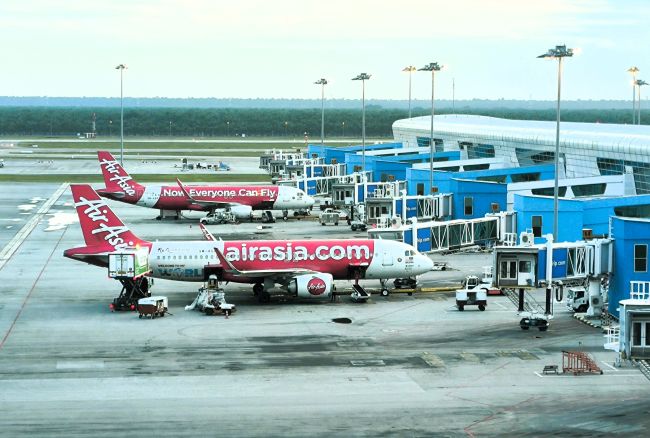
At what level can a price increase be considered moderate? For the low-cost airline AirAsia, the answer is simple: beyond 40%. Almost two weeks ago, Tony Fernandes, the boss of Capital A, AirAsia's parent company, indicated that the crisis in the Gulf and its corollary – the surge in oil prices – would translate into a moderate increase.
Quoted by the Malaysian news agency Bernama at a press conference on 30 March, the President of Capital A stated: "We will not cut flights as demand is good and we are doing our best to keep fares as low as possible [...] Our fares will have to go up, there is no doubt about it, but they will go up much less than others."
These two facts were denied barely a week later. The group announced that it was immediately increasing its fares by between 30% and 40% depending on the sector. The paraffin surcharge was also increased by 20%.
Cascading reductions on air frequencies
As for its routes, the carrier has cut back on domestic and regional routes from virtually every one of its markets. In Malaysia, the airline has reduced its domestic frequencies on 20 routes, in Indonesia on 12 routes, in the Philippines on 9 routes and in Thailand on 27 routes. This corresponds to capacity reductions of between 7% and 17% depending on the country. The airline has also reduced or cancelled routes from Thailand to China, India and Nepal; from Malaysia to China, India and Indonesia; and from the Philippines to Hong Kong and Tokyo-Narita, while Manila-Seoul has been cancelled.
Another decision still pending is that of establishing a hub in Bahrain to connect Europe and Africa with Asia. While the airline's management is maintaining for the moment the launch of a daily flight between London and Kuala Lumpur via BahrainHowever, as the situation remains unstable, the establishment of a base could be delayed or even cancelled.
Plan B" would be a base in Turkey, at Istanbul Sabiha Gökcen airport, in the Asian part of the city. The hub is the main base of Pegasus Airlines, which has been linked to Kuala Lumpur by AirAsia since last year. The group's management recently indicated that negotiations for a partnership were being held with "a major Turkish player in air transport".
Nevertheless, AirAsia remains the largest provider of flights in Asia. The airline serves over 160 destinations worldwide, 150 of which are in Asia alone.