












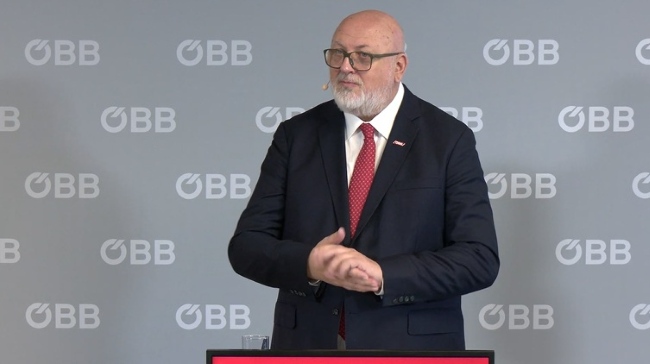
2025 was a mixed year for the Austrian Federal Railways (ÖBB), a year that the company's CEO, Andreas Matthä, described as a "chiaroscuro" year. On the bright side, the opening of the massive project of the Koralm Railway In the south of Austria, a new line with a tunnel has reduced the journey time between the cities of Graz and Klagenfurt – two regional capitals – to 41 minutes instead of the previous 1 hour 30 minutes. On the downside, the difficult economic context has weighed on freight activity, which has declined, while the rise in energy costs began to be felt last year, as stated by the CEO of ÖBB.
This "light and shade" report nevertheless illustrates the resilience of the Austrian railway group, which is continuing its transformation while maintaining an ambitious course in terms of investments and the energy transition.
Passenger traffic still on the rise
With 559 million passengers transported (+1.4 %), the company marks another year of growth. Long-distance traffic continues to advance, supported particularly by the commissioning of the new Koralmbahn line. This new connection, considered the true project of the century for ÖBB, is already attracting nearly 7,000 passengers per day. "It not only strengthens the tourist appeal of southern Austria but also key European routes," analyses Andreas Matthä.
"Given the difficult economic situation, we have achieved a respectable 2025 result. The continued increase in the number of travellers is particularly pleasing," stresses Andreas Matthä.
Operationally, punctuality stands at 94.1%, confirming Austria's position among Europe's top-performing rail networks. Regional lines also achieved a satisfactory punctuality rate of 95.8%. The only blemishes on the record: the regional network east of Vienna towards Hungary and Slovakia, whose regularity is affected by construction work. And, most significantly, international lines with Germany. "While our punctuality rate is around 80%/85%in the direction of our neighbour, it drops to 60 %/65 %as soon as we cross the border," describes the CEO of ÖBB.
Financially, the group remains profitable with a profit before tax of €68.1 million, down 40 % year-on-year. This decrease is mainly due to the economic climate and an exceptional impairment in freight. Passenger transport remains the main driver of profitability, with a profit of €228 million, partly driven by an exceptional effect related to infrastructure charges. Excluding this item, the profit stands at €102 million, a significant improvement.
2026 without major announcements
Despite these challenges, ÖBB is maintaining a high level of investment this year, continuing to develop major new infrastructure projects such as the Semmering Base Tunnel (scheduled for completion in 2030) and the very important Brenner Base Tunnel, which connects Austria and Italy (scheduled for completion around 2032). At the same time, the modernisation of the Vienna S-Bahn network and the deployment of the European ETCS signalling system aim to increase capacity and traffic flow.
On the rolling stock front, modernisation is accelerating with the arrival of 84 new Railjet, Nightjet and double-decker trains. However, there are no new line openings planned, nor any development on the night train front. The network will remain in its current state. And when asked about the potential return of the Paris-Vienna night train line – should operating conditions change with financial participation from France, Andreas Matthä dashed all hopes of a return for this line, which he admitted was very popular but also very loss-making.