




















In many people's minds, Beijing is still, despite everything, the city where Mao Zedong's portrait dominates the entrance to the Forbidden City, with his eyes fixed on Tiananmen Square... The simple fact that the central government of this rapidly expanding superpower is based there explains why, of the 2,000 French companies established in China, two thirds have a representative office in Beijing. And this despite the fact that its administrative and diplomatic role still exceeds its economic weight. On the surface at least... "The city is evolving in the shadow of Shanghai and Hong Kong, explains Vincent Perrin, Director of the Ubifrance office. It both benefits and suffers from its image as the capital of the world's second largest economy. However, we often tend to forget that it is also a major business city.

On the consumer front, although Shanghai remains China's luxury shopping paradise, Beijing seems to be opening up to the finer things in life. In fact, it's common knowledge that Beijingers, despite having much lower incomes than Shanghaiers, are much bigger spenders than the latter. High-end, glitzy living no longer seems to be the preserve of the inhabitants of its southern rival. Is it really by chance that Galeries Lafayette chose to set up its very first Asian store right in the heart of the Chinese capital? It will be recalled that some fifteen years ago, the Parisian department stores' had already attempted a breakthrough in China. But now, faced with a growing demand for quality products, this return was inevitable, with a store planned for 2013, occupying a total surface area of 50,000 m2 over five floors.
Consumer boom
 Is Beijing's strategic choice a sign of the times? Has the Chinese capital finally decided to shed its rigid and austere image? What is certain is that the city has real development potential. With a GDP of over 1,600 billion yuan (RMB) in 2011, or 193 billion euros, Beijing grew by 8.1 % compared with 2010. Its secondary sector, which accounts for 19% of GDP, generated nearly €37 billion in revenue, up 6.6 % on 2010. "We are seeing strong growth in the energy, construction and distribution sectors".the municipality officially notes. The pharmaceutical and telecommunications industries are also booming. But it is the tertiary sector, worth more than 110 billion euros, that is showing the most spectacular growth, with an increase of +8.6 % compared with 2010. "Basic services, particularly training and business start-ups, are up sharply".says the city council spokesman. In 2011, the tertiary sector was responsible for 83 % of Beijing's growth, compared with 15 % for the secondary sector and 2 % for the primary sector.
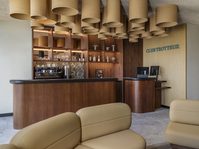
This explains why Beijing is currently undergoing what many are already calling a new-look bobo phase. Indeed, since 2008 and the Olympic Games, the city has literally been transformed, giving rise to a "gentrification" phenomenon. Art galleries, bohemian-chic cafés, designer hotels and designer boutiques are flourishing in certain districts, notably in the hutongs, the narrow streets lined with old houses with pagoda roofs. Houhai and Nanluoguxiang are good examples, as is 798 Space, a vast artistic zone set up on the site of disused factories in the Dashanzi district. Even more upmarket, the Sanlitun district, in particular The Village, where international brands rub shoulders with the most inventive Chinese fashion designers, is another example of the capital's new profile. "Consumers here are not quite the same as in Shanghai, but there is still a growing middle and upper class, points out Flore Coppin, representative of the French Chamber of Commerce in Beijing. In the 12 e five-year plan unveiled by the central government at the end of 2011, boosting consumption is one of the key points"..
The national strategy, based on modernising the pension, public health and social security systems, should make budgets more flexible and encourage households to spend more. "That's why Beijing is currently a great location for consumer goods and luxury companies".says Flore Coppin. All the same, there remains one imperative for foreign retailers: to adapt to the Chinese version of the internet. "By 2014, China is set to become the world's leading e-commerce market".says the representative of the French Chamber of Commerce. While censorship is no longer as much of a problem as it once was, what counts today is first and foremost creating an IP address in China, and then ensuring a good online delivery and payment system. For example, having a presence on the Weibo site, the Chinese equivalent of Facebook, has made it possible to initiate direct communication between consumers and businesses. It is even the sine qua non for the survival of a foreign brand in China. The way people consume in Beijing is changing.

The way we get around too. "The Olympic Games really transformed the city, in particular with the Bird's Nest and the Water Cube, emblematic monuments of the Olympic site, but also with major projects such as new metro lines, some of which are still under construction".adds Vincent Perrin. In 2015, the Beijing tramway should see the light of day, serving the "fragrant hills" to the west of the city. "Another positive result of the Olympic Games is the beautiful Central Business District. (Editor's note: a CBD for short, or business district) was such a success that Beijing chaired the last World CBD Congress".continues the Ubifrance director.
The promise of eco-business

Because of the problems of urban congestion, many secondary towns are currently being developed in the suburbs of Beijing, served by very efficient public transport. Tongzhou, for example, in the south-east. "The advantage of Beijing is that there is still a lot of potentially developable space, particularly in former military zones that have been left fallow".concludes Vincent Perrin. There is one imperative, however: these future developments will have to go green. "Because China's last five-year plan really emphasised environmental protection".explains Aymeric Novel, director of the Beijing branch of Terao, an environmental and green building design and consultancy firm. This French company has made a name for itself by participating in a number of Franco-Chinese cooperation projects on sustainable construction, notably in Beijing, Shanghai and Wuhan. "In services and ecology, the added value of Western companies remains high, while it is starting to decline in other formerly buoyant sectors".continues the director of Terao.
 Today, because its environmental problems are becoming worrying (lack of water, problematic urban planning, harsh climate, excessive traffic, desertification, etc.), but also because its economic growth is only exacerbating them, Beijing must react. "The capital and its region are becoming an interesting area where there is a real need for environmental know-how, even if this is true for many other regions of China".says Aymeric Novel, pointing out that demand from companies specialising in ecology is emerging in Beijing. "Demand is evolving rapidly, increasing from half-year to half-year".says the environmental specialist.
 Supposed to be the first city in China to encourage companies specialising in ecology by offering them subsidies, notably as part of China's green building certification scheme, Beijing still seems a little cautious. Despite this, the advantages of setting up in Beijing remain. In the 2011 five-year plan, the sustainable development and energy saving sector is the one where foreign investment is most encouraged, followed by innovation and new technologies, services, agri-food and food safety... "As a French company, our advantage has been that we were able to establish ourselves early enough - in 2008, when the market was still in its infancy - to raise our SME to the required level and take advantage of the Chinese market, continues Aymeric Novel. Because here we have an advantage because we are specialists".. An observation that could serve as both a viaticum and some very good advice.


