


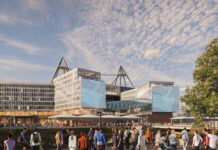











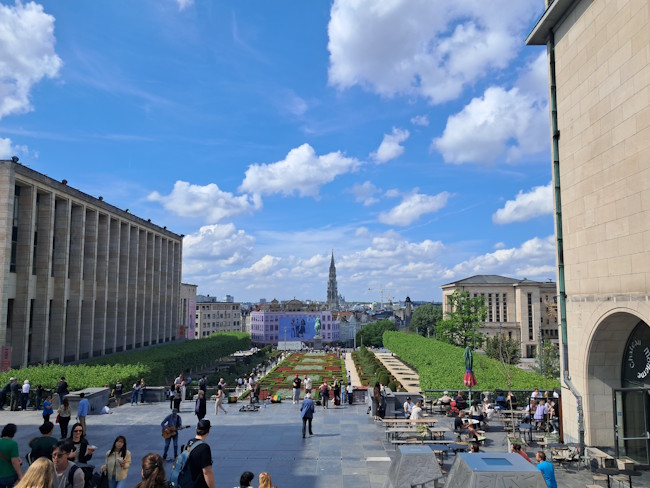
In Brussels, a new approach to professional events is emerging: Brussels Convention Street. This initiative aims to make the Mont des Arts a unified congress district by connecting the SQUARE convention centre with four emblematic institutions: BOZAR, KBR – Royal Library of Belgium, the Royal Museums of Fine Arts of Belgium, and the BELvue Museum. An update on this launch with Ariane Deguelle, Managing Director of SQUARE – Brussels Convention Centre, managed by GL Events.
Before going any further, for those who might not know Brussels very well, could you remind us what the Mont des Arts district represents?
Ariane Deguelle – This is a very beautiful area, its main advantage being its location right in the heart of Brussels. The Grand Place, the Royal Palace, the Royal Park, the Central Station: everything is just a few minutes' walk away. Another advantage is having 7,000 hotel rooms at the foot of the district. Each of the sites can be reached in less than a five-minute walk. Even at Disneyland Paris, it takes longer to get from one attraction to another! This proximity, this accessibility, make the offering different from what other destinations provide. And that's what's interesting: you're not in a large site outside the city, but right in the middle of the action. You become a "Bruxellois" when you come to our place.
Now that the introductions are done, can you go back to the genesis of this project?
A. D. - Each of the partner venues, some of which have existed almost since the Belgian Revolution in 1830, managed their activities separately. A non-profit association (Editor's note: the equivalent of a 'loi de 1901' association in France) had indeed existed since the 1980s, but it was essentially just a neighbourhood committee. Gradually, I realised that, without congress hosting being their main activity, these museums and cultural venues also had meeting spaces, auditoriums, and prestigious halls. It's a bit embarrassing to say, but since the reopening of the SQUARE – Brussels Convention Centre in 2010, we didn't really know our neighbours. Then in 2024, I proposed that we pool our halls and spaces.
And they opened their arms to me, and rightly so. It’s an experience to understand how public service companies work compared to a company like ours, GL Events, which is part of the private sector world. But the dialogue and this collaborative process went very well. We first took stock of the available spaces and their capacities, before defining how we would work together to get to the officialisation of this combination of venues today. Which we describe with the motto: "When the city becomes a single venue".
Was it customer demand that led you to come together?
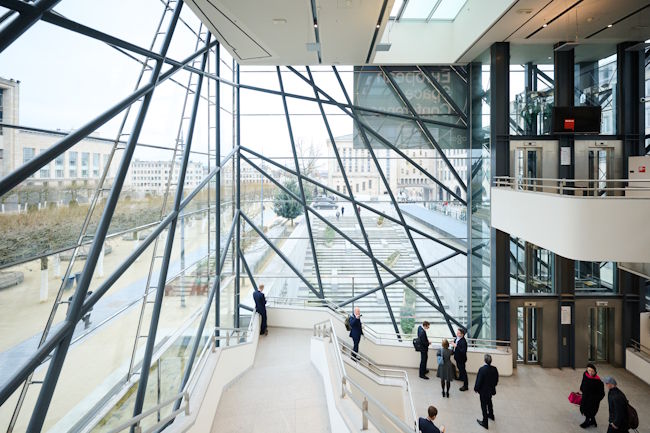
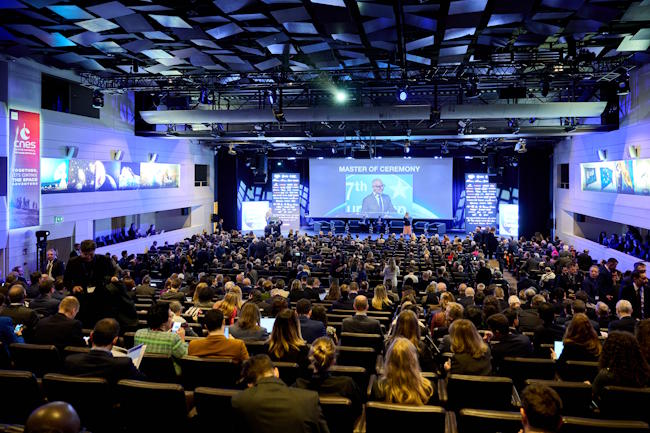
A. D. - No, we have done the opposite. Not having the capacity to host congresses of more than 3,000 participants, we excluded these requests. Now, we can aim for capacities of 5,000 participants, or even more. Together, we offer more than 25,000 m² of event space – compared to 13,000 m² at SQUARE – over 9,000 seats and 42 meeting rooms. In addition to this, in order to simplify organisers' lives, the objective of this project, led by SQUARE and Visit.Brussels, is to combine our commercial and operational strengths. They will no longer have to go from one body to another, but will have a single point of contact with a team that manages their event across the different sites. This is both a time and efficiency saving.
How will this "Brussels Convention Street" materialise?
A. D. - Leveraging our proximity, we can create dedicated traffic flow for groups using all our sites. With a physically marked path, event-specific signage, and in agreement with the authorities, fire services, and police, as we are using public space. This is why we've named this offering the "Brussels Convention Street". Imagine the congress is called the "Super Congress", then this Convention Street will be called the Super Street.
Can you describe to us, more concretely, what a two-day congress on all these sites would look like?
A. D. - The opening session would be held at BOZAR, which has the largest plenary hall, seating 2,200 people compared to 2,000 at SQUARE. Then, after a coffee break, participants would move to the three auditoriums at SQUARE and the one at the Royal Library of Belgium to begin their meeting sessions in groups and sub-groups. Catering services will be expanded at each venue. Therefore, at the end of these meetings, each group would remain at its location for the lunch break, before the afternoon working session.
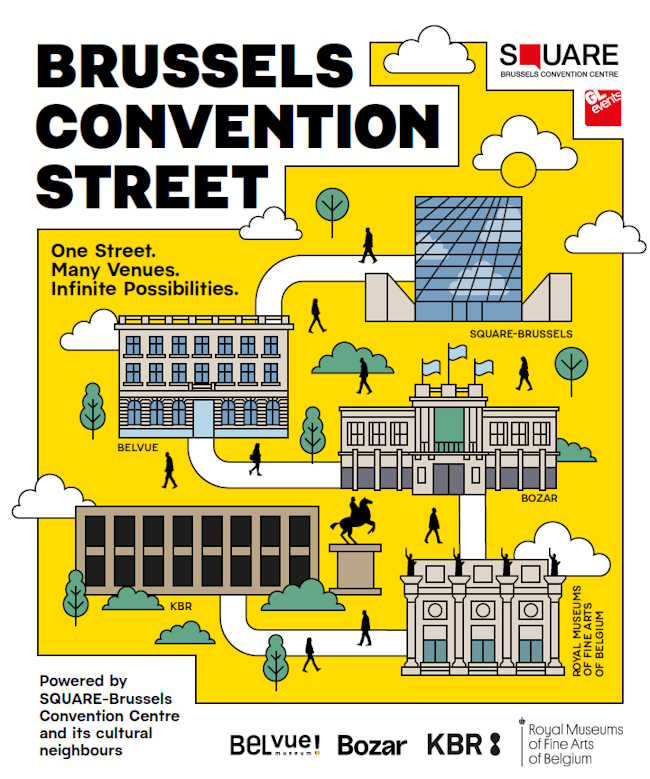
At 5 p.m., after a good day's work, we'll want to meet up and network. So, we'll head to the Royal Museums of Art and History of Belgium, which are open in the evening for the occasion, for a cocktail reception, interspersed with guided tours of their collections, for example the Magritte Museum. Afterwards, we'll continue with a show or musical or theatrical entertainment. Then, everyone will return to their hotel or go out to explore the nearby bars, and we'll start again the next day, finishing with a closing ceremony, probably at BOZAR.
What kind of clientele will you be able to reach with this new offer?
A. D. - Our aim is to attract scientific and medical conferences, as well as major corporate conventions, professional federations, and large public institutions. We are fortunate, in Brussels, to have the European Commission and all its Directorates-General, as well as being the host to the headquarters of nearly 2,200 international organisations. I will qualify this figure by saying that among these, there are certainly 600 that organise meetings and conferences annually. However, not all of them did so in Brussels, due in part to a lack of capacity. I hope now, particularly in light of carbon footprint reduction ambitions, that they will do us the favour of coming to meet here.
Is the MICE market in Brussels, in general, experiencing good momentum?
A. D. - It's not regressing, but it's not progressing either. We are currently in a period of great stability. But I hope we will contribute to its growth. Especially since the city has other ambitions and recently announced a very significant investment in transforming the Brussels Expo park, at Heysel, into a convention centre capable of hosting up to 20,000 participants. A huge, multi-year project. In this context, I would say that our project comes at the perfect time. There are many ideas in Brussels, but they need to be implemented. And our idea for Convention Street at Mont des Arts, we have implemented it. The Convention Bureau is very enthusiastic and is now eager to promote this project.
