











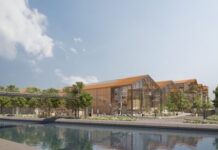







At the end of last year you announced the forthcoming opening of a Spaces coworking space at La Défense. Can you tell us more about this project?
Christophe Burckart - It will be both the France's largest coworking centre and one of the five largest in the worldand of course the biggest Spaces that we offer. This very important project, which we finalised at the end of last year with the owner of the AG2R La mondiale building and the developer Vinci, will open its doors in January 2019. To give a few figures, it will extend over 18,000 m² in a nine-storey tower with a rooftop - as this is increasingly in demand - and will offer a total of 1800 workstationsThese are complemented by a wide range of services, including three or four catering outlets in the business club on the ground floor, a restaurant and a bar. fitness rooms and wellness centres, a barber... We really liked the location, because it's a large building on a human scaleIt is extremely well served by public transport, but also from the boulevard circulaire, which is very much in demand at La Défense. But, above all, we are at a pivotal point between La Défense historically and extending the district beyond the Grande Arche with the U Arena, hotels, companies and, eventually, the future Grand Paris station. As the Arena is the flagship of this new area, we have associated ourselves with this development by name.
Who are the customers potentially interested in this new space?
C. B. - We will be targeting large groups who are looking for offices for their teams that are close to their head office, but with a more flexible model than traditional leases to meet their flexible needs. At the same time, our second clientele will obviously be the partners and subcontractors of these major groups who want to be closer to them, but can't take advantage of conventional leases because, in essence, their contracts are not as long, and may or may not be renewed. And finally, we're also looking at all the start-ups that work in the world of these major groups. Just as the new economy is based in the centre of Paris, fintechs want to stay in La Défense, because that's where everything happens. We're going to start marketing the space in February and some major groups have already expressed an interest. We know the market well, because we already have 1,500 workstations in our existing centres. So it's a logical next step in this business district.

Beyond this major opening, what is your development strategy in France?
C. B. - The development of our network in France is based on two objectives: the expansion of our network and the deployment of our brands. To our original offer, the Regus business centres, we have added Regus Express and Stop & Work in 2014, then Spaces in 2017. The next brand to be offered in 2018 is Signature, our Premium offer to be launched in Paris. It didn't yet exist in France, so we'll have a portfolio of brands to cover every need.
You talk about Signature as a "six-star" business centre. Can you describe this concept in more detail?
C. B. - It's very simple. The difference between a Signature and a traditional business centre is a bit like the difference between a palace and a good hotel. Someone who stays at the Ritz can come and work at Signature. We are pushing the concept of very, very high-level services with a level of quality that is also very high, including a concierge who can respond to all requests, but also large offices and an aesthetic in unison with mouldings on the ceiling and very high-quality furniture. Without going any further into the unveiling of this project, which will open its doors at the end of the first or beginning of the second quarter of 2018, I can say that the first Signature will be housed in a private mansion in the 8th arrondissement.
Someone who stays at the Ritz may well come to work for Signature.
While the arrival of this new brand will be a milestone for your group, what about your other brands in France?
C. B. - As I said, we're continuing to strengthen our network, because large groups expect to benefit from a presence just about everywhere in France. The number of Spaces and Regus that we hope to open or sign in 2018 is identical, i.e. around twenty venues for both of them. We also want to double the number of Stop & Work centres, with the priority being to continue building up the network in the Paris region, and in the inner and outer suburbs, in order to provide an alternative to working from home for teleworkers from large groups and local entrepreneurs. In the coming months, this subsidiary, which we have set up with Caisse des Dépôts and Orange, will be opening in Saint-Quentin en Yvelines and Montigny-Le-Bretonneux.
Is your Regus Express brand, which is particularly well suited to nomadic business locations such as stations and airports, also in the spotlight?
C. B. - Two new stations will be opened at Amiens and Lille Flandres, bringing the total to six. We are still discussing other projects with SNCF. This can take the form of Regus Express centres integrated into the company's frequent flyer lounges, such as those in Le Mans or Paris. Gare du Nord station in Pariswhich has been a real success, with 800 to 1,000 people attending every day. It can also involve new workplaces, not integrated into the lounges, but directly in the stations, as is the case in Nancy or Bordeaux. The Regus Express concept could fit in perfectly with the SNCF's plans to renovate major stations. Other possibilities also exist in smaller stations, notably those planned for the Greater Paris area.

When we talk about mobility and frequent travellers, airports also come to mind. Do you have any plans for airports?
C. B. - We want to develop in this direction, but it's not yet complete. The financial equation is more difficult to find in airports, where operators give priority to retail outlets, which generate a huge amount of revenue. There are no formal discussions underway at the moment, but it could happen one day. We think that airports, like stations, are going to try to offer travellers more places to live and work, and could call on people like us to do this.
In view of your ambitions in France, would you say that the current attraction for everything to do with coworking and teleworking puts a new light on the more traditional business centres that Regus has developed around the world?
C. B. - It's true that there's a lot of buzz about flexible workplaces. The concept is much better known today than it was ten years ago. The market has accelerated and takes different forms for different users. The whole new economy is turning to Spaces, but key accounts also want greater flexibility when it comes to real estate and are asking us to stay with more traditional spaces, with larger private areas. This supports the development of the Regus brand.
So the future looks more than bright for your sector...
C. B. - Although we currently offer around a hundred venues in France, we believe that the potential is around 1,000 to 2,000 locations in France. Take the UK, which has a much smaller population than France, and they have four times as many centres as we do. Even though we have the largest network in France, with a presence in 47 towns and cities, we still have very strong potential. If you take Lille for example, we're going to go from one to seven centres in the space of three years. In the Ile-de-France region, we have 60 workplaces, but our presence is still relatively weak to the east of the capital. So our ambition is both to expand our presence in the towns where we are already established, and to add new ones like Schiltigheim at the end of last year. This dynamic is the same throughout the world. 2017 was a record year, with 71 % growth in project signatures compared with 2016. While we foresee 1,000 to 2,000 centres in France, our managers estimate a potential of 20,000 worldwide, compared with 3,200 today. This will enable us to offer mobile travellers a very broad range of services, because when you are a customer of one of our centres, you have access to our entire network.