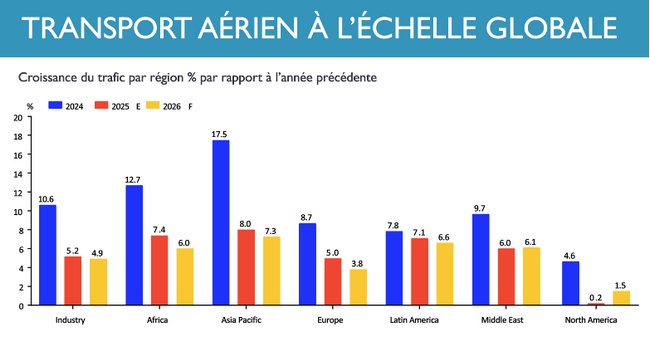
A good year in 2025, but plenty of "buts". Pascal de Izaguirre, President of the Fédération Nationale de l'Aviation et de ses Métiers (FNAM), gave a contrasting assessment of the air transport sector at the presentation of its new year's greetings. On the positive side, the sector recorded " impressive figures "With five billion passengers worldwide and sales of more than 10 billion dollars, this year's growth is set to continue. The momentum is there, and should continue this year, with further growth of +4.91TP3Q. On the front, "long-term growth will be neither European nor American" warned the FNAM Chairman, with both Europe and North America at the bottom of the growth forecast between now and 2043, partly because of the maturity of these markets.
Similarly, on a positive note for European and French air transport, 2025 marked the definitive end of the Covid period, with almost as many flights last year as in 2019, and for France, a total of 183 million passengers, i.e. 1.9% more than the year before the pandemic. And this despite the fact that the sector has seen its activity disrupted by global geopolitical instability, with overflight bans and airspace closures. However, and this is the big "but", this growth in France is more than two points lower than that for Europe as a whole, with just +2.8% compared with +5% for the continent as a whole. Even more worryingly, this summer, supply in France fell from fourth place in Europe to sixth.
Plunge in domestic flights
Several trends are confirmed, with a collapse in domestic traffic of -21% below that of 2019. On the radial routes, traffic levels are even equivalent to those of 1983, while cross-border traffic is struggling to reach 2015 levels. In the end, only the French Overseas Departments and Territories held up well, with growth of +3%. While international traffic now accounts for 85% of French traffic and has recorded growth of 7.3% compared with 2019, this reality confirms that " French traffic is increasingly international, less European and less domestic." said Pascal de Izaguirre.
However, it is not just French airlines that are responsible for the weaker growth in the French air transport sector. " For the first time in 2025, the foreign flag grew less quickly than the French flagsays Pascal de Izaguirre. Not because of the dynamism of the French flag, but because foreign airlines have preferred to shift their capacity to other markets that are less fiscally penalised. ".
The FNAM is not shy about pointing the finger at the culprit, as it has regularly warned the public authorities: taxation, with an additional €1.33 billion in taxes by 2025, is undermining the competitiveness of French air transport. While ticket prices have risen by only 1%, the impact of the tax increase is estimated at 2%, with airlines having absorbed part of the increase without passing it on in full to passengers.
French flag in decline
This may explain why the French flag's market share is in sharp decline, carrying only 29% of passengers between France and the European Union, and only 16% on France-Middle East routes. At the same time, French business aviation is undergoing a veritable " destruction" According to Pascal de Izaguirre, in a growing market: " French business aviation traffic was down 20% in the third quarter of 2025 compared with the previous year. Today, 90% of business aviation traffic to France is carried by foreign operators."
With the presidential elections looming in 2027, the FNAM intends to " going to see the candidates and their teams to raise awareness and advocate a national strategy for air transport. " Before that, Pascal de Izaguirre is already satisfied with having " obtained a relative stabilisation of taxation in the 2026 Finance Bill "seeing it as a sign that our arguments are beginning to bear fruit" This is particularly true of other European countries such as Sweden and Germany, which have reduced their aviation taxes.
However, this key issue is not the only factor causing disruption for the airline industry, which is also facing major supply constraints - and, by snowball effect, tensions on the second-hand market, which could weigh on future growth. " We are faced with insufficient aircraft production and delivery capacity on the part of aircraft manufacturers." warns the FNAM Chairman, pointing out that Airbus has delivered only 793 aircraft in 2025, compared with 863 in 2019.
Another cause for concern is that the operational performance of French air navigation services has continued to deteriorate in 2025, with 6.4 million minutes of delay recorded from January to October - the Aix-Marseille control centre accounting for a large proportion of this - i.e. 50% more than in 2024 at an estimated cost of 843 million euros.

Compromised objectives for FAS
While 2026 will be a particularly busy year at European level, with the publication by the Commission of its strategy for aviation and the conclusion of discussions on the revision of the regulation on passenger rights, the introduction of the Exit Entry System (EES) for non-European passengers is also perplexing. Expected to come into force on 10 April, this European-style ESTA will be introduced at a time when the system of check-in kiosks is not yet fully operational in France and other European countries. Although exemptions will be possible until the end of the summer, the FNAM believes that further exemptions may be necessary to ensure that border crossings run smoothly.
There remains the question of decarbonisation of the air transport sector, which is still of great concern to industry players. While it should be possible to meet the quotas for the incorporation of sustainable fuels (SAF) required in 2025 and 2030, i.e. 2% then 6%, Pascal de Izaguirre makes no secret of his concerns for 2035: " Today, I don't see how we can achieve 20% ". In particular with these sub-quotas imposing 1.2% of e-SAF in 2030 and 5% in 2035, while "qhe first outline of an e-SAF sector or production process has not yet been drawn up" . The President of the FNAM called for a " earmarking part of the environmental taxes we pay to support our efforts to reduce carbon emissions" citing the example of maritime transport, which has obtained this redistribution.