














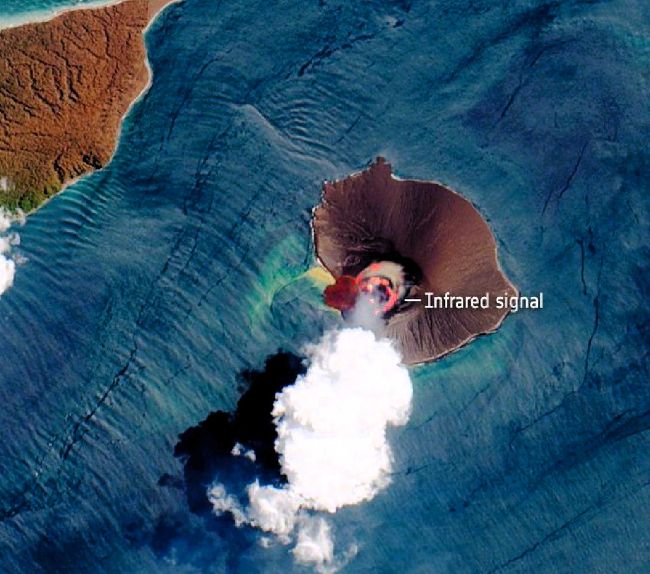
The eruption of the Anak Krakatau volcano has been disrupting air traffic in Indonesia since Sunday 6 September. Admittedly, the volcano's activity ceased on Sunday evening. Nevertheless, the release of lava into the atmosphere forced authorities to temporarily suspend traffic at seven airports in the region on Monday 7 September.
According to the latest estimates from the Ministry of Transport, this resulted in 3,000 cancelled flights, including more than a hundred international routes, and some 340,000 passengers stranded in airports across the entire country. This is not to mention travellers stuck abroad at major transit airports such as Singapore or Dubai.
The worst was the suspension of flights at Jakarta Soekarno-Hatta International Airport, the country's main point of entry. There has also been the closure of the domestic airport in Bandung, the capital of West Java – a city of 2.5 million inhabitants – as well as an airport in southern Sumatra.
Three diversion airports
In the face of these disruptions, the government has prepared three alternative airports in order to maintain air links as much as possible. However, these are of relatively little use for international routes coming from the western hemisphere, as flying over Sumatra and the western part of Java is practically a route with no alternative.
Nevertheless, Transport Minister Dudy Purwagandhi has designated Kertajati in West Java as well as the airports of Semarang (Central Java) and Surabaya (East Java) as alternative hubs.
Airlines are authorised to divert their flights there, subject to operational and safety conditions. In particular, these facilities must make it possible to maintain domestic connections from the other islands as well as certain international connections, notably for passengers travelling to Jakarta.
The authorities have furthermore announced a full refund for passengers whose flights were cancelled due to airport closures linked to volcanic ash.
Finally, airport traffic resumed this Tuesday morning, 8 September. Particularly at the very important airport of Jakarta. Nevertheless, the Ministry estimates that the recovery will take time due to inspections on aircraft affected by the volcanic ash. And it recommends continuing to check with each airline, as the volcano remains active. And could once again affect air traffic in the country.
Updated on 08/09/2026 at 13:00.