


















According to the consultant OAGThe week of 13 December saw a slight increase in air capacity. It rose by 3.8 1TP3Q week-on-week to 81.4 million registered seats.. Compared to 2019, the capacities expressed in seats remain, however of 26.2%.
OAG notes that the Omicron variant does not, however, appear to have damaged airlines' short-term capacity. Demand remains strong, particularly in the run-up to the festive season. However, OAG is wondering about the impact of Omicron on demand in the medium term.
The first quarter of the year is generally the low point in aviation activity. OAG notes, however, that the planned aviation capacity for the first quarter of 2022 is currently 1.149 billion seats. This represents a slight drop of 8 million seats compared with the last quarter of 2021. The consultant notes a major dichotomy between the perception of the airline industry and that of political circles.
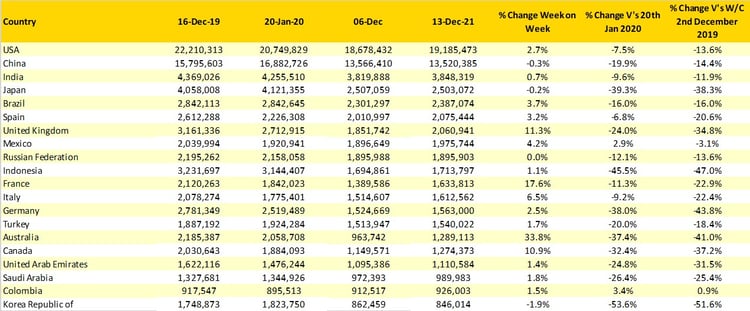
Regionally, theNorth America returns to growth with many major airlines increasing their domestic capacity. From one week to the next, the United States recorded an increase in seat capacity of 2.7%, lCanada by nearly 11 %. Mexico is the only exception, with a slight fall in capacity of 3.1% compared with December 2019.
Europe holding up well
Europe is also experiencing significant levels of capacity increases week after week as the ski season gets underway. Many markets have expressed their intention to remain open this year. However, capacity in Europe is still 28% lower than in the week of 16 December 2019.. France outperforms the European average with a 22.9% reduction in capacity. In fact, from one week to the next (6 December compared with 13 December), it recorded an increase in head office of 17.6%, the highest growth rate in Europe according to OAG.
In any case, France is 20 points ahead of Germany, whose seat capacity is still 43.8% lower than it was in December 2019.
The United Kingdom, for its part, posted a week-on-week increase of 11%. Even so, these seat capacities are still more than a third lower than at the end of 2019.
Asia generally lagging behind
South-East Asia continues to suffer more than elsewhere with air capacity down by 59%. By contrast, the Indian sub-continent is recovering. Capacity in this part of the world - supported in particular by Indian domestic demand - was down by 13% compared with 2019.
OAG also sees a recovery in the Pacificparticularly in New Zealand. The consultant notes an increase in weekday capacity of 72 %. Its Australian neighbour recorded a capacity increase of more than 33 %. Here again, we are talking exclusively about domestic capacity.
L'North Africa has seen airline capacity increase by 25 % from one week to the next, proving that airlines and authorities are better than politicians at assessing passenger demand on the African continent.
According to OAG, it is clear that over the last few months, the aviation sector as a whole confirmed its recovery. And rather than stopping or being overwhelmed by the new difficulties linked to Covid, the airlines seem to be working on solutions to continue and even amplify this recovery. In the consultant's view, the airlines are thus demonstrating considerable optimism.
Which suggests that 2022 will not be as hopeless as all that. Proof of this is the growing number of announcements of route reopenings by the world's major carriers.