












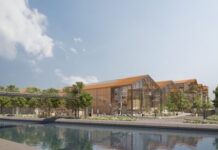







"City is the body which, like Epad at La Défense, will manage the operation of the new business district and its economic activities", explains its very young vice-president, Dmitri Grandkin. The aim is to turn this site, which is still under construction, into a high-flying business district within the next three to five years. Created in 1992 to attract investors to Moscow, City quickly realised that it would have to be a large-scale project. It was impossible to envisage a site in the historic centre of Moscow," explains Dmitri Grandkin, "because not only was there a shortage of class A offices, but we wanted to develop a place where everything was accessible by cluster1, without having to travel halfway across the city to meet your contacts." A crucial point in Moscow, where nothing is on a human scale, starting with the oversized metro... and continuing with the nightmare of unmetered taxis.
The location, 4 kilometres west of Red Square, along the Moskva River, quickly became obvious: 60 hectares of former stone quarries, disused factories and industrial wastelands just waiting to be converted. "It was really the only space left in Moscow to accommodate a project of this scale", continues the vice-president. Today, companies such as IBM, General Electric, Renaissance Capital, Citigroup, Hyundai and General Motors are flocking here as and when the offices open. The prestige of this future business district is also due to an important political decision: City Hall and the Duma will soon have their four 300-metre towers here. This, incidentally, will allow the hundreds of small administrations scattered across the capital to finally be centralised.
But projects take a long, long time to see the light of day. "First we had to reconsider all the infrastructure in the surrounding area," says Dmitri Grandkin. In all, 10 billion dollars will have been used, among other things, to open two new metro stations, Delovoy Tcentr and Mezhdunarodnaya. Not to mention the other $10 billion spent on construction. Then came the crisis. Some projects were abandoned, most were simply delayed. For a long time, there was talk of a Norman Foster tower... now there's less talk. "Today, 18 % on the site are operational, but we're aiming for 39 % by the end of 2010," says the vice-president. Ultimately, 4.5 million m2 of space (including 2.5 million of offices) should accommodate 300,000 employees and a few thousand residents.
Green movement and top-of-the-range service
Residential space, then, but also schools, such as Skolkovo, a famous Russian business school that is taking a very close interest in Moscow City, and a vast 200,000 m2 shopping centre planned for the end of the year. This desire to optimise possibilities (work, shopping, relaxation, housing, administration, parks, etc.) and limit the use of vehicles is perfectly in line with the current green trend, as is the presence of a serious hotel infrastructure. A Sofitel and a Novotel are due to open in 2012. But make no mistake. The first hotel group to bet on Moscow City is not French. It's American. Moscow City will be the new face of Moscow," explains Jaco Leroux, manager of the Grand Hyatt Moscow Residences & Spa. "It will be the Canary Wharf of Russia, but in a very, very upmarket version. So, despite the economic ups and downs, the Hyatt's plans have been maintained, albeit in a slightly altered form. "The original boutique hotel was transformed into 18 luxury flats with hotel services on the 49th and 50th floors of the 62-storey West Tower," explains Jaco Leroux. The conversion has been a success, as the apartments have been fully booked since they opened a year ago. "We thought we were attracting a clientele of expatriates, but it's the wealthy Russians who are most keen on these top-of-the-range products.
 This very first residence operated by an international five-star hotel chain has created a very real and, above all, very specific demand. Examples of what makes it such a success are the back doors in the lobby that conceal waiting rooms for bodyguards and private chauffeurs... and the highly sophisticated home automation systems in the flats, as well as the opulence of the welcome products by Chopard. So hopes of opening a 368-room hotel in the east tower are gradually reviving. "It's just a matter of time," says Jaco Leroux, adding that at 93 storeys, it will be the tallest hotel in Europe. Meeting rooms and a restaurant are already planned for the 92nd floor, and a nightclub and bar for the 93rd. The two towers are to be linked by a footbridge that will provide access to the sublime spa on the 60th and 61st floors in the west tower, due to open before the end of 2010. There will also be a 700 m2 Franco-Japanese restaurant on the 62nd floor, with a 360-degree view over the whole of Moscow.
Moscow's next 'place to be
And there's more to the restaurant than just the food: a real birch forest, a stylised portrait of Ivan the Terrible of superhuman proportions, chandeliers in an Eastern Russian style, a lounge dedicated to Peter the Great, a library with a fireplace, and a private lounge overlooking the swimming pool.
In short, a place that will be Moscow's next 'place to be'. "Our two Federation Towers will be the icons of Moscow City", concludes Jaco Leroux. Icons worth 1.2 billion dollars. It seems that the 21st century version of business Russia no longer has anything to envy to that of the Tsars.

