




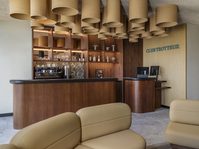
















Guarded by two lions reflecting the Asian roots of the restaurant, it is an endless terrace, covered by a light metal structure, that lines the Avenue Kléber and welcomes guests to Peninsula Paris. It is undoubtedly one of the most beautiful terraces in the capital to enjoy a drink on a fine day. For its first arrival in Europe, and its 10th establishment worldwide, the Hong Kong and Shanghai Hotels group, founded in 1866 by the Kadoorie family, is immediately following in the footsteps of Parisian hotel legends such as the Ritz, Crillon and Plaza Athénée, whose rival the Peninsula will be once these 'grandes dames' have completed their facelift.
Its opening on 1er The opening of a new building next August, in place of the former Majestic Hotel, marks the end of a hiatus of almost 80 years. But the essence of the place where Gershwin composed An American in Paris remains intact. The Peninsula Paris seems to be taking up the story where it left off, when the luxury palace ceased its hospital career in 1936 to become part of the French Ministry of Defence, before being requisitioned by the Germans during the Occupation and then transformed into a conference centre for the Ministry of Foreign Affairs. It was here that the agreements ending the Vietnam War were negotiated in 1973.

And so the story continues, still written in a timelessly chic style, underlined by an ultra-exclusive art of service. And, as the 21st century demands, with a touch of high technology. "The best of the old and the new", as Nicolas Beliard, the general manager, described the establishment when it was presented to the press. On the old side, the building, built in 1908 in the Second Empire style, has been restored to its original splendour after four years of work, thanks to almost 900 workers, gilders, stuccoers and cabinet makers, all used to restoring the galleries of Versailles and the Louvre.

The two entrances - the one on Avenue des Portugais, where residents are welcomed, and the other on Avenue Kléber, which opens onto the city and leads to the Lobby, a large dining room where guests can enjoy international cuisine and the creations of pastry chef Julien Alvarez - combine the timeless features of Parisian chic, with high ceilings, marble, mouldings and majestic chandeliers. In this setting, the hotel reception adds a contemporary touch to the surrounding classicism with a suspension made up of 800 'dancing leaves' in crystal, a nod to the plane trees that line the Avenue Kléber. Hand-blown by a master glassmaker, they come from the Lasvit workshops in the Czech Republic.

On the modern side, contemporary art is on display here and there, including works by Catalan sculptor Xavier Corbero and Ben Jakober. But in this almost timeless setting, the rooms are in direct contact with the present, as evidenced by the huge flat screens - which can be hidden behind panels - and an interactive tablet that controls all the room's functions and services. Business travellers also benefit from a real desk with a WiFi scanner printer; wireless internet is included in the room rate, as are video on demand and international calls.

In creamy grey tones contrasted by dark lacquer elements, the 200 rooms and suites all have the same sober, couture elegance, designed by Henry Leung of the Chhada Siembieda & Leung agency. The 166 classic rooms, ranging in size from 35 to 65 m², feature a king-size bed, a large dressing room and black and white marble bathrooms. Among the 34 suites, all with a lounge and guest toilet, five benefit from a private roof garden, offering spectacular views over Paris.
Outside guests can enjoy views of the Eiffel Tower and Montmartre from the gourmet cuisine of the French restaurant l'Oiseau Blanc, headed by executive chef Jean-Edern Hurstel . Located on the 6e On the first floor, its name is a tribute to Nungesser and Coli's attempt to cross the Atlantic, and visitors are greeted by a replica of the plane, before being led under a forty-seater glass roof opening onto the roofs of Paris. In summer, this extends to a terrace bar.

Chinese cuisine is also in the spotlight at Peninsula LiLi, run by Hong Kong chef Chi Keung Tang, who previously won a Michelin star at Peninsula Tokyo. In addition to the forty-cover dining room with its Chinese opera-inspired décor, there are alcoves for two or four people where you can enjoy dim sum and other Cantonese specialities in complete privacy. Groups can also gather in a modular room seating ten or twenty.
While a large proportion of the clientele is expected to be leisure travellers and, on the business side, senior executives or diplomatic delegations, the hotel offers three meeting rooms for 10 to 40 people for very upmarket executive committees and a lounge, the Salon de l'Etoile. With its state-of-the-art technology hidden from view, this room can accommodate around a hundred participants for very upmarket meetings.
There is also an ESPA spa, with eight treatment rooms open to Parisian customers. However, the 20-metre swimming pool in the basement is reserved for hotel guests. The same goes for the Cigar Lounge, a space dedicated to hotel guests, with a personal locker where they can leave their cigars and smoke their dreams away. All the while subconsciously hoping that they won't have to borrow the Rolls Royce Phantom, Peninsula's iconic and glamorous service, to take them back to the airport...

