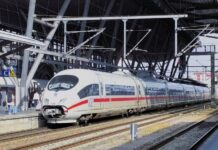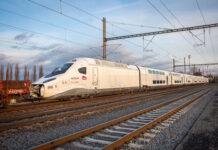


















For a long time a monopoly, Deutsche Bahn has been facing competition for more than a decade now, a competition that for the time being has not yet manifested itself. than on regional lines. With one striking result: Deutsche Bahn's (DB) share is shrinking year on year. Admittedly, Germany's national rail carrier remains number 1, with a market share of more than 65% in terms of passenger kilometres (95 billion in 2016). But it is now up against some 300 passenger rail operators. Nearly 35% of regional lines are in the hands of private operators such as Abellio, Jeolis & Co, Go Ahead and National Express. Abellio is a subsidiary of Dutch railways NS, Keolis is the German subsidiary of SNCF, while National Express and Go Ahead are British and listed on the stock exchange.
According to rail industry experts, the share of private transport in regional rail traffic should reach 40% by 2020. All the more so as most of the new lines created are now entrusted to private operators. New entrants are generally selected by the Länder - the equivalent of regions - which receive 8.2 billion euros from the Federal Government for public transport policies. For several years now, the Länder have tended to select private operators, who are generally more efficient in terms of cost management.
The contracts between the Länder and the rail operator may concern an entire regional network (urban or supra-urban) or individual lines. This is the case, for example, in Lower Saxony, where trains are operated by the Metronom rail group, a private company set up by the public transport networks of Lower Saxony and Bremen. Metronom serves lines as important as Bremen-HamburgHamburg-Hanover and Hanover-Brunswick. In North Rhine-Westphalia, the British National Express GmbH serves routes linking Cologne to Wuppertal, Münster and Bonn.
The positive effect of this multiplication of players is that the quality of journeys has improved, with Deutsche Bahn and its private competitors introducing new trains offering electric sockets at the seats, toilets and luggage compartments. However, passengers are desperately waiting for effects on tariffs. No real reduction has been seen, especially as fares are compatible between the different operators. Fares were even raised in December 2017, following Deutsche Bahn's 0.9% price increase.
While competition exists on regional routes, it has not yet been able to develop. to take shape in broad terms. DB only faces competition on two lines, as most attempts by private operators have failed. Among these, the Interconnex line linking Leipzig to Rostock via Berlin, launched by Veolia in 2002, closed in 2014. The reasons for this abandonment: on the one hand, no passengersThis was mainly due to the high rail tolls (1700 euros per journey) it had to pay DB for using the network.
Flixbus enters the rail sector
For its part, the HKX Hamburg-Köln-Express line, running between Hamburg and Cologne, ceased service at the start of the year, but has just been taken over by... Flixbus, a German start-up created five years ago and now Europe's leading long-distance coach operator. Since 24 March, Flixtrain trains run between Hamburg-Düsseldorf and Cologne every day except Wednesday. In mid-April, Flixtrain will inaugurate a second line between Berlin and Stuttgart via Frankfurt, a section previously operated by Locomore, an operator which has gone bankrupt. This link will operate five days a week - there will be no convoys on Tuesdays or Wednesdays in either direction - but the service will become daily during the summer, with the possibility of a second daily train before the end of the year.
The introductory fare is set at €9.99, with trains running at the same speed as the ICE, DB's high-speed train. "We are already thinking about other rail routes for 2019 and our managers are working on their planning. "says Martin Mangiapia, communications manager for Flixbus. The company could then offer four to five major routes.
A decade after the privatisation of rail transport, competition seems to have finally arrived. a positive effect for passengers. The SNCF, which seems to be panicking in the face of competition, can still sleep soundly: it will be a few years before the competition is severely felt in France.