

















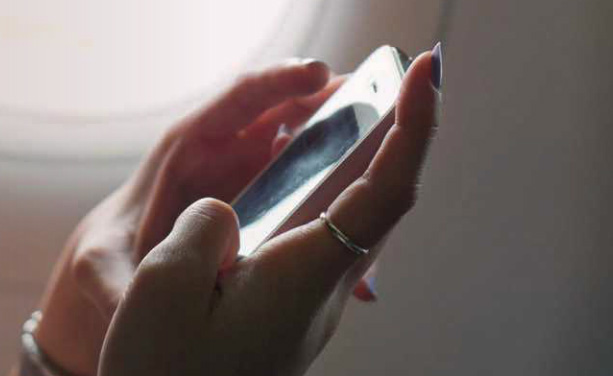
A key ally of mobility, WiFi has rapidly become essential in all public places, in hotels and more recently in stations and airports. However, its use in air travel is still limited. At least in Europe, but not in the United States, where in 2008 GoGo equipped a Virgin America aircraft with a wireless Internet connection. Basing its technology on the terrestrial telephone network, this forerunner was quickly able to cover the whole of the US by directing its antennae not towards the ground, but towards the sky, winning over a number of carriers across the Atlantic. GoGo now has nearly 2,000 WiFi-equipped aircraft on board. The drawback of this method of communication is that it cannot work on transcontinental routes. As a result, Aeromobile, a Panasonic subsidiary, and On Air, a joint venture between aircraft manufacturer Airbus and aeronautical solutions provider SITA, have turned their attention to the subject, this time creating offers based on satellite links, the solutions favoured by many major non-American carriers.
Still in the test phase
According to RouteHappy, 52 airlines now offer WiFi on a greater or lesser number of aircraft. Lufthansa has equipped most of its long-haul flights with the FlyConnect service. At British Airways and Air France-KLM, WiFi is still being tested on board a few long-haul aircraft. Last year, the French airline also launched a pilot phase with Orange for its short- and medium-haul services. Other developments have taken place recently. Since March, Japan Airlines has extended its JAL Sky Wi-Fi service on its long-haul B787 and 767 aircraft flying to Europe and North America, while SriLankan offers WiFi on board its brand new A330. "Providing internet and mobile connectivity is a very important part of our new offering in an extremely competitive market."explains G. T. Jeyaseelan, the airline's Marketing Director. Some low-cost carriers have made the same observation. According to Reuters, Ryanair is due to start offering WiFi on its busiest business routes and Vueling, in partnership with Telefonica, is testing WiFi on four of its A320s.
This service is eagerly awaited, according to Honeywell's survey of American, British and Singaporean travellers. More than three quarters of them want wireless Internet access to be available on all flights, whether domestic or international. Most are even prepared to trade an acquired advantage - a wider seat, a drink or the chance to go to the toilet! - for the guaranteed presence of an in-flight Internet connection.
Connected but frustrated
Unfortunately, while the demand is there, the infantry does not always follow. The Honeywell study also shows that, in 90% of cases, the poor quality of the connection leads to frustration. While the speed is often sufficient for checking email, downloading files or staying connected to social networks, the capacity is limited for watching videos or using Skype, for example.
As bandwidth is the lifeblood of the Internet, technologies are evolving fast. In the United States, GoGo is installing new terrestrial antennas promising speeds of up to 9 Mbps, compared with 3 Mbps. This pioneer has also launched a satellite solution called 2Ku. This promises a throughput 20 times higher, initially of 70 Mbps and even more than 100 Mbps in the future. While Aeromexico is rolling it out at the end of 2015, Delta has announced that 250 aircraft for medium-haul flights to Latin America, the Caribbean and long domestic flights will be equipped with this system. "Global connectivity means greater productivitysaid Tim Mapes, the company's vice-president of marketing. Business travellers want more bandwidth and faster download speeds."The competition is not to be outdone. OnAir is a partner of Inmarsat's Global Xpress system, which will come into service in 2015 and has announced speeds of up to 50 Mbps. The time is not far off when watching live sport and streaming films, just like at home but at 35,000 feet, will become commonplace...
WiFi, but at what price?
Equipping an aircraft with WiFi costs around 100,000 $ for a connection to the terrestrial network and almost 500,000 $ via satellites. As a result, few airlines like JetBlue offer this service, and even then only for connections requiring low bandwidth. Regardless of the airline, WiFi often costs around 5 to 10 euros/dollars per hour and between 15 and 20 euros/dollars for the duration of the journey. Delta also offers monthly (49.95 $) and annual (479.95 $) passes. For example, a passenger arriving in Singapore who had taken out a pass for 28.95 $ and 30 MB of downloading ended up with a bill of almost 1,200 $! According to his blog, however, he only used it to send e-mails and download a 4 MB Powerpoint...
In figures
According to a study conducted by Honeywell last June among a thousand American travellers over the previous twelve months :
- 85 % of travellers surveyed accessed WiFi on domestic flights and 40 % on international flights.
- 85 % would use WiFi on most of their flights if it were free.
- 66 %s admit that in-flight WiFi influences their choice of flight.
- 37 % would be unhappy if they couldn't find a WiFi connection on their next trip.
- 22 % paid more for a flight with WiFi.
- 17 % changed airline to get access to a better in-flight Internet offer.
In addition, half of travellers would be embarrassed if their seatmate could see their online activity, with 50 % using WiFi to connect to dating sites, 32 % to watch cat videos - all the rage - and 30 % to watch children's programmes.
Percentage of flights offering WiFi


