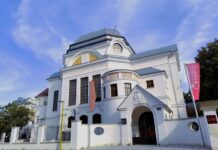
A 45-minute train journey takes you from Lausanne to Fribourg, capital of the canton of the same name. Fribourg is the French equivalent of Berne. Behind the creation of these two cities in the twelfth century was a great dynasty of German origin, the Zähringers. But Berne has somewhat overshadowed Fribourg on the tourist circuit. And wrongly so!
Gothic purity in Fribourg
Like Bern, Fribourg is one of Europe's most beautiful medieval towns. The latter has been preserved, as it is surrounded by fortifications from which powerful watchtowers still emerge. As you wander through the narrow streets, you will be amazed to see more than 200 Gothic-style houses as well as an incredible density of 18th-century town houses. Molasse - a local stone - comes in an infinite range of light grey tones, some with green highlights. It gives Fribourg that unmistakable charm, especially in the sunshine!
Fribourg also rivals Berne for the privilege of having the most beautiful cathedral in Switzerland, with the highest tower. It measures 74 metres, while Berne's tower reaches 100 metres. There is a slight difference in this competition: Fribourg is a Catholic cathedral, while Bern is a collegiate church, because it is Protestant. The honour is safe for both cities...

Neuchâtel, the French art of living
It takes just under an hour by train to reach Neuchâtel from Fribourg. Along its lake, the largest in the country and entirely on Swiss territory, the third most populous city in French-speaking Switzerland takes on the appearance of a riviera. Turn-of-the-century middle-class houses line the promenades, interrupted by a few large buildings: the Museum of Art and History, the former Central Post Office, the former Latin College (now a library) and the not-to-be-missed Beau-Rivage Palace.
Just a few metres away, the lower town with its medieval houses - including the beautiful Maison des Halles with its oriel windows - bustles with life around its market. On the higher ground, the castle and the collegiate church with its glazed tile roof complete this picture postcard image.
There's something profoundly French about Neuchâtel. This impression is linked to the proximity of the border, just 35 km away, but also to the domination of French ruling families for several centuries. The Burgundian dynasty in the early Middle Ages, then the d'Orléans-Longueville family until 1707, and finally a brief Napoleonic interlude during the town's Prussian period.
Along the rue du Faubourg de l'Hôpital, you can see the beautiful French classical-style facades of the town hall, the Villa Castellane and the Hôtel DuPeyrou. Built from yellow Hauterive limestone, these façades take on an almost bronze colour in the evening.
This led Alexandre Dumas to say that Neuchâtel was " carved from a lump of butter".. The writer was not the only Frenchman to visit the town. Neuchâtel welcomed Voltaire, Diderot, Balzac, Blaise Cendrars and Rousseau. You'd be forgiven for forgetting that the latter two were in fact Swiss!
The city also offers a first taste of Swiss watchmaking. There are two ideal locations. At Museum of art and historyThree androids, "The Writer", "The Musician" and "The Draughtsman", created in La Chaux-de-Fonds, the birthplace of watchmaking, demonstrate a technical precision that is unique in the world. These creatures were the delight of Europe's royal courts in the 18th century.

Watchmaking at its best in La Chaux-de-Fonds and Le Locle
You can also learn how or even make your own watch in the a watchmaking workshop. The Watchmaking Centre gives you the chance to discover the fascinating world of watchmaking by assembling and dismantling a few components of a mechanical movement or even assembling a complete watch...
Two other workshops, "Les Apprentis du Temps" and "Le Garde Temps" offer similar activities. The first is in Le Locle, the second in La Chaux-de-Fonds. The two cities are at the heart of Switzerland's watchmaking history. Le Locle is home to Tissot, Montblanc and Zenith. Corum, meanwhile, has been closely linked to La Chaux-de-Fonds for 100 years. The city is also home to the workshops of Breitling, Cartier, Girard-Perregaux, Jaquet Droz, JeanRichard and TAG Heuer. They can all be visited by appointment.
Even more than in Le Locle, it is in La Chaux-de-Fonds the industrial heart of Swiss watchmaking. The town developed according to an urban plan imposed by the watch manufacturers. In the mid-19th century, watchmaking became an integral part of workshops and homes. But it also supported the development of running water, the construction of railways, schools and public buildings.
This unique urban structure has earned the town - as well as Le Locle - a UNESCO World Heritage Site in 2009. An exhibition on watchmaking town planning explains the specific features of this architecture. From the top of 14e On the first floor of the Espacité Tower, you can enjoy a bird's-eye view of the grid of streets and their workshops. In 1870, these workshops employed 4,500 people - half the local population! As well as visits to watchmaking workshops and apprenticeships, both Le Locle and La Chaux-de-Fonds have their own watchmaking museums...

Biel/Bienne, the true watchmaking capital of Switzerland
On the borders of the cantons of Neuchâtel and Bern, you reach the unique town of Biel. Probably not the prettiest town in Switzerland, even if its small historic centre is well worth a visit, Biel nevertheless has two special features to offer the curious. It is officially the Switzerland's only fully bilingual town where German and French are spoken and written without distinction. The split between French and German speakers is almost even, with 47% for the former and 53% for the latter. Hence the double name of Biel/Bienne on every billboard...
Here again, a detail that is little known to the general public, Biel is emerging as the true watch capital of Switzerland. At the New Museum, several rooms tell the story of the city's development as a watchmaking and industrial centre. Here you can discover the first watches from famous brands.
The tradition has continued to this day: Rolex for movement mechanisms, Mikron and Movado have their manufacturing centres in Biel. The Swatch Group also has its headquarters and factory in Biel. The group is notably behind the Breguet, Longines, Certina and Tissot brands. These are some 2,500 people work here in the watchmaking sector.
Unfortunately, it is not possible to visit the factories, but there is one exception - and it's a big one! In 2019, the "Cité du Temps" campus opened its doors, a spectacular, transparent structure. The architect is Japan's Shigeru Ban, the same man who built the Centre Pompidou in Metz. The campus houses the headquarters of Swatch and Omega as well as two museums, Planet Swatch and Omega Museum. This futuristic architecture reflects a Switzerland whose watchmaking history has enabled it to redefine its future.

Special report - Destination incentive: Switzerland through the ages
Incentive: Switzerland through time
Lausanne reinvents its culture
- A journey through time: from Fribourg to Neuchâtel and Bienne
In Bern, the art of living is the talk of the town
Discovery: Solothurn, both Baroque and French
Incentive Switzerland: guide and address book