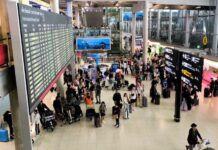


















" In May, demand for business travel almost recovered its pre-crisis 2019 level" stresses the Marco Polo Association, which publishes its monthly index of business travel. Several studies, unveiled in quick succession, highlight both the ever-increasing pace of business travelBut we're also looking at the major trends that will underpin business travel over the coming months.
Few companies or employees have not taken to the train stations or airports. According to the latest survey carried out by the GBTA last June, 89 % of those questioned said that domestic business travel was authorised in their company, as was non-essential international business travel (78 %). A brighter outlook for suppliers too which are 84 % to record growth in corporate bookings.
A survey of 500 business travellers in France and abroad, conducted by Opinion Way for AXA Partners and Carbookr, shows a similar upturn. Over the last twelve months, the average number of domestic journeys was 8.7, while international travel is gradually picking up, with un average number of journeys: 3.6mainly intra-European.
While the spread of the virus, which has been particularly high in France over the last few days, and the restrictions imposed by countries on entry to their borders remain major concerns, albeit on the wane, there are other factors at play which could weigh on the positive trend in the sector in the future. " We note that other factors, beyond Covid, could affect the speed and trajectory of the business travel recovery as we head into the second half of 2022" said Suzanne Neufang, CEO of the GBTA. The travel managers questioned cited the following in particular inflation (28 %) and oil prices (27 %)But even more so are the bottlenecks at suppliers (30 %), with the chaos at European airports a factor. Added to this, for European travel managers, are concerns about the war in Ukraine (33 %).
The Marco Polo Association points out that, while the business travel sector recovered in May 90 % of activity from what it was in 2019, this performance is " all the more remarkable it has been achieved in a context where supply has not always been able to meet demand. " Without all the staffing problems facing the airline industry today, Marco Polo believes he can " It is reasonable to assume that, without these supply constraints, the level of activity would have been broadly comparable to that of May 2019."
Of all the facets of business travel, meetings are the one that drives the sector as a whole. According to the GBTA, meetings with customers and prospects (31 %), attendance at conferences, trade fairs and events (21 %)but also internal meetings (17 %) account for the vast majority of travel expenditure. This finding is corroborated by Châteauform''s activity, which has exceeded its best-ever months since last March, and by Sophie Hulgard, Accor's Senior Vice President Sales Northern Europe, in in a recent interview on our website : " As far as demand for meetings & events is concerned, we are already back to 2019 levels and, in recent weeks, we have been seeing requests to book seminars for more than 200-300 people for 2023."
The use of videoconferencing and the spread of teleworking have not suddenly changed the need to travel on business. " 76 % of travellers consider travel essential or necessary and useful in carrying out their mission" According to the fifth wave of the survey on business travel in France and abroad carried out by OpinionWay and Corporate Mobilities for AXA Partners France and Carbookr. However, while a large proportion of business travellers still consider it necessary, these studies detail the future of this type of travel, which is increasingly regulated by awareness of environmental impact and employees' desire for well-being.

In its survey of a sample of 500 business travellers carried out between 23 May and 2 June this year, OpinionWay drew up four typical traveller profiles and outlined the new expectations of employees: 33% are "involved".42% are "followers" who, although not quite as aware of the issue, are waiting to be "informed" about it. convinced by concrete solutions for moving towards more eco-responsible travel" according to Opinion Way. While 5% travel little or not at all, the study shows only one category of professionals with little sensitivity to the subject, the distant (20%), regular domestic travellers who probably take the train and feel less concerned by the future of travel.
Faced with these developments, employees will undoubtedly be more inclined in future to do the following Choosing environmentally-friendly suppliers or travel that will preserve their balance between personal and professional life. These expectations are more than just emerging, and are echoed by their employers, with 75 % of them focusing more on passenger safety and well-being according to the GBTA, and 55 % on sustainability and social responsibility. This is a clear improvement on two years ago. " Over the course of the pandemic, business travel and travellers have changed and business travel programmes therefore need to evolve accordingly" said Suzanne Neufang, CEO of the GBTA.
According to Opinion Way, 41% of companies have now put in place a mobility policy that takes into account economic issues, carbon impact and employee well-being. An increase of 4 points on the previous survey, at the end of last year. At the same time, the number of companies that have only partially done so has remained stable at 44%. Encouraging videoconferencing and the use of trains, hotels and eco-responsible car hire companies are just some of the measures deployed by companies, as is the integration of car-sharing and soft mobility into their travel policies. In this context, the survey notes that company mobility policies " also includes the vehicle fleet and commuting."
A global trend, since this point of view is corroborated by a study carried out on the North American market by the GBTA and Uber for Business, The Corporate Travel Comeback: The Evolution of Ground Transportation and Other Trending Business Travel Topics. " At a time when more and more companies are moving towards face-to-face and hybrid working methods, it is important for companies to re-imagine their travel policies so that they are adapted to this trend. new business era in which we operate" said Susan Anderson, Global Head of Uber for Business.
The study shows that 50 % of companies in the USA say that sustainable development is very or extremely important in the design of their travel programme. As for putting your hand in your wallet... Only 6 % of those surveyed said that their company allows them to spend more on sustainable travel options. However, a further quarter (26 %) are planning to do so. It remains to be seen whether this will translate into reality.