Travellers departing from or arriving at Paris CDG Airport have just under a year to wait before discovering the CDG Express, which is expected to launch on 28 March 2027. However, alongside this dedicated line directly connecting the airport to Paris-Est station, they will also be able to travel in greater comfort by taking the usual route to the airport, the RER B. This will be available at a more distant horizon, however, from the end of 2028 if all goes well.
As with the TGV M or the CDG Express, this project is not without its delays, with the delivery of the new MI20 trainsets initially scheduled for 2025. However, as the delivery schedule has been able to be tightened, the Alstom/CAF consortium, which assembles them at its Crespin site in the Hauts-de-France region, recently carried out the first test run of the first trainset. This was a trial attended by the line's operators – RATP CEO Xavier Piechaczyk and SNCF Voyageurs CEO Christophe Fanichet – on May 7th, alongside the President of the Ile-de-France region, Valérie Pécresse.
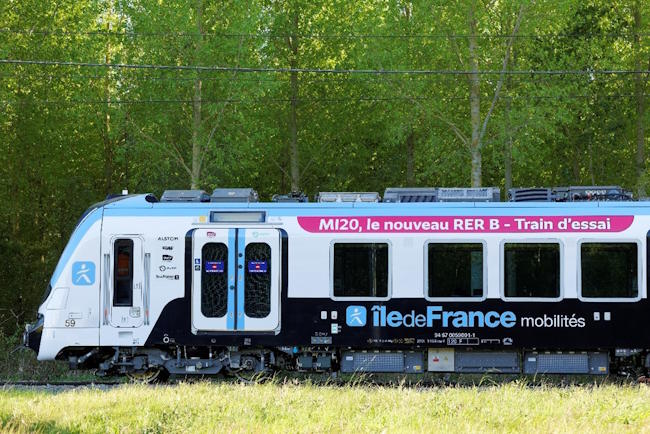
As part of the comprehensive rolling stock renewal plan across the entire Île-de-France network, Île-de-France Mobilités has invested €2.5 billion to enhance the service on this strategic line, the second busiest in Europe – after the RER A – with its million daily passengers. While 10 trains are currently in production, a total of 146 trains will gradually replace the trains currently in service, the MI79 and MI84 types, dating back to the 1980s.
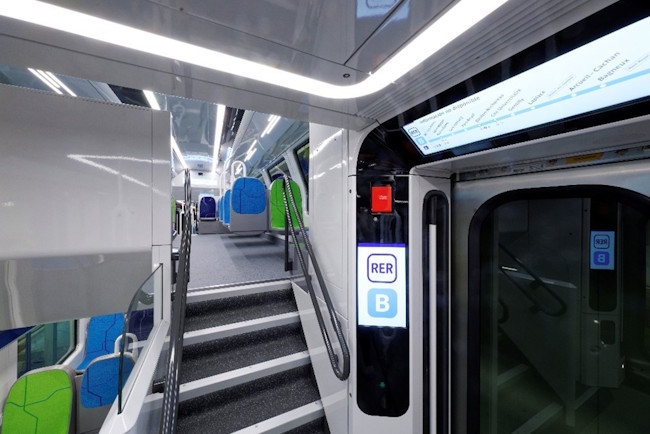
Greater comfort, greater reliability: these new RER B trains will be able to carry 1,063 passengers (an increase of up to 351 passengers), including 342 seats (an increase of up to 22 seats), on one or two levels. As long as the current trains but 20 cm wider, they will consist of 7 short carriages instead of 4 long ones. And this will be achieved without any partitions, allowing passengers to move around easily and spread out evenly throughout the train. Its 14 doors will also help reduce transfer times, ensuring smoother journeys and greater punctuality.
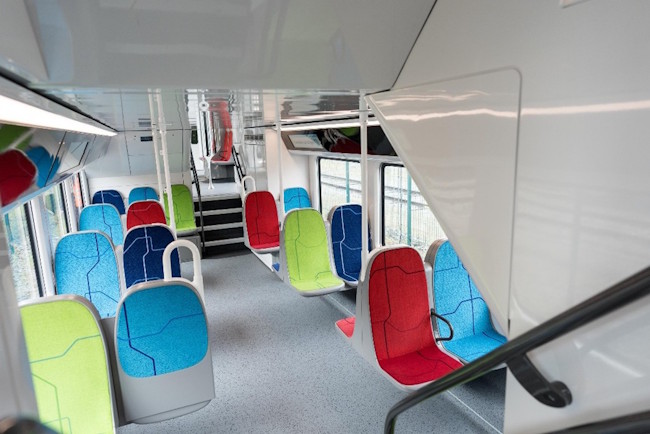
© Aymeric Guilloneau – Île-de-France Region
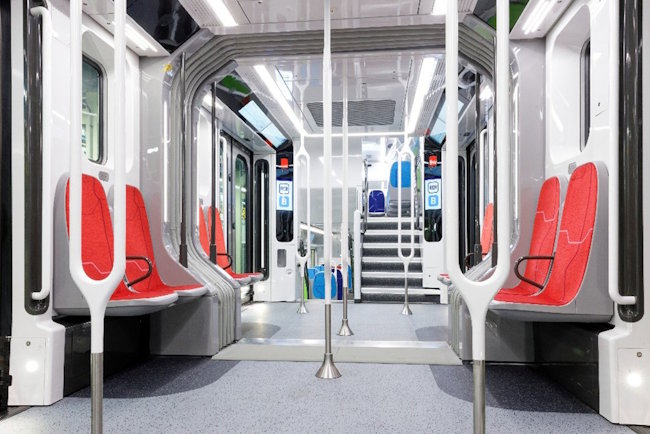
© ALSTOM SA 2026 – Samuel Dhote | MI20
By alternating single-deck and double-deck carriages, the new RER B trains will also be adapted to different needs, with double-deck sections offering greater seating capacity for longer journeys, ‘underground-style’ areas equipped for shorter journeys, and spacious single-deck areas for passengers with luggage, pushchairs or those with reduced mobility, with the trains being fully accessible to all. In addition to other comfort features – air conditioning and underfloor heating, 92 dual USB-C sockets, screens and dynamic route maps – and safety measures including 44 CCTV cameras, that is 50 more than today.