


















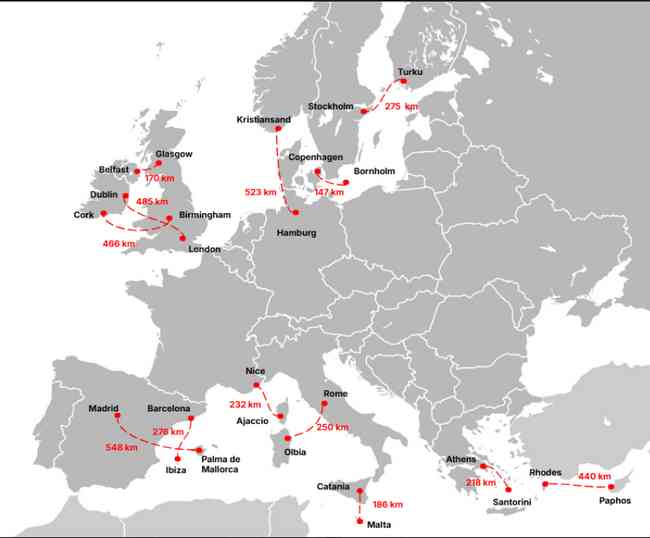
Transport & Environment (T&E), a clean transport NGO, has published a new analysis on the potential of electric aviation. According to the European Union Aviation Safety Agency (EASA), a quarter of all flights operated in Europe cover less than 500 km, a distance within the reach of electric aircraft currently under development. Meanwhile, hybrid-electric aircraft will be able to cover up to 1,000 km.
Several French and European routes fall within this scope: Nice-Pisa, Marseille-Bastia, Nice-Bastia, Marseille-Figari, Bordeaux-Lyon, Nice-Clermont-Ferrand and Montpellier-Ajaccio. On a European scale, London-Dublin, Athens-Santorini, Barcelona-Ibiza and Rome-Sardinia are also among the routes concerned. These routes often serve islands or regions that are difficult to access by train, which, according to T&E, reinforces the relevance of electric aircraft on these segments.
Start-ups in the lead, ahead of major aircraft manufacturers
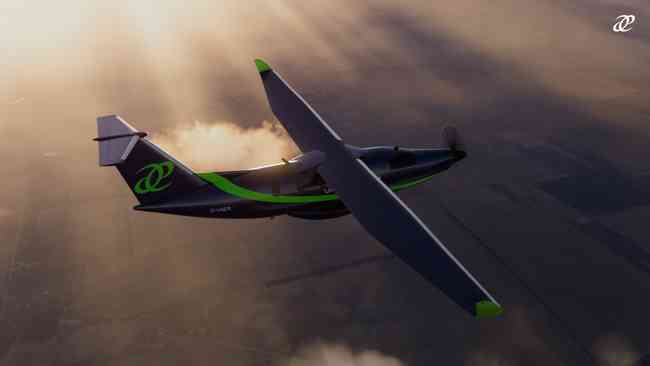
Three European companies are concentrating the most advanced developments. The German start-up Vaeridion is working on a 9-seat regional electric aircraft, with a range of 400 to 550 km depending on the payload, aiming for passenger transport certification by 2030; it already boasts over 100 purchase commitments. The Dutch company Elysian Aircraft, in partnership with KLM, is developing a 90-seat battery-powered aircraft capable of travelling up to 1,000 km, with entry into service scheduled for 2035. In France, Aura Aero is designing a 19-seat hybrid-electric aircraft boasting a range of 1,500 km, with certification announced for the end of 2029, before planning 40 to 90-seat versions. Airbus, meanwhile, has recently postponed the development of its own zero-emission programme.
According to price projections provided by Vaeridion, regional electric transport could reach a fare of less than €0.50 per passenger-kilometre, or around €200 for a London-Dublin flight. Furthermore, in July, the European Union proposed opening up investments previously reserved for sustainable aviation fuels to electric aircraft, while introducing carbon pricing on private jets.


