


















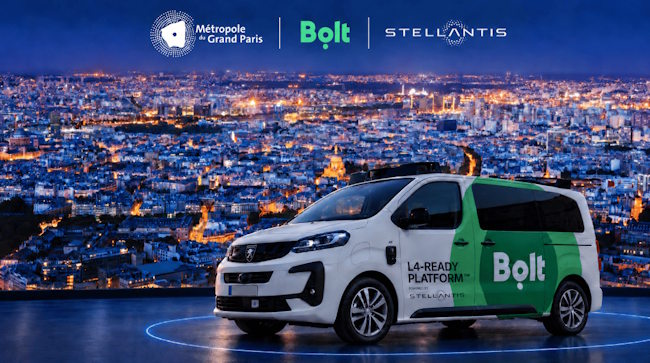
On October 23, the three partners presented the «Greater Paris Autonomous Driving Living Lab». The project is submitted under the European Commission’s ADACities (Autonomous Drive Ambition Cities) initiative. It is intended to assess, under real-world conditions, the operational, societal, and regulatory conditions for these services in dense urban environments. The initial deployments will involve a maximum of five municipalities. A second phase will then study an extension to thirty more municipalities, with commercial operations targeted for 2030, subject to obtaining the appropriate permits.
The use cases target needs that are not currently covered by the current offer: first and last mile delivery, access to employment hubs, travel during off-peak hours, and service for major events.« Autonomous vehicles will only be of interest if they solve real transportation problems. »That's why we're here," emphasizes Markus Villig, founder and CEO of Bolt.
Three partners, three roles
The Métropole will coordinate the project with the municipalities and oversee its evaluation. Bolt, through its subsidiary Bolt Autonomous Driving Solutions, will pilot the integration of the service and its deployment. Stellantis will provide vehicles based on its L4-Ready platforms. In addition, Pony.ai is identified as a potential provider of the driving technology, supported by the NVIDIA Hyperion platform. .
An independent evaluation
The initial deployment will be subject to an independent evaluation. It will focus on safety, user acceptance, integration into public transport, and social, environmental, and economic impacts.« Technological progress only makes sense when it brings concrete benefits to our fellow citizens. »", says Patrick Ollier, President of the Greater Paris Métropole.