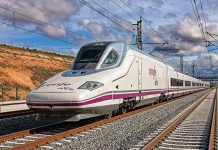
















Are there any security issues on the Spanish high-speed rail network? After the collision in Adamuz nine months ago, a new accident occurred this morning at 8:54 in the Castile-La Mancha region between an AVE, the Spanish TGV, operated by the national company Renfe, carrying 397 passengers, and the second one belonging to Iryo, a subsidiary of FS Group (operator in France of Trenitalia), with 147 people on board. This accident on the Madrid-Seville line killed at least 68 people and injured 80 according to the latest information. Three days of national mourning have been declared by the Spanish government.
According to initial reports, the line’s signaling system stopped to switch to manual mode. The Iryo train was stopped 150 km south of Madrid while the Renfe train, which was allowed to resume service, got stuck in the first one at a speed of about 100 km/h.
A previous one on the same line last January
This disaster follows the railway accident in Adamuz, which occurred on January 18 on the same line, but near Cordoba in Andalusia. That accident had already caused heavy casualties with 46 deaths and 170 injuries. This accident, which was the first accident on the Spanish high-speed network, involved the same two operators., Iryo And Renfe. The first company’s train derailed due to the failure of a rail on a track that had been renovated, before being hit seconds later by a Renfe train arriving in the opposite direction.
In 2013, another Renfe AVE was involved in a railway accident while traveling at low speed on a connecting line near Santiago de Compostela. Seventy-nine people lost their lives in what remains to this day the largest Spanish railway disaster.
Renfe orders 30 carriages from Siemens Mobility
It is worth noting that this collision occurs the day before a call for a strike by Renfe’s drivers regarding, precisely, railway safety on the network. It is not certain that this movement will be maintained given these dramatic circumstances. Spain has the second-largest high-speed rail network in the world, behind China, with 3,995 km, of which 3,225 km allow the AVE to travel at more than 250 km/h. Four operators operate there with Renfe, Iryo, Ouigo Spain and Avlo, the low-cost brand of the national company.
Renfe announced this week the acquisition of 30 high-speed trains with a capacity of up to 520 seats from the German manufacturer Siemens in order to replace its older AVE trains. This contract, worth at least 1.2 billion euros and including maintenance of the trains, is subject to an option for an additional 10 trains. According to the tender, Siemens will have 5 years to build and deliver the 30 trains, which must be able to travel at 350 km/h between Madrid and Barcelona in order to reduce the travel time between the two cities to 2 hours, compared to 2 hours 30 minutes currently according to the schedules.