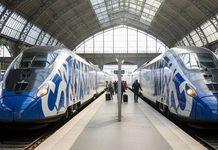

















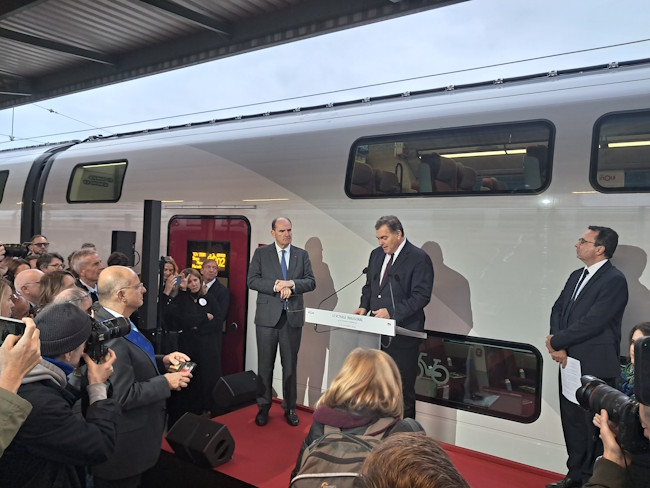
Finally. Some cynics would add: «It’s not too early…» The TGV Nouvelle Génération – formerly known by its project name, TGV M – is now on the rails after accumulating delays. 2023, 2024, 2025, summer 2026: no need to recall the series of delays in its launch. The newborn rushed slowly before its commercial service was launched on November 6 at 9:56, for an inaugural journey from Paris to Marseille.
" The big stars always take a long time to arrive », Jean Castex, the CEO of the SNCF, did not fail to emphasize this. But it was worth it. More than just a new generation, it’s a whole new concept that continues the TGV saga. »Beyond the last details that took time, more time to be resolved, it took more than a decade to bring to life a concentrated of technologies demonstrating the know-how of its designer Alstom, working in concert with the SNCF at its inception.
This New Generation TGV incorporates more than 400 innovations, some of which are invisible to passengers but have an impact on the environment. Among other things, it uses 25% recycled materials for its construction, making it almost 100% recyclable afterwards %, in addition to reducing energy consumption by 20% thanks to new aerodynamics.
Hidden from the eyes of travelers, another innovation could be more noticeable on certain occasions, in case of a breakdown, with a «spare unit,» a battery for energy storage integrated into a space between the engine and the first car. A first for the sector, this solution allows the train to continue its journey for several tens of kilometers while extending air conditioning – or heating – and the use of restrooms for two hours.
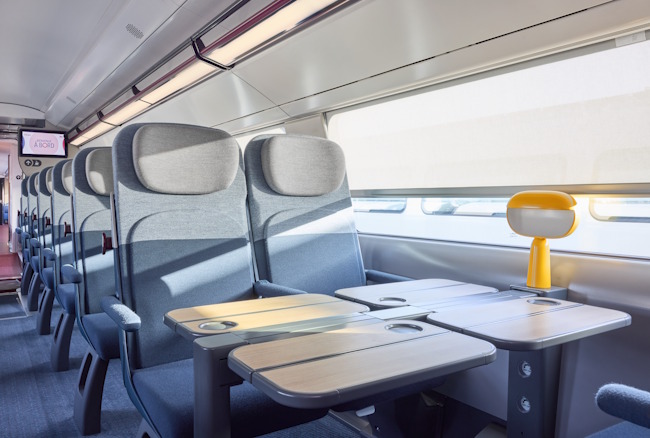
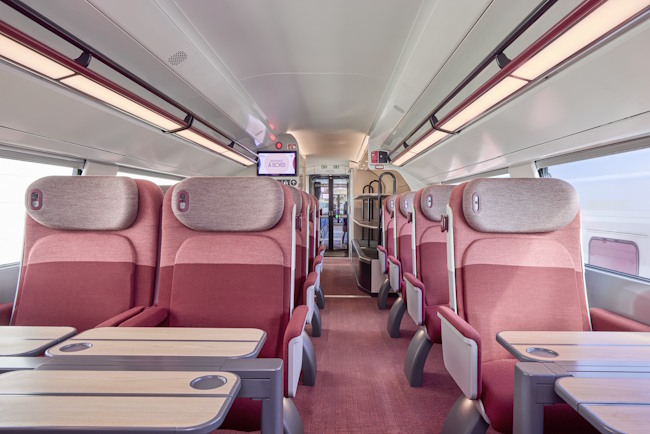
Fortunately, the passengers on the inaugural journey – including officials, journalists and guests mixed with a few lucky customers – did not have the privilege of testing this useful emergency service in the event of a catenary incident. On the other hand, they were able to discover the qualitative leap offered by the design of this new TGV, whose technical areas have been compressed to gain 20 square metres % of living space.
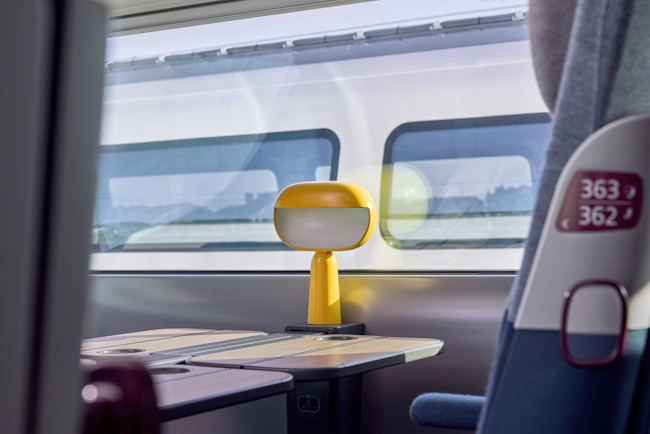
Thanks to this, passengers benefit from refined seats that offer 5 cm more legroom in 2nd class, while the seating in 1st class also gains 5 cm in width. Passengers will also appreciate the softness of the seat, thanks to innovative foam that provides better support by reproducing the effect of the springs that equipped the seats of the first TGV trains. Or the ’hammock effect« of the backrest, which conforms to the shape of the passenger’s back, regardless of their morphology.
A contemporary design, a serene and minimalist atmosphere conceived by the Japanese design studio Nendo and the agency AREP from Gares & Connexions, LED lighting that adapts to the time of day, larger windows, more gentle air conditioning that adjusts to the number of passengers on board the cars: without revolutionizing travel at 300 km/h, business travelers will undoubtedly feel all these new features aboard. In any of the classes, professionals will naturally find individual outlets to connect their computers; the 1st offers an additional USB C port for nomadic tools. Wi-Fi remains, not quite the latest generation, that one…
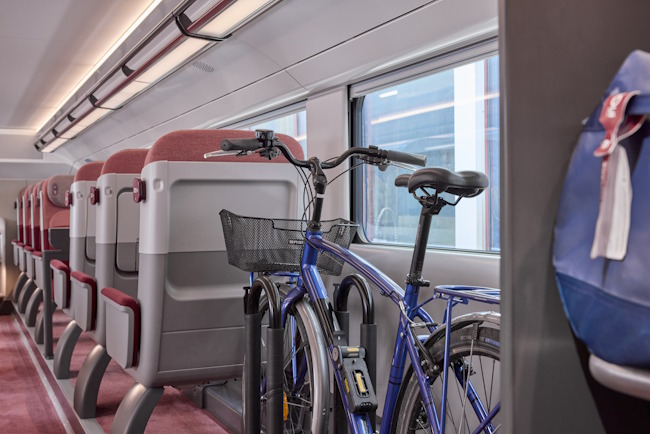
Fewer but more spacious toilets, 20% more spaces for luggage, more space for bicycles with three spaces that can accommodate a total of 8 bicycles: the more compact format of the TGV Nouvelle Génération paradoxically translates into increased comfort and, for passengers with reduced mobility, better accessibility.
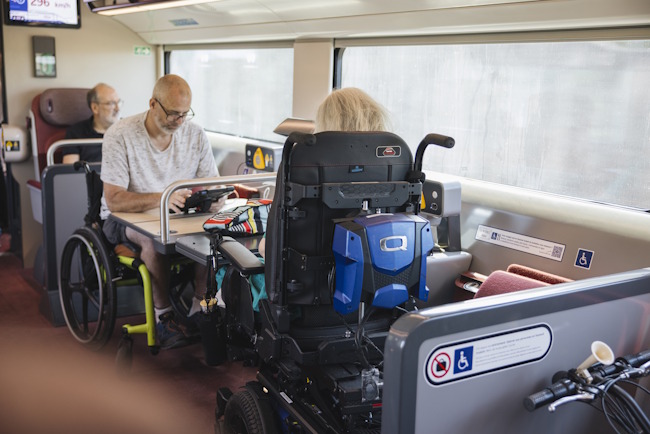
At the lower levels of cars 3 and 13, a wheelchair user space (UFR) allows passengers in wheelchairs to board easily. In addition to five UFR spaces, there are now two, and toilets with dimensions mandated by the STI-PMR standards, while visually impaired people benefit from adapted signage and a door detection system based on smartphone guidance using built-in Bluetooth beacons. Access to the catering services has also been designed with this in mind. A catering service, still offered in partnership with Newrest, but which is one of the most striking innovations of the TGV Nouvelle Génération. In fact, the technical equipment previously located under the car-bar has been compacted and repositioned towards the engines, the car bar extends over two levels.
On the mezzanine of the Bistro TGV Inoui, travelers will now find a convivial space composed of 28 seats and, on the lower level, a self-service grocery store where passengers can take sandwiches and drinks from the refrigerators before paying for their purchases at the automatic payment terminals. All of this is complemented by two coffee machines and, to warm up the emblematic croque-monsieur, two microwaves. While the traditional bar service has disappeared, two baristas are also present to assist passengers. An evolution that, according to those present during this inaugural trip, offers them more time to chat with them while guiding them through their purchases.
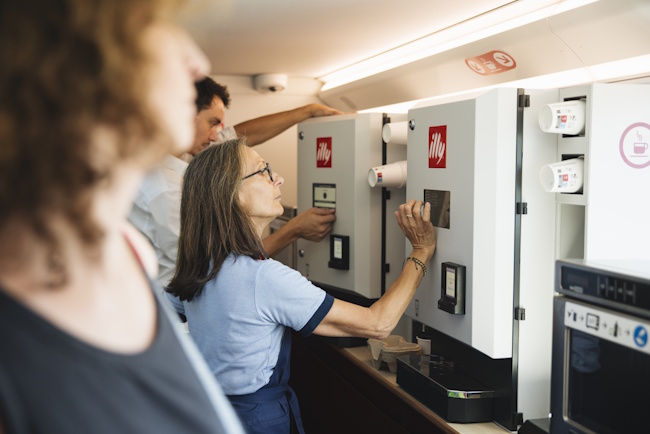
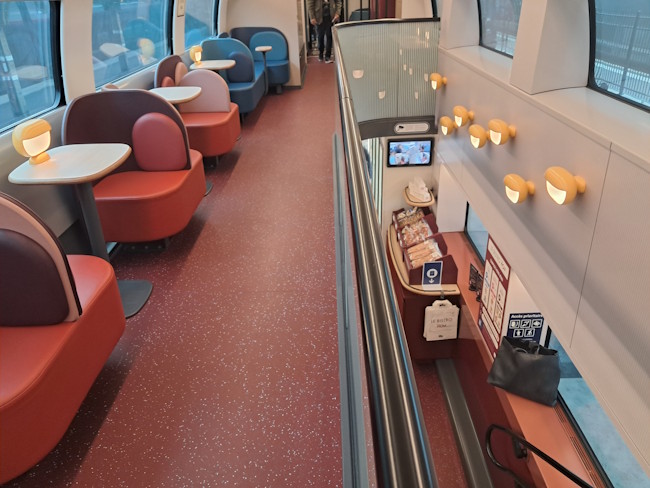
That's the case with the innovations. But the TGV Nouvelle Génération also aims, and above all, to meet a pressing need: the strong demand for train travel, with more capacious TGV trains. By shortening the engine by 4 meters and gaining one meter per car, Astom has freed up space for a ninth car and increased the number of seats from 509 in conventional TGV trains to 573 for the Inoui TGV. And even 740 in the new version expected for the Ouigo TGV trains.
But this is undoubtedly the big question posed by business travelers: when and how can they take advantage of this new TGV? Six carriages are currently available and will initially operate between Paris and Marseille, before a round trip Paris-Nice starting from the end of November, and then serving the Alps, namely Bourg Saint-Maurice, in early 2027. The Paris-Lyon line, the most frequently used by professionals, is not affected for the time being. On the one hand, because the Océane carriages operating on this line already offer more space – 556 seats – and on the other, because SNCF intended to offer this new comfort on longer journeys.
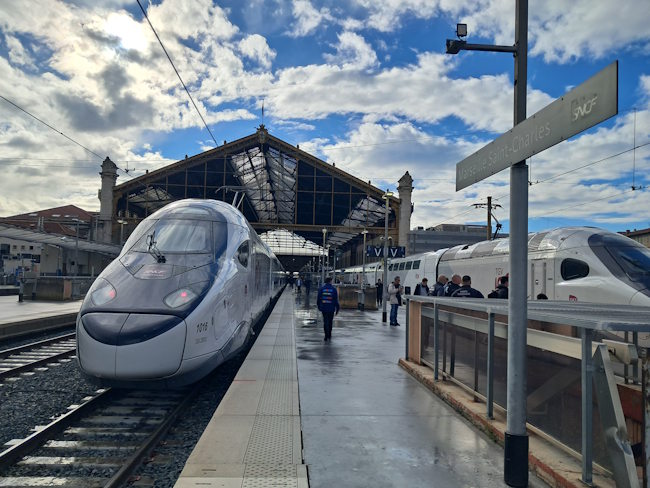
The deployment will therefore be gradual, and focused initially on the Southeast.« We will have twelve trains available at the very beginning of 2027, and the announced delivery rate is 15 trains per year. »This will allow SNCF Voyageurs to offer 100 carriages on its domestic market, as well as 15 more for its Belgium service, 15 more for its Ouigo service in Italy, and 30 more carriages, plus 20 more as an option, dedicated to Eurostar," said Alain Krakovitch, Deputy General Manager of SNCF Voyageurs.
Meanwhile, as train sales become more advanced, six months before departure, it is currently difficult for a business traveler to know whether they will have the opportunity to get the advance payment. However, Karine Dussert-Sarthe, Deputy General Manager of SNCF Voyageurs and Director of TGV-Intercités, explains that « The train will be commercially identified as TGV Nouvelle Génération within the TGV InOui brand. »and that starting next year, « Travelers should be able to identify this equipment when choosing their ticket ». However, on condition that the travel agencies pass this information on to them.".