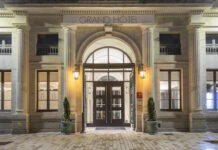
















Last March, a major event shook Milan: the opening, or rather the re-opening after renovation, of the legendary Excelsior Hotel Gallia. Since its beginnings in 1932, this imposing building has welcomed every traveller in the world in search of style and elegance, unclassifiable characters disembarking from the sumptuous central station on the other side of the avenue, inaugurated just one year before the hotel. Even today, it's easy to imagine the luxurious train journeys of the inter-war years ending there, in trunks and hat boxes, at the foot of majestic staircases. Never has the Excelsior lived up to its name so well. The renovations have not failed to elevate the place to the height of its original splendour.
After four years of closure and millions of euros spent, the result is absolutely divine. The classic details have been preserved and the contemporary additions, in silver-grey tones, are neither lacking in inventiveness despite their great sobriety, nor - so much for the oxymoron - extravagance. With distinction, this 235-room hotel has entered a new era, offering its guests hospitality products by Trussardi, a dazzlingly graceful bar-restaurant, a sumptuous 1,000 m2 spa, as well as a pleasant roof terrace and a smoking room featuring an endless table made from a single, almost unfinished tree trunk. The interior atmosphere has been entirely orchestrated by a Milanese design studio, Marco Piva, with sleek Murano chandeliers and furniture by Poltrona Frau, Cassina and Fendi Casa. The Excelsior has long been known as Le Méridien, and has remained part of the Starwood group, but has now joined the ranks of the prestigious Luxury Collection. If one last detail were needed to testify to the refinement of the place: the subtle scent of orange blossom wafting through the lobby. A true delight.

Armani supreme
Yet this is no exception in the Lombardy capital's hotel landscape. It would even seem that olfactory pleasure is sublimated in Milan. A mark of elegance and well-being, perhaps even of great luxury. The Armani Hotel is just such an experience. There's no escaping the soft amber clouds, the discreet, racy fragrances, the je-ne-sais-quoi of a man's world. As at the Armani in Dubai, the first of Giorgio's two hotels, the intimacy here verges on the obscure. You take the lift, and then, miraculously, you discover the facade and bell tower of a Baroque church behind the bay window, which is slightly obscured by beautiful blinds. Without really realising it, you are standing in a monument, a somewhat severe building constructed in 1937 by the architect Enrico Griffini, one of the leading thinkers of the Italian rationalist movement. Long the serious headquarters of Assicurazioni Generali, it was not always the palace of delights it is today. Nevertheless, you can still feel the original austerity - whether in the very zen yet voluptuous Armani/Bamboo Bar or in the 95 rooms - perfectly reinterpreted in a contemporary simplicity.
The same street - via Manzoni - and the same district, right in the heart of the Golden Quadrilateral, but a completely different style, much more lyrical: at the Grand Hotel et de Milan, which celebrated its 150th anniversary in 2013, it is above all music that runs through the corridors. The music of Verdi, of course, who lived for over twenty years within the walls of the palace, when he worked at the nearby La Scala. It was even in room 105, at a religiously preserved table, that the maestro composed Falstaff and Othello. It was here too, in room 106, that he breathed his last. Opera lovers will be able to book one or the other, or even both, as together they form a large enough ensemble to organise events and cocktail parties.


Leading hotels
Verdi was obviously not the only great figure to appreciate the charm of the place. If Hemingway 'kept' his suite here, the proximity of La Scala explains the predominance of dancers, divas and great musicians among the regulars, from Nureyev to Callas. More recently, the conductor Daniel Barenboïm also wished to occupy two rooms: one to rest, the other for his piano! Despite these many melodic memories, the hotel has not cut itself off from the modern world. Its Art Deco lounge, bathed in light, offers its services for afternoon tea, except on Fashion Week days, when the place is taken by the catwalks. Models and designers from all over the world gladly choose this hotel to establish their Milanese quarters, which has long been affiliated to the prestigious Leading Hotels.
Closer to the Duomo and the Galleria Vittorio Emanuele, a completely different story is being written. It's that of the Park Hyatt, a little less steeped in memories than its predecessors, but just as undeniably placed under the sign of fashion. In 2003, the hotel found its home in the former warehouse of the La Rinascente department stores'. This temple of petticoats and corsets, founded in 1877, was known as Aux Villes d'Italie, an almost exact copy of the Bon Marché so admired by the world at the time. There is still something powdery and velvety about the hotel's small lobby, crowned by a dome under which voices echo softly. No doubt a delicate allusion by the architect to the mythical opera house nearby and its superb acoustics? But it's the sight that counts as much as the sound, as you are directly attracted by Anish Kapoor's beautiful work, all curves, sparkling, discreet, but nonetheless very present. Being located in the very heart of Milan, tucked away in an alleyway at the entrance to the emblematic Galleria, is the other asset of this hotel, which offers all the service that a Hyatt knows how to provide. Some of the 106 rooms overlook not only the Duomo, but also the glass roof of the Galleria. So much so that, from the splendid whirlpool bath in the Diplomatic Suite, located on a huge terrace, it seems as if you can brush up against it without having to leave the water.

And where do Italy's beloved palaces fit into all this? Milan is not Rome or Venice, and Renaissance frescoes can be seen in churches and museums, not in hotels. The city suffered greatly from the bombardments of the Second World War, and what are known here as the Palazzi are often beautiful nineteenth-century patrician residences... However, located in a private street in the historic centre, the Bulgari is housed in a building dating from the eighteenth century. But here too, everything is new, and of course, in this exclusive location with just 58 rooms, everything is beautiful and precious. But nothing, almost nothing, remains from the time when Mozart, still a teenager, came to the Teatro Ducale, the forerunner of La Scala, to conduct his very first operas... What remains is the garden. A superb breathing space adjacent to the Brera rose garden, right in the heart of Milan. It has to be said that, like all the great capitals of the world, in Milan you sometimes need to take a breather.
Milan: a creative capital for Italy
The economy in Milan, a true Italian showroom
Milan success story: Paula Cademartori, bag and shoe designer
Milan success story: Tommaso Caldera, designer
Milan Universal Expo 2015: bis non repetita
Prada Foundation: luxury recycles in Milan
- Hotels in Milan: chic fragrances and lyrical flights of fancy
Milan, capital of risotto
Milan according to Ludovica Palomba
Milan: address book