



















"Euratlantique is unique in France in terms of its scale, since it will eventually offer 2.5 million m2 urban mix, with housing and businesses of all kinds"says Stephan Delaux, in charge of Bordeaux's economic attractiveness. Created at the end of the 2000s, the project is mainly focused on around Saint-Jean stationrenovated in 2017 for the arrival of the Paris-Bordeaux High Speed Line. The aim is to modernise the city by redeveloping almost 740 hectares of industrial and small business wasteland around the station and the city centre. making Bordeaux a metropolis for the 21st centurye century.
Scheduled for completion by 2030, the district is gradually taking on a soul. "Euratlantique is first and foremost a business district. its vocation is mixed. It is home to a large number of head offices as well as hotels and restaurants, start-ups, coworking spaces and housing."says Stephan Delaux. A number of emblematic buildings have already been completed. These include the MÉCA, the creative economy and culture centre, which was inaugurated this year.
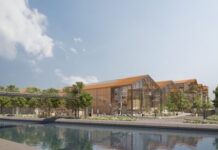
Designed by Danish architect Bjarke Ingels, this sublime objet d'art The white lace building along the Garonne is dedicated to artistic creation and experimentation. Other buildings, almost always 'smart' buildings, such as the headquarters of the Caisse d'Épargne, offer positive energy with water recovery and lighting regulation systems. Other examples include the Silva tower, with 80 % in wood, and the Hyperion tower, which will become the tallest wooden tower in the world, at 57 m high.
The redevelopment of Bordeaux's former landmarks is also noteworthy. This is the case of the postal sorting centre, which in 2016 was transformed into a Digital City. In the near future, a food court will be set up in the former abattoirs and a winery will be renovated by Millésima, the world's largest online wine sales company. Proof of the district's mixed vocation, a hospital centre, youth hostels and mobility hubs will also soon see the light of day. But Euratlantique remains above all a district dedicated to the service sector, which will bring a total of 500,000 sq. m. of new office space to a city that has been creating around 8,000 jobs a year for the past decade. A veritable laboratory for the Bordeaux of tomorrow.


