


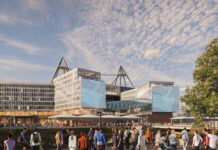








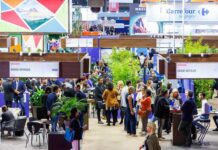






By 2020, the NantesFrance's sixth regional station, should be connected to the European transport network. That's why its metamorphosis had become necessary in order to accommodate an increased number of users. Currently used by 12 million passengers, it is expected to accommodate 25 million by 2030, especially as traffic, fuelled by the development of regional express trains and suburban services, has been increasing from 3 % to 5 % per year for several years. After the works currently underway, the two pre-existing buildings will be preserved and linked by a mezzanine located above the tracks. This gallery will house shops and services, while the area around the station will become more pleasant for pedestrians, cyclists and all users. The redevelopment of the station was also essential because a new business hub, EuronantesLaunched in 2007, this project will eventually provide the city with an additional 500,000 sq. m of office space. Just a few minutes' walk from the city centre, the site has been designed not only as a centre for tertiary activities, but also as a real place to live, situated as it is between the station, the congress centre and the banks of the Loire, which a footbridge will soon span to link the district directly with the Jardin des Plantes and the city centre.
The redevelopment of the station was essential, not least because Euronantes, a real business hub launched in 2007, is in full development.
Like so many other new business centres in France, Euronantes aims to bring together a population of working people and residents. Supported by Nantes Métropole, the project is at the heart of the Greater West's economic territory, and should boost both the Nantes business property market and the local economy. stimulating the establishment of businesses local, national and international.
Major groups such as Capgemini, Primagaz and Engie have also set up operations in Euronantes, as has a flagship of Nantes' digital economythe start-up iAdvize, Europe's leader in conversational marketing. At the same time, the city is supporting the development of the Quartier de la Création on the Ile de Nantes, transforming its former industrial wastelands into a creative and cultural eco-city, with the famous Machines de l'île, the former Alstom halls converted into the temple of Nantes Tech and the lively bars of the Hangar à bananes as a highlight.
More traditional in spirit, Euronantes nonetheless favours life outside office hours. Around the Mail Picasso, the district's main thoroughfare, restaurants and shops are multiplying in a setting where nature is integrated, thanks in particular to the introduction of a soft mobility with the Loire as a backdrop. By 2025, Euronantes will have added 200,000 m² of new offices, 15,000 m² of retail space, 2,000 homes and 12 hectares of additional public spaces. In the very near future, between 2020 and 2021, a number of projects are already expected to be completed, including the Îlot 3D. A new centre for innovation.


