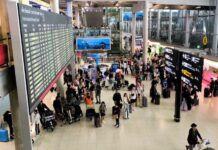



















Scott Morrison, Prime Minister of Australia since August 2018, will have been the gravedigger of the Australian tourism industry since the start of the pandemic. A paradox for a man who, we tend to forget, was Chief Executive of Tourism Australia, the country's national tourism agency, from 2004 to 2006. Since March 2020, Australia is almost hermetically sealed off to all visitors from outside - including its own nationals.
This strategy has certainly enabled Australia to control the Covid pandemic better than elsewhere. On September 30, the number of Covid-positive cases was 107, 128 and the number of deaths 1,309. A very low ratio indeed for this country of 26 million inhabitants. But at the same time, the number of people who have been unable to be reunited with their families or to accompany a dying person has been rising.
Despite the good results achieved in controlling the pandemic, the Australian government has constantly postponed the possibility of reopening the country, always citing the risks involved in the health situation.
The agony of the "Zero Covid" theory
This attitude is now coming up against greater public scepticism. In fact, the Morrison government has now reached the limit of its "Zero Covid" strategy, especially as it has been very slow to implement its vaccination campaign. By September 30, 44% of Australians had received their two doses of vaccine. This is still a long way from the collective immunity of 80% advocated by Scott Morrison to authorise travellers.
Also in September, the country descended into an internal political crisis. The seven states (plus the federal territory of Canberra) that make up the Commonwealth of Australia closed their intra-state borders in the face of the resurgence of the pandemic.
Because strategies now differ from one country to another. La New South Wales (Sydney) and Victoria (Melbourne) have, for example, abandoned the "Zero Covid" theory. They consider it impossible to achieve and have been ostracized by the other Commonwealth states. In contrast, the State of Western Australia (capital Perth) wants to stick to "Zero Covid", as this part of Australia remains immune to the virus.
With anger rising, the Prime Minister has finally decided to speed up the reopening of borders. This will be done in stages. It will initially concern the Australian states that have achieved the famous immunity of 80%.. This should be the case at Sydney, Melbourne and Adelaide, South Australia from November.
"It's time to give Australians their lives back", said Prime Minister Scott Morrison on Friday 1st October. People will be allowed to travel as soon as their state's vaccination rate reaches 80 %he insisted.
The compulsory 14-day quarantine in Australian hotels - which costs each traveller 3,000 Australian dollars (€1,900) - will gradually be abolished.. And replaced by a seven-day home quarantine for vaccinated travellers.
Travel will not be open to foreign tourists immediatelyBut now the government is talking about a return. Scott Morrison said he was working "to welcome tourists back to our shores".
So by 2022 we risk having a two-speed Australia for potential international travellers. On the one hand, the States in the east of the country (New South Wales, Victoria, Queensland and South Australia) will finally be open to domestic and then international travellers, while on the other, the States will remain closed at the whim of their local Premier. This would be the case in Western Australia and in the Northern Territory (Darwin).

Qantas plans its international comeback
The prospect of a loosening of the stranglehold on travel has already led caustralian company Qantas to reschedule international flights. The carrier has updated its international flight schedule, which has been announced and postponed several times.
According to the latest information on the company's website, Qantas resumes three weekly flights between London Heathrow and Sydney from 14 November as well as between Los Angeles and Sydney.
The company has announced the opening of a major air bridge with Singapore in mid-December.which offers connections to Europe. Flights to Canada and Japan would also be added. Qantas to put remaining network up for sale in April 2022.
There is, however, a small downside to this recovery for Qantas. The famous non-stop flight between London and Perth will not resume before mid-2022. This is due to Western Australia's phobia of keeping its borders hermetically sealed from the rest of the planet.