













The future of African air transport will be built 40 km south of Addis Ababa, the capital of Ethiopia. This is where the future Bishoftu International Airport (BIA) will be built, the hub for Ethiopian Airlines, already Africa's leading airline with 19 million passengers and 150 destinations.
The hub will be built in the Oromia region by Chinese companies at a cost of 12.5 billion dollars. Ethiopia and its national carrier will thus have a leading global air hub by 2035, the first in Africa.
The groundbreaking ceremony took place on Saturday 10 January 2026, in the presence of Ethiopian Prime Minister Abiy Ahmed Ali.
An initial phase for 60 million passengers
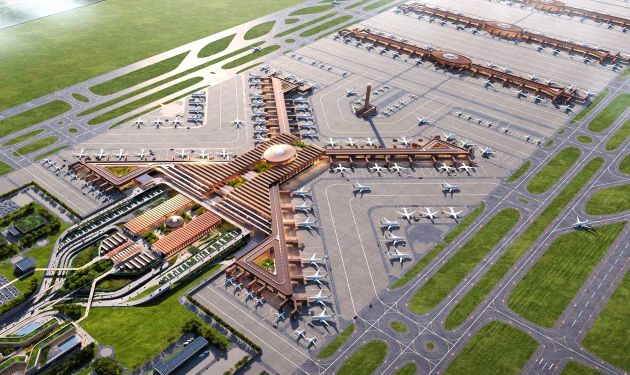
Scheduled to open in 2030, the project will be developed in stages. In its initial phase, the airport will be able to handle 60 million passengers with two independent Code 4E parallel runways and a 660,000 m² terminal. In the final phase, its capacity will reach 110 million annual passengers.
Bishoftu will then have four runways and infrastructure capable of parking up to 270 aircraft. " It will be the largest aviation infrastructure project in Africa's history, with a capacity more than four times greater than that of the current Bole International Airport, which will reach its limits in the next two to three years. "said the Prime Minister.
Designed by Zaha Hadid Architects, BIA will be the main airport for Ethiopian Airlines, now Africa's largest airline. The infrastructure has been designed to meet the airline's operational needs and future growth, with a strong focus on transit. Up to 80 % of passengers will connect here without leaving the airport, a model that places Bishoftu at the heart of intercontinental flows.
The terminal will incorporate vast areas dedicated to transit passengers, including a 350-room hotel in a reserved area, a wide range of catering and entertainment facilities, as well as gardens and outdoor courtyards. The interior architecture will be inspired by Ethiopia's geographical and cultural diversity, with each pier adopting materials and colours specific to different regions of the country. A single central axis, reminiscent of the Great Rift Valley, will link the terminals and boarding piers to reduce connecting distances.
A strong environmental dimension
BIA has also been designed with a strong environmental dimension. The terminal is aiming for LEED Gold certification, with natural ventilation, reinforced solar protection and semi-open spaces. Rainwater will be recovered and reused in wetlands, while photovoltaic installations will generate energy on site.
With an altitude approximately 400 metres lower than that of the current Bole airport, BIA will also offer better aeronautical performance. These features will enable Ethiopian Airlines to optimise the maximum take-off weight of its modern fleet, while reducing fuel consumption and increasing capacity on long-haul non-stop flights.
Linked to the centre of Addis Ababa and to Bole airport by a high-speed rail link, BIA will operate 24 hours a day with no curfew. Combined with an integrated "Airport City", the project will form part of Ethiopian Airlines' "Vision 2035" strategy. It is to be hoped that the country's chronic political instability will not derail this ambitious project.