











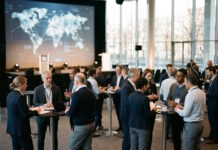





"Travelling or doing something for the planet, should you choose? After a scorching summer, which was also marked by an unprecedented wave of fires, the theme chosen for the 16th edition of UnivAirPlus was a timely one. " When I chose this subject in January, I didn't know that we were going to experience a summer with so many exceptional situations and so many challenges. back-to-school news focused on climate issues and controversiesespecially in air transport".explained Julie Troussicot, Director of France for the corporate payment specialist, as a preamble to the presentations.
Held at the Jardin d'Acclimatation, this traditional back-to-school event organised by AirPlus was not intended to provide a definitive answer to this question. reconciling opposites - whether or not to travelThe aim of the conference was not just to raise awareness of the issue, but to shed light on a subject that goes right to the heart of the business travel industry. Some of these insights came from speakers from outside the sector, such as Lise-Hélène Cortes, representing the non-profit investment fund Time For the Planet, which supports innovative environmental projects, and Jacques Barreau, co-founder of Grain de Sail, a company based in Brittany that has revived the maritime trade by sail to import coffee and chocolate. " Pleasurable products that you don't want to do without, that come from far away, but this time almost without a drop of petrol".he explained.
Keeping your lifestyle, your comforts, the world you love: François Siegel, co-founder of the GSPresse group, which also owns the magazine We Demainsees this defence mechanism as an explanation for the ongoing denial of climate change, which is also the result of a lack of public awareness of these fundamental issues. to this coming revolution in society, the likes of which the world has not seen for centuries"..
While the IPCC regularly warns of the potentially irreversible consequences of climate disruption, and the world's governments agreed to limit warming to 1.5° at COP 21, awareness remains limited, particularly in France. According to a recent OECD study, only 57% of French people are aware that global warming is linked to human activityThis is the lowest score among rich countries, while 37% believe that climate change will affect them little or not at all.
Is less business travel the solution?
Even if this question is " already a reality for many of us for some time".says Julie Troussicot, the world of business travel can no longer afford not to think things through. " What share of the collective effort can the business travel industry take?"asked Françoix-Xavier Izenic, host of the event. " To contribute, it will undoubtedly pass by a reduction in short-term travel".says Guillaume Duny, head of purchasing for local banks at Crédit Agricole, which has set itself the target of reducing business travel by 50 % by 2030 compared with 2019.
The pandemic has heightened awareness, both of the impact of carbon emissions and of alternatives to travel. However, while the covid period has taught companies a great deal, enabling them to function properly without having to travel, shaking hands with customers or meeting with far-flung subsidiaries will always be just as important. So, which trip is important and which is not? " Everyone needs to ask themselves these questionssays Guillaume Duny. Some of our subsidiaries are working on this and will provide their employees with operating procedures".
For Marc Levasseur, Managing Director of CSR Purchasing for the ADP Group, raising awareness and training employees is a shared necessity, but it is also management's responsibility to guide travellers' choices: "The director approves the purchase of the ticket after exploring the possible alternatives".. As for reducing the number of journeys made under duress, this can only be a last resort according to Guillaume Duny: "The first step is to raise awareness and explain get people to adhere to what we ask. However, a budget constraint per team or department can be a good way of arbitrating in favour of the most important trips.
Do key suppliers such as airlines and hoteliers share this call for sobriety? " Because we sell rooms to people who cross the planet to work, we could have this defensive reflex of saying that we have to carry on as beforesays Brune Poirson, Accor's Director of Sustainable Development. However, we mustn't go back to travelling left and right to sign contracts, but think about the real need to travel.. "

This may seem paradoxical coming from a company that generates a large proportion of its profits from business customers, but it is also a view shared by Air France. " We need to encourage new behavioursFor example, travelling less but staying longer, or taking the train for short distances.says Vincent Etchebehere, Director of Sustainable Development and New Mobility at Air France. It's important for travellers to think about their carbon impact individually and, for us, to provide them with transparent information about their footprint".. A not insignificant footprint for a long-haul flight with a return trip from Paris to New York equivalent to 2 tonnes of CO2, or the annual cost of a French person to stay within the Paris Agreement.
The recent controversies surrounding private jets and other sports team travel have shown once again that air transport is regularly criticised for its impact on the environment. But Can this sector, which generates between 2% and 3% of CO2 emissions, decarbonise? emissions worldwide, almost half of which are concentrated in the 1% most frequent travellers? Vincent Etchebehere discussed this question with Grégoire Carpentier, co-founder of Supaéro-Décarb. " The airline industry, like all other sectors, has to do its bit. Transition will be expensive, but the lack of transition will be even more expensive".he emphasises.
More fuel-efficient aircraft, SAF and hydrogen
So what is the industry doing to ensure that we can continue to fly as we do today in 2050? They can be summed up in three levers, the first of which - more energy-efficient aircraft - has already been activated by Air France. The airline is committed to having 45 latest-generation % aircraft in its fleet by 2025, rising to 60 % by 2030. " To reach our target of reducing our emissions by 30% by 2030Our main investment is in fleet renewal".says Vincent Etchebehere.
However, the doubling in the number of passengers expected by IATA in 2050 is likely to eat into the efforts made by the airlines. Hence the need to use two other levers: on the one hand, decarbonising transport with environmentally-friendly propulsion systems and, on the other, a more radical lever, limiting use. As far as decarbonisation is concerned, aircraft manufacturers are working on electric aircraft - but these will only be able to cover short distances with few passengers - or hydrogen-powered aircraft - but these will not reach the market before 2035, all hopes are pinned on SAFsustainable aviation fuel made from waste oils, organic waste or, for the next generation, synthetic fuels. " SAF will be our No. 1 lever for reducing emissions from 2030″says Vincent Etchebehere.
At a time when engine and aircraft manufacturers are actively looking into this alternative to paraffin, production sectors are gaining momentumThey are now being pushed by European regulations requiring companies to incorporate 2% of SAF in 2025, then 20% in 2035 and 63% in 2050. Companies are also taking part in this trend, as they can purchase this "green" fuel from certain producers or even companies to limit their indirect carbon emissions. " Since January 2021, we have been offering a voluntary contribution scheme to companies that can purchase SAF, which will then be used by Air France. Some sixty companies are currently doing so.says Vincent Etchebehere.
However, with expected demand rising from around 100 million litres today to 400 or even 500 billion litres in 2050, is this solution the whole answer to the problem? " Fuels made from used oils will only be able to cover 10% of 2050 needs, while the production of synthetic SAF would require one-sixth of the world's electricity, comments Grégoire Carpentier, for all that, it's impossible not to believe it, because what other solution do we have? To allow time for the development of new technologies, for the growth of FAS and for the widespread use of hydrogen propulsion, which will not arrive before the second half of the 21st century, we need to be able to take advantage of the new technologies.e But the co-founder of Supaéro-Décarb sees additional leverage: " Moderation of use, sobriety rather than punishment. We can't avoid thinking about a drop in traffic. "
While Air France's Vincent Etchebehere believes that the effect on demand of the rise in ticket prices following the introduction of these more expensive fuels is probably underestimated, a moderate increase in traffic is also envisaged. " As part of our 2030 commitment to reduce emissions, we could vary the offer according to these climate objectives".says the company's Director of Sustainable Development.
The hotel industry embarks on its energy transition
Although the future of the hotel industry is less uncertain than that of the airline industry, due to its smaller impact on the carbon footprint of business travel, it is also committed to its energy transition, as Brune Poirson showed. The former Secretary of State for the Ecological Transition, in her first speech to the business travel community, reaffirmed the Accor group's commitment to achieve carbon neutrality by 2050, including scope 3. " It's up to us to be part of this profound change".says Brune Poirson.

To this end, Accor has taken a number of initiatives, such as phasing out the use of single-use plastics throughout the Group by the end of 2022, as well as the launch of a training programmeSchool for Change, to provide all employees with a common, scientific and rational grounding in CSR, pending the announcement of measures on biodiversity. Another ambition is to see the group's hotels certified by third parties - european ecolabel, green key and others -. to go further than these internal labelling systems which, admittedly, " have made it possible to start a positive process, but have reached their limits".she notes.
At a time when online travel agencies are increasingly promoting their labels, and when future customers will undoubtedly be more and more attentive to CSR issues, Brune Poirson and her teams intend to convince hotel owners to make a firm commitment to this energy transition. A transition that is a source of savings up to a point, but that requires investment.
At the same time, in view of the expected - or even hoped-for - reduction in business travel, Accor's General Manager for Sustainable Development believes that ". that rethinking the primary purpose of our hotels" . A hotel that doesn't just happen to be there, over-standardised, but one that, on the model of lifestyle hotels, is lively, open to its neighbourhood, its city. " We can't help thinking about doing something else with our hotels eithersays Brune Poirson, welcome other services such as EPAHD or other audiences like schools.