











In recent months, companies have continued to tighten the screws on their travel budgets. In the search for the smallest savings, some companies have reduced the frequency of trips, while others now only send one employee, as opposed to two. "They prefer to make a return trip on the same day, or book the cheapest hotel to keep costs down."says Florent Martin of the Paris agency Tourexcel, part of the Selectour Afat Affaires network. "We are seeing a decline in travel and a trend towards downgrading"Barbara Dalibard, Director General of SNCF Voyages, who has seen her best customers move from the Pro Première area to the cheapest fares, which are usually subject to restrictions.
This downgrading is even more marked than in 2009, when travel policies became even more restrictive. Companies have converted to Prem's fares and even IDTGVs, the leisure trains that are beginning to be appreciated by business passengers for their Zen atmosphere, which is more conducive to work. Because a calm environment is not always appropriate in second class. Serge Bacchus, travel manager at Unisys, a company specialising in new technologies, recalls a Eurostar journey where his company's employees were travelling in the middle of a group of Spanish students "who made a mess that was almost unbearable".
The low-cost option
Like many companies in France, Unysis bases its travel policy on the search for the best rates on the market, in other words on the best buy. "We buy Prem's tickets with the risk of losing a certain number of them, as they are neither exchangeable nor modifiable. But in the end, the company wins, given the number of tickets purchased over the year."continues Serge Bacchus. He adds: "The 'best buy' approach is highly developed in the United States. As an American company, we adopted this practice in 2006. Long before the crisis, in other words". Companies are now juggling with the wide range of SNCF fares. For example, they have no hesitation in mixing a non-changeable leisure ticket on the outward journey, when a meeting has been scheduled for a long time, with a Pro fare on the return journey to take advantage of its flexibility. This choice of the best price may, however, require a request for authorisation from the travel manager to prove that the fare is really more attractive.
However, not all companies can adopt this strategy, simply because they are obliged to make their purchases at least 14 days in advance. Claude Lelièvre, vice-president of the Association française des travel managers (AFTM), also points out that "some companies are not completely free in their choices, because their collective agreement specifies, in black and white, the compulsory class of travel when travelling by train; this is not the case for air travel".
Today's companies are juggling with the wide range of SNCF fares. They don't hesitate to mix a non-modifiable leisure ticket on the outward journey, for a meeting scheduled in advance, with a Pro fare on the return journey to take advantage of its flexibility.
On the advice of their corporate agencies, companies use the art of compromise to avoid a total downgrading. For example, first-class travel can be maintained for journeys of more than 2.5 or 3 hours. "As a result, journeys between Paris and Lyon are now made in second gear, including by senior managers. This is the quickest way to impose a travel policy at all levels.It's a real problem for us," says Laurent Vergolin, travel consultant at Bleu Voyages (Selectour Afat Affaires) in the Rhône-Alpes region. For several months now, European rail companies have been trying to curb this phenomenon of downgrading, which is penalising their revenues. Their sales teams are on the alert, contacting companies either directly or through their business agencies.
The SNCF is therefore communicating first and foremost on its Pro offer, which it considers to be poorly known by users. "We try to take a very proactive approachBarbara Dalibard insists. The focus is on SMEs and SMIs, where the message is more likely to be heard than in large groups with rigid travel policies.". For his part, Marco Filipe, the French company's network sales manager, assures us: "our customers travel with the Pro fare, but they are not always aware of all the advantages, such as flexibility and comfort". A campaign will therefore be launched in September 2013 to highlight the three major advantages of this offer: Pro Flexi, which allows passengers to exchange their ticket and take any train during the day; Pro Mobile, which allows passengers to consult their travel file on a smartphone, receive information in real time, exchange e-tickets and board with an m-ticket in the form of a barcode; and Pro Express, which gives passengers access to specially dedicated Pro and Grand Voyageur ticket offices in stations. "To exchange a ticket, customers can also use the Pro Express ticket machines, located in front of the platforms and recognisable by their purple colour."adds Marco Filipe.
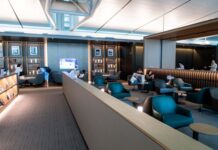
Eurostar's Business Premier offer, like SNCF's Pro Première fares, includes services such as access to lounges, taxi bookings on arrival and in-seat catering.
Working in peace and quiet
The Fréquence season ticket is the SNCF's other big hobbyhorse. As well as the comfort of a first-class journey, it offers great flexibility and the guarantee of a 50 % reduction on the TGV Pro fare. "Business travellers think they have to make a lot of journeys, but this formula pays for itself very quickly, from six to eight return trips a year."says Sophie Roger, Marketing Manager at SNCF Voyages. All that remains is to choose the right period of validity, with the Fréquence pass available in three-month, six-month and one-year versions. Even so, these corporate fares are considered expensive by companies, which still prefer to offer the former to their employees so that these executives have the option of modifying or cancelling a ticket.
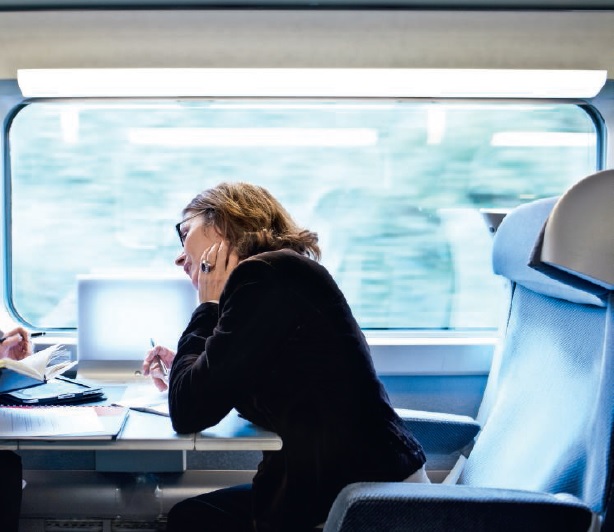
"Our customers prefer the flexibility of the Pro tariff, says Florent Martin at Tourexcel. The problem sometimes arises from the lack of space in Pro Première, with passengers finding themselves in the middle of leisure passengers. Which is not ideal for working.". A travel consultant from the Travelil agency in Lille also points out that, ".Despite the short duration of a journey between Lille and London, its customers travel in Business Premier on Eurostar or, if this class is full, in Standard Premier. They don't want second class so that they can work in comfort, because the aim is to optimise their return journey during the day.".
Eurostar is also making the most of the services associated with Business Premier, such as fast boarding, access to the lounge, taxi reservations on arrival, etc. Similarly, Sophie Roger, from the SNCF, points out: "travel at the Pro rate First offer four additional services: access to the Grand Voyageur lounges, in-flight travel in Pro Première lounges, the option of booking a taxi and in-seat catering. [for a fee". Finally, the travel agencies interviewed pointed out that there are power sockets in first class for recharging a computer or smartphone, although these are not always available in second class trains. However, this argument is unlikely to hold water for long, as the new TGVs will all be equipped with sockets in second class...
To reduce the bill, companies with large purchasing volumes on certain routes do not hesitate to sign agreements with carriers to benefit from negotiated fares. At Thalys, the level of access to contracts offering Comfort 1 discounts is fairly low, starting at 15,000 euros of annual expenditure.

And at €30,000, the contract covers all classes of travel. At Eurostar, this threshold is set at 150,000 euros of purchases over the year in Business Premier. The carrier could eventually develop a dedicated offer for SMEs, or at least for companies with purchase volumes below this particularly high threshold. "The fares negotiated by travel managers are sometimes difficult to justify, as travellers often find cheaper tickets on voyages-sncf.com."says Serge Bacchus. That's why companies prefer to forego this type of agreement in order to stay on the lookout for the best fares and compete with airlines. "There is a desire not to be tied to a single operator"he adds.
Limits at the best prices
However, not everything is so rosy in the world of best buys. In addition to the tickets that are lost because they are not used, companies need to step back from the call price, which often conceals the reality of what was actually spent. "Leisure fares can be expensive if travellers use them incorrectly, for example by making changes at the last minute."says Claude Lelièvre of the AFTM. Before the summer, the association addressed this point at a meeting devoted to yield management. "It is difficult to provide feedback when changes are made, as there are many channels through which these changes can be made and they are difficult to trace."says Claude Lelièvre. To know whether using leisure fares is more advantageous than the Pro offer, companies would need to be able to establish an average price "after costs". To get companies back on the right track, SNCF is emphasising that the difference between the two is very small. And above all that 18% of train journeys are subject to an exchange operation.
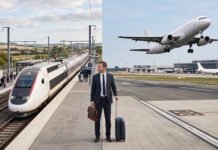
Commercially offensive, the SNCF is feeling a "tremor" in business traffic. But any real increase in sales accompanied by a real return to first class travel is dependent on a sustained upturn in economic activity in France and Europe. For the time being, this has been slow to materialise. However, the picture is not completely bleak for the rail companies, which are seeing passengers who used to travel by plane for business purposes take to the skies. Philips, for example, has switched from planes to Thalys TGVs for journeys to its head office in Eindhoven, the Netherlands.
"In order to avoid talking about savings, companies are justifying this change in mode of transport on the grounds of sustainable development and safety, particularly in relation to car parking.says Claude Lelièvre. As part of this shift from air to rail, high-speed rail has a lot going for it. "It offers advantages in terms of proximity, comfort and punctuality. It's a less stressful means of transport than flying, and allows you to manage your time more effectively."says Serge Bacchus. For a year now, Thalys has been communicating on the amount of time needed on board to work or rest before a meeting. The essentials, so to speak.